

111
Cycles of seed production vary even between closely related species. Previous
observations in populations from Argentina and Chile suggest that high seed production occurs every 3 years in N. obliqua (Donoso et al. 2006a). For N. alpina, in
contrast, cycles of high flower production would occur every 2 years (Donoso 1993;
Marchelli and Gallo 1999; Donoso et al. 2006b). Nevertheless, at an individual
scale, such periodicities are to be taken cautiously, since inter-individual variations
in the periodicity of flower production have been observed even between neighbour
con-specific trees (Torres et al. 2016). Years of massive seed production are characterised by both a high production of seeds per plant and a high proportion of seedproducing trees (Marchelli and Gallo 1999).
Phenological concurrence is a critical/important issue to be considered for controlled crossings: viable pollen from the selected pollen-donor tree must be available within the period of stigmatic receptivity of the pollen-receptor tree. In this
regard, it has been demonstrated that, under natural conditions, pollen viability of
N. alpina is drastically reduced 4 days after pollen release (García et al. 2015) so
that both pollen viability and stigmatic receptivity provide a limited time-lapse
available for pollination. This inconvenience may be sorted out by obtaining pollen
from cut-flowering branches before the natural occurrence of anther dehiscence.
Pollen release may be accelerated by keeping cut-flowering branches in hydroponic
culture in a warm and dry environment (Torres and Puntieri 2013). To guarantee
pollen collection, flowering branches should be cut after the unfolding of the perigonium of staminate flowers, when stamen lengthening begins.
Manual pollinations were applied to assess the degree of self-interference and
the compatibility between N. obliqua and N. alpina in the two possible crossing
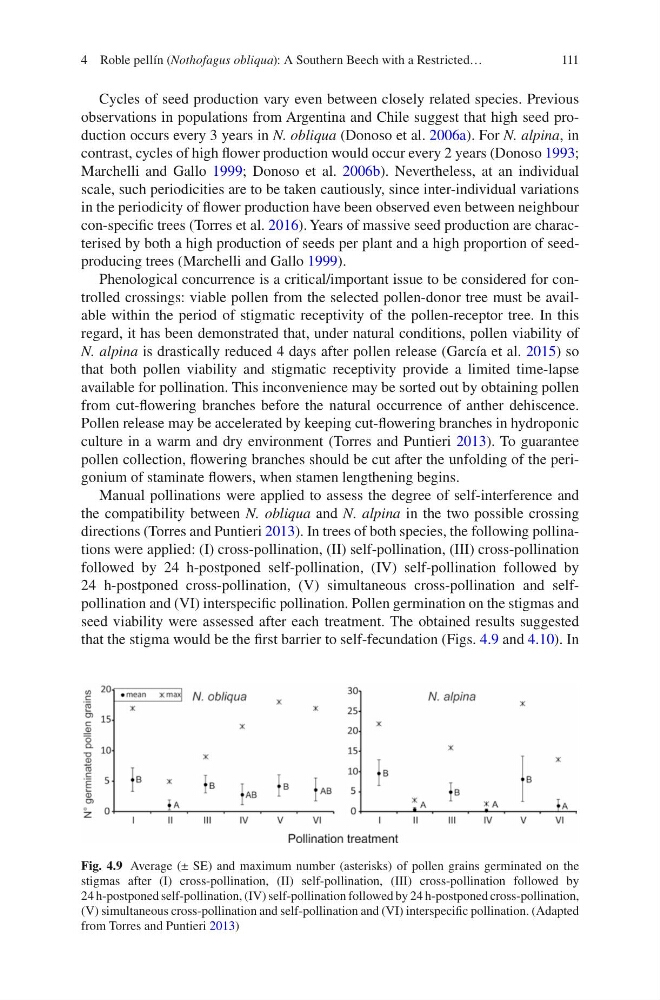
directions (Torres and Puntieri 2013). In trees of both species, the following pollinations were applied: (I) cross-pollination, (II) self-pollination, (III) cross-pollination
followed by 24 h-postponed self-pollination, (IV) self-pollination followed by
24 h-postponed cross-pollination, (V) simultaneous cross-pollination and selfpollination and (VI) interspecific pollination. Pollen germination on the stigmas and
seed viability were assessed after each treatment. The obtained results suggested
that the stigma would be the first barrier to self-fecundation (Figs. 4.9 and 4.10). In
Fig. 4.9 Average (± SE) and maximum number (asterisks) of pollen grains germinated on the
stigmas after (I) cross-pollination, (II) self-pollination, (III) cross-pollination followed by
24 h-postponed self-pollination, (IV) self-pollination followed by 24 h-postponed cross- pollination,
(V) simultaneous cross-pollination and self-pollination and (VI) interspecific pollination. (Adapted
from Torres and Puntieri 2013)
4 Roble pellín (Nothofagus obliqua): A Southern Beech with a Restricted…
Cycles of seed production vary even between closely related species. Previous
observations in populations from Argentina and Chile suggest that high seed production occurs every 3 years in N. obliqua (Donoso et al. 2006a). For N. alpina, in
contrast, cycles of high flower production would occur every 2 years (Donoso 1993;
Marchelli and Gallo 1999; Donoso et al. 2006b). Nevertheless, at an individual
scale, such periodicities are to be taken cautiously, since inter-individual variations
in the periodicity of flower production have been observed even between neighbour
con-specific trees (Torres et al. 2016). Years of massive seed production are characterised by both a high production of seeds per plant and a high proportion of seedproducing trees (Marchelli and Gallo 1999).
Phenological concurrence is a critical/important issue to be considered for controlled crossings: viable pollen from the selected pollen-donor tree must be available within the period of stigmatic receptivity of the pollen-receptor tree. In this
regard, it has been demonstrated that, under natural conditions, pollen viability of
N. alpina is drastically reduced 4 days after pollen release (García et al. 2015) so
that both pollen viability and stigmatic receptivity provide a limited time-lapse
available for pollination. This inconvenience may be sorted out by obtaining pollen
from cut-flowering branches before the natural occurrence of anther dehiscence.
Pollen release may be accelerated by keeping cut-flowering branches in hydroponic
culture in a warm and dry environment (Torres and Puntieri 2013). To guarantee
pollen collection, flowering branches should be cut after the unfolding of the perigonium of staminate flowers, when stamen lengthening begins.
Manual pollinations were applied to assess the degree of self-interference and
the compatibility between N. obliqua and N. alpina in the two possible crossing
directions (Torres and Puntieri 2013). In trees of both species, the following pollinations were applied: (I) cross-pollination, (II) self-pollination, (III) cross-pollination
followed by 24 h-postponed self-pollination, (IV) self-pollination followed by
24 h-postponed cross-pollination, (V) simultaneous cross-pollination and selfpollination and (VI) interspecific pollination. Pollen germination on the stigmas and
seed viability were assessed after each treatment. The obtained results suggested
that the stigma would be the first barrier to self-fecundation (Figs. 4.9 and 4.10). In
Fig. 4.9 Average (± SE) and maximum number (asterisks) of pollen grains germinated on the
stigmas after (I) cross-pollination, (II) self-pollination, (III) cross-pollination followed by
24 h-postponed self-pollination, (IV) self-pollination followed by 24 h-postponed cross- pollination,
(V) simultaneous cross-pollination and self-pollination and (VI) interspecific pollination. (Adapted
from Torres and Puntieri 2013)
4 Roble pellín (Nothofagus obliqua): A Southern Beech with a Restricted…