

Organisation at the Ecosystem Level 55
producing organic matter from inorganic compounds, without light. Thus,
almost all biosphere production, but also all atmospheric oxygen, in addition to mineral fuels, are the products of photosynthetic processes. Primary
production is the created biomass of producer organisms, whereas the production of consumer organisms is called secondary production.
Respiration is the basic ecological process of energy consumption. It corresponds to the total of chemical reactions of all the aerobic organisms’
metabolism taking place in the ecosystem. Photosynthesis and respiration
are the biological phenomena determining energy flow, as well as the circulation of carbon and oxygen, in the biosphere.
4.1.3 Ecosystem Energy Model
A significant way of studying and understanding ecosystems’ function is
the analysis of matter and energy exchanges between ecosystems and their
environment, as well as the analysis of energy and matter flow between different sectors of the ecosystem. Useful mathematical tools for this analysis
are multi-compartment models. The basic idea consists in the division of
the system in a finite number of compartments, interconnected with quantitative exchanges. The system state is determined by the content values of
all the compartments. The system’s time variation depends on flow values
between the compartments. These models have been widely used for the
study of ecosystems’ energy state.
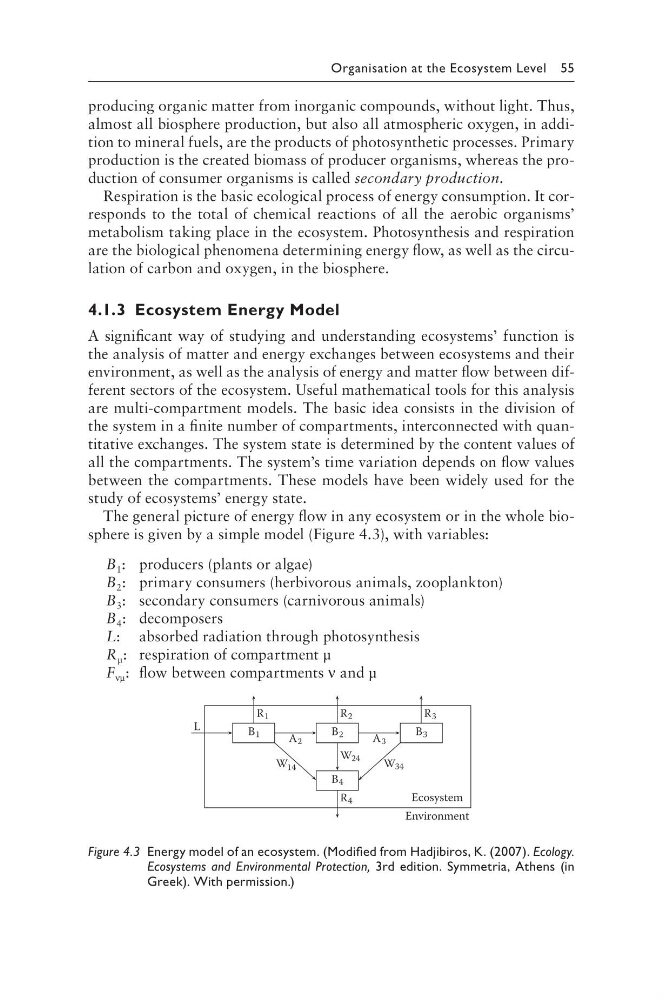
The general picture of energy flow in any ecosystem or in the whole biosphere is given by a simple model (Figure 4.3), with variables:
B 1 : producers (plants or algae)
B 2 : primary consumers (herbivorous animals, zooplankton)
B 3 : secondary consumers (carnivorous animals)
B 4 : decomposers
L: absorbed radiation through photosynthesis
R μ : respiration of compartment μ
F νμ : flow between compartments ν and μ
B 1
A 2
B 2
A 3
B 3
W 24
B 4
R 4
W 34
W 14
R 1
R 2
R 3
L
Ecosystem
Environment
Figure 4.3 Energy model of an ecosystem. (Modified from Hadjibiros, K. (2007). Ecology.
Ecosystems and Environmental Protection, 3rd edition. Symmetria, Athens (in
Greek). With permission.)
producing organic matter from inorganic compounds, without light. Thus,
almost all biosphere production, but also all atmospheric oxygen, in addition to mineral fuels, are the products of photosynthetic processes. Primary
production is the created biomass of producer organisms, whereas the production of consumer organisms is called secondary production.
Respiration is the basic ecological process of energy consumption. It corresponds to the total of chemical reactions of all the aerobic organisms’
metabolism taking place in the ecosystem. Photosynthesis and respiration
are the biological phenomena determining energy flow, as well as the circulation of carbon and oxygen, in the biosphere.
4.1.3 Ecosystem Energy Model
A significant way of studying and understanding ecosystems’ function is
the analysis of matter and energy exchanges between ecosystems and their
environment, as well as the analysis of energy and matter flow between different sectors of the ecosystem. Useful mathematical tools for this analysis
are multi-compartment models. The basic idea consists in the division of
the system in a finite number of compartments, interconnected with quantitative exchanges. The system state is determined by the content values of
all the compartments. The system’s time variation depends on flow values
between the compartments. These models have been widely used for the
study of ecosystems’ energy state.
The general picture of energy flow in any ecosystem or in the whole biosphere is given by a simple model (Figure 4.3), with variables:
B 1 : producers (plants or algae)
B 2 : primary consumers (herbivorous animals, zooplankton)
B 3 : secondary consumers (carnivorous animals)
B 4 : decomposers
L: absorbed radiation through photosynthesis
R μ : respiration of compartment μ
F νμ : flow between compartments ν and μ
B 1
A 2
B 2
A 3
B 3
W 24
B 4
R 4
W 34
W 14
R 1
R 2
R 3
L
Ecosystem
Environment
Figure 4.3 Energy model of an ecosystem. (Modified from Hadjibiros, K. (2007). Ecology.
Ecosystems and Environmental Protection, 3rd edition. Symmetria, Athens (in
Greek). With permission.)