

54 Ecology and Applied Environmental Science
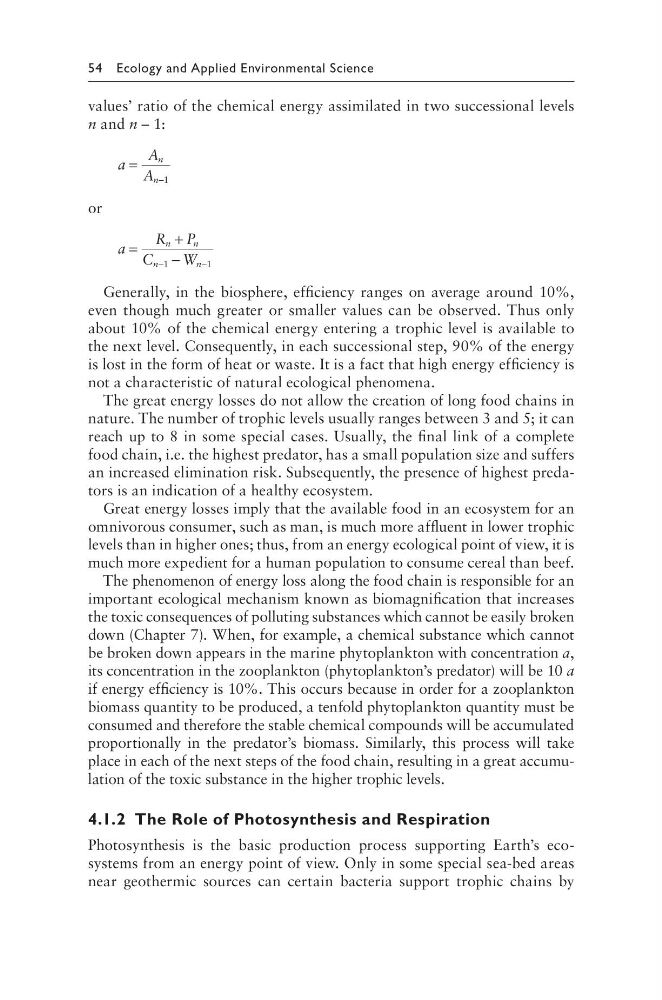
values’ ratio of the chemical energy assimilated in two successional levels
n and n – 1:
a
A
A
n
n
=
−1
or
a
R P
C
W
n
n
n
n
=
+
−
−
−
1
1
Generally, in the biosphere, efficiency ranges on average around 10%,
even though much greater or smaller values can be observed. Thus only
about 10% of the chemical energy entering a trophic level is available to
the next level. Consequently, in each successional step, 90% of the energy
is lost in the form of heat or waste. It is a fact that high energy efficiency is
not a characteristic of natural ecological phenomena.
The great energy losses do not allow the creation of long food chains in
nature. The number of trophic levels usually ranges between 3 and 5; it can
reach up to 8 in some special cases. Usually, the final link of a complete
food chain, i.e. the highest predator, has a small population size and suffers
an increased elimination risk. Subsequently, the presence of highest predators is an indication of a healthy ecosystem.
Great energy losses imply that the available food in an ecosystem for an
omnivorous consumer, such as man, is much more affluent in lower trophic
levels than in higher ones; thus, from an energy ecological point of view, it is
much more expedient for a human population to consume cereal than beef.
The phenomenon of energy loss along the food chain is responsible for an
important ecological mechanism known as biomagnification that increases
the toxic consequences of polluting substances which cannot be easily broken
down (Chapter 7). When, for example, a chemical substance which cannot
be broken down appears in the marine phytoplankton with concentration a,
its concentration in the zooplankton (phytoplankton’s predator) will be 10 a
if energy efficiency is 10%. This occurs because in order for a zooplankton
biomass quantity to be produced, a tenfold phytoplankton quantity must be
consumed and therefore the stable chemical compounds will be accumulated
proportionally in the predator’s biomass. Similarly, this process will take
place in each of the next steps of the food chain, resulting in a great accumulation of the toxic substance in the higher trophic levels.
4.1.2 the role of Photosynthesis and respiration
Photosynthesis is the basic production process supporting Earth’s ecosystems from an energy point of view. Only in some special sea-bed areas
near geothermic sources can certain bacteria support trophic chains by
values’ ratio of the chemical energy assimilated in two successional levels
n and n – 1:
a
A
A
n
n
=
−1
or
a
R P
C
W
n
n
n
n
=
+
−
−
−
1
1
Generally, in the biosphere, efficiency ranges on average around 10%,
even though much greater or smaller values can be observed. Thus only
about 10% of the chemical energy entering a trophic level is available to
the next level. Consequently, in each successional step, 90% of the energy
is lost in the form of heat or waste. It is a fact that high energy efficiency is
not a characteristic of natural ecological phenomena.
The great energy losses do not allow the creation of long food chains in
nature. The number of trophic levels usually ranges between 3 and 5; it can
reach up to 8 in some special cases. Usually, the final link of a complete
food chain, i.e. the highest predator, has a small population size and suffers
an increased elimination risk. Subsequently, the presence of highest predators is an indication of a healthy ecosystem.
Great energy losses imply that the available food in an ecosystem for an
omnivorous consumer, such as man, is much more affluent in lower trophic
levels than in higher ones; thus, from an energy ecological point of view, it is
much more expedient for a human population to consume cereal than beef.
The phenomenon of energy loss along the food chain is responsible for an
important ecological mechanism known as biomagnification that increases
the toxic consequences of polluting substances which cannot be easily broken
down (Chapter 7). When, for example, a chemical substance which cannot
be broken down appears in the marine phytoplankton with concentration a,
its concentration in the zooplankton (phytoplankton’s predator) will be 10 a
if energy efficiency is 10%. This occurs because in order for a zooplankton
biomass quantity to be produced, a tenfold phytoplankton quantity must be
consumed and therefore the stable chemical compounds will be accumulated
proportionally in the predator’s biomass. Similarly, this process will take
place in each of the next steps of the food chain, resulting in a great accumulation of the toxic substance in the higher trophic levels.
4.1.2 the role of Photosynthesis and respiration
Photosynthesis is the basic production process supporting Earth’s ecosystems from an energy point of view. Only in some special sea-bed areas
near geothermic sources can certain bacteria support trophic chains by