

Organisation at the Ecosystem Level 53
• Decomposers are the bacteria and fungi which are consumers in
essence but execute a special function in the ecosystems. Their role is
to break down dead organic matter to inorganic compounds, which
thus become available again for producers’ consumption.
A series of species, each one of which constitutes food for the next
(Chapter 3, Section 3.4.3), is described as a food chain. Often, food chains
are interconnected, since many ecosystem organisms belong to more than
one food chain. Thus, trophic webs, which can be divided in trophic levels,
are created. The first trophic level contains plants or algae, the second one
herbivores or zooplankton, the third one the first carnivore animals, the
fourth the second carnivore animals etc. Omnivorous animals are placed
in more than one trophic level.
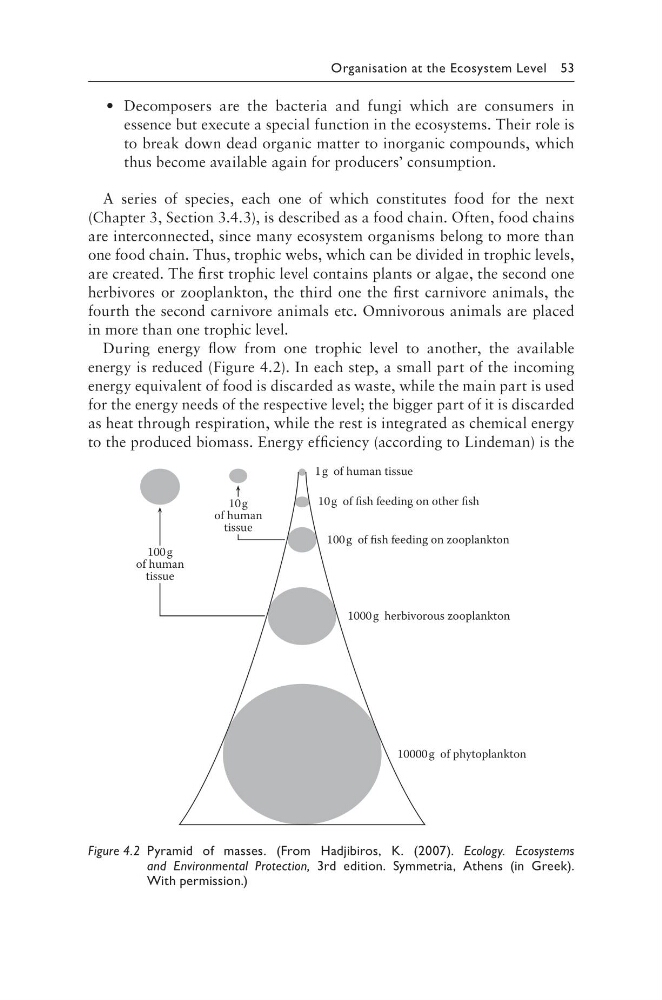
During energy flow from one trophic level to another, the available
energy is reduced (Figure 4.2). In each step, a small part of the incoming
energy equivalent of food is discarded as waste, while the main part is used
for the energy needs of the respective level; the bigger part of it is discarded
as heat through respiration, while the rest is integrated as chemical energy
to the produced biomass. Energy efficiency (according to Lindeman) is the
1 g of human tissue
10 g of fish feeding on other fish
100 g of fish feeding on zooplankton
1000 g herbivorous zooplankton
10000 g of phytoplankton
10 g
of human
tissue
100g
of human
tissue
Figure 4.2 Pyramid of masses. (From Hadjibiros, K. (2007). Ecology. Ecosystems
and Environmental Protection, 3rd edition. Symmetria, Athens (in Greek).
With permission.)
• Decomposers are the bacteria and fungi which are consumers in
essence but execute a special function in the ecosystems. Their role is
to break down dead organic matter to inorganic compounds, which
thus become available again for producers’ consumption.
A series of species, each one of which constitutes food for the next
(Chapter 3, Section 3.4.3), is described as a food chain. Often, food chains
are interconnected, since many ecosystem organisms belong to more than
one food chain. Thus, trophic webs, which can be divided in trophic levels,
are created. The first trophic level contains plants or algae, the second one
herbivores or zooplankton, the third one the first carnivore animals, the
fourth the second carnivore animals etc. Omnivorous animals are placed
in more than one trophic level.
During energy flow from one trophic level to another, the available
energy is reduced (Figure 4.2). In each step, a small part of the incoming
energy equivalent of food is discarded as waste, while the main part is used
for the energy needs of the respective level; the bigger part of it is discarded
as heat through respiration, while the rest is integrated as chemical energy
to the produced biomass. Energy efficiency (according to Lindeman) is the
1 g of human tissue
10 g of fish feeding on other fish
100 g of fish feeding on zooplankton
1000 g herbivorous zooplankton
10000 g of phytoplankton
10 g
of human
tissue
100g
of human
tissue
Figure 4.2 Pyramid of masses. (From Hadjibiros, K. (2007). Ecology. Ecosystems
and Environmental Protection, 3rd edition. Symmetria, Athens (in Greek).
With permission.)