

56 Ecology and Applied Environmental Science
F 12 and F 23 are A 2 and A 3 (assimilations of compartments 2 and 3),
respectively and F 14 , F 24 , and F 34 are W 14 , W 24 , W 34 (wastes from compartments 1, 2, and 3 to compartment 4), respectively.
The ecosystem’s state is determined by the energy content of the four
compartments, which can correspondingly be expressed as biomasses: B 1 ,
B 2 , B 3 , B 4 .
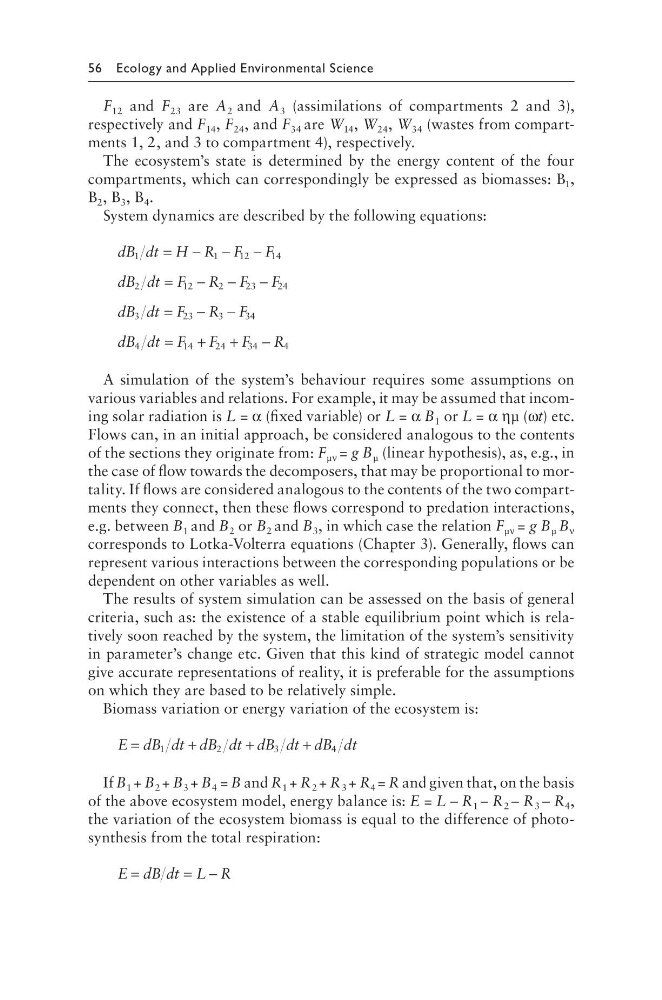
System dynamics are described by the following equations:
dB dt H R F
F
dB dt F
R F
F
dB dt F
1
1
12
14
2
12
2
23
24
3
23
= − −
−
=
− −
−
=
− − −
=
+
+
−
R F
dB dt F
F
F
R
3
34
4
14
24
34
4
A simulation of the system’s behaviour requires some assumptions on
various variables and relations. For example, it may be assumed that incoming solar radiation is L = α (fixed variable) or L = α B 1 or L = α ημ (ωt) etc.
Flows can, in an initial approach, be considered analogous to the contents
of the sections they originate from: F μν = g B μ (linear hypothesis), as, e.g., in
tality. If flows are considered analogous to the contents of the two compartments they connect, then these flows correspond to predation interactions,
e.g. between B 1 and B 2 or B 2 and B 3 , in which case the relation F μν = g B μ B ν
corresponds to Lotka-Volterra equations (Chapter 3). Generally, flows can
represent various interactions between the corresponding populations or be
dependent on other variables as well.
The results of system simulation can be assessed on the basis of general
criteria, such as: the existence of a stable equilibrium point which is relatively soon reached by the system, the limitation of the system’s sensitivity
in parameter’s change etc. Given that this kind of strategic model cannot
give accurate representations of reality, it is preferable for the assumptions
on which they are based to be relatively simple.
Biomass variation or energy variation of the ecosystem is:
E dB dt dB dt dB dt dB dt
=
+
+
+
1
2
3
4
If B 1 + B 2 + B 3 + B 4 = B and R 1 + R 2 + R 3 + R 4 = R and given that, on the basis
of the above ecosystem model, energy balance is: E = L – R 1 – R 2 – R 3 – R 4 ,
the variation of the ecosystem biomass is equal to the difference of photosynthesis from the total respiration:
E dB dt L R
=
= −
F 12 and F 23 are A 2 and A 3 (assimilations of compartments 2 and 3),
respectively and F 14 , F 24 , and F 34 are W 14 , W 24 , W 34 (wastes from compartments 1, 2, and 3 to compartment 4), respectively.
The ecosystem’s state is determined by the energy content of the four
compartments, which can correspondingly be expressed as biomasses: B 1 ,
B 2 , B 3 , B 4 .
System dynamics are described by the following equations:
dB dt H R F
F
dB dt F
R F
F
dB dt F
1
1
12
14
2
12
2
23
24
3
23
= − −
−
=
− −
−
=
− − −
=
+
+
−
R F
dB dt F
F
F
R
3
34
4
14
24
34
4
A simulation of the system’s behaviour requires some assumptions on
various variables and relations. For example, it may be assumed that incoming solar radiation is L = α (fixed variable) or L = α B 1 or L = α ημ (ωt) etc.
Flows can, in an initial approach, be considered analogous to the contents
of the sections they originate from: F μν = g B μ (linear hypothesis), as, e.g., in
tality. If flows are considered analogous to the contents of the two compartments they connect, then these flows correspond to predation interactions,
e.g. between B 1 and B 2 or B 2 and B 3 , in which case the relation F μν = g B μ B ν
corresponds to Lotka-Volterra equations (Chapter 3). Generally, flows can
represent various interactions between the corresponding populations or be
dependent on other variables as well.
The results of system simulation can be assessed on the basis of general
criteria, such as: the existence of a stable equilibrium point which is relatively soon reached by the system, the limitation of the system’s sensitivity
in parameter’s change etc. Given that this kind of strategic model cannot
give accurate representations of reality, it is preferable for the assumptions
on which they are based to be relatively simple.
Biomass variation or energy variation of the ecosystem is:
E dB dt dB dt dB dt dB dt
=
+
+
+
1
2
3
4
If B 1 + B 2 + B 3 + B 4 = B and R 1 + R 2 + R 3 + R 4 = R and given that, on the basis
of the above ecosystem model, energy balance is: E = L – R 1 – R 2 – R 3 – R 4 ,
the variation of the ecosystem biomass is equal to the difference of photosynthesis from the total respiration:
E dB dt L R
=
= −