

Organisation at Population Level 29
A central issue for ecology is the search for the causes of ecosystem stability, which are considered to be connected with the interactions between
populations. The explanation of ecosystem stability represents a main theoretical and practical challenge for population dynamics. The existence of
stability, a precondition for persistence, is an important criterion for evaluating models used to describe ecological phenomena. However, the high
complexity of ecosystems does not allow, at least for the time being, the
formulation of a stability theory. Consequently, all theoretical approaches
are limited to the exploration of stabilising factors which could eventually
contribute, to a lesser or greater degree, to the observed stability of the
ecosystem. Such factors might be intra- or inter-population competition,
predation, the diversity of species or of interactions or of the natural conditions, spatial or temporal lack of homogeneity that creates possibilities
for the diminishing population to seek refuge, the natural change of the
parameters due to populations’ evolution etc. Other factors, such as the
anthropogenic modifications, could hardly be stabilizing.
3.3 PoPulation SizE variation ModElS
3.3.1 Exponential Model
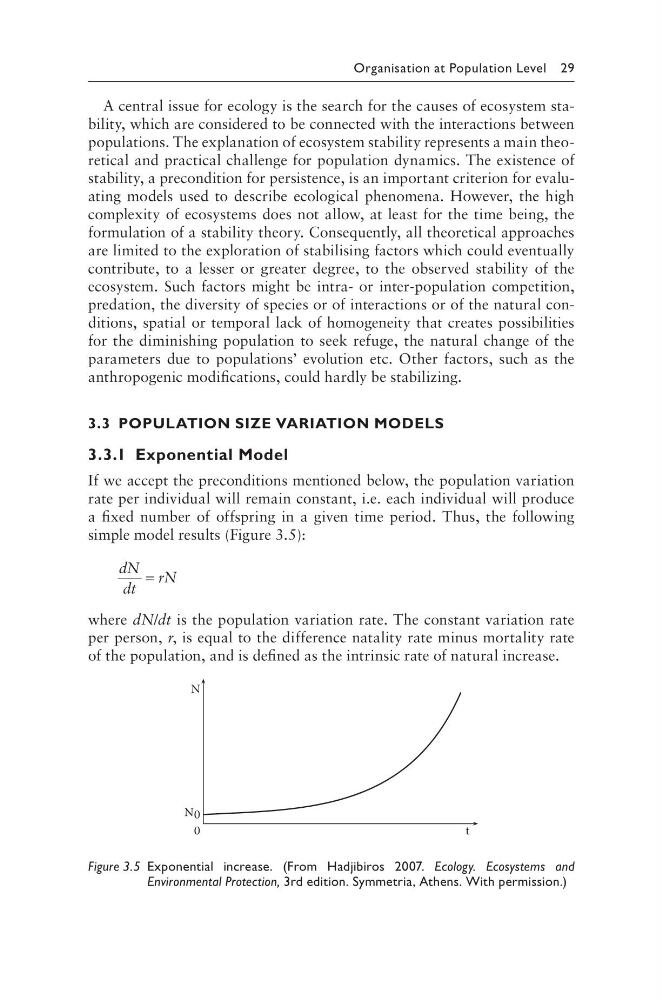
If we accept the preconditions mentioned below, the population variation
rate per individual will remain constant, i.e. each individual will produce
a fixed number of offspring in a given time period. Thus, the following
simple model results (Figure 3.5):
dN
dt
rN
=
where dN/dt is the population variation rate. The constant variation rate
per person, r, is equal to the difference natality rate minus mortality rate
of the population, and is defined as the intrinsic rate of natural increase.
0
t
N
N 0
Figure 3.5 Exponential increase. (From Hadjibiros 2007. Ecology. Ecosystems and
Environmental Protection, 3rd edition. Symmetria, Athens. With permission.)
A central issue for ecology is the search for the causes of ecosystem stability, which are considered to be connected with the interactions between
populations. The explanation of ecosystem stability represents a main theoretical and practical challenge for population dynamics. The existence of
stability, a precondition for persistence, is an important criterion for evaluating models used to describe ecological phenomena. However, the high
complexity of ecosystems does not allow, at least for the time being, the
formulation of a stability theory. Consequently, all theoretical approaches
are limited to the exploration of stabilising factors which could eventually
contribute, to a lesser or greater degree, to the observed stability of the
ecosystem. Such factors might be intra- or inter-population competition,
predation, the diversity of species or of interactions or of the natural conditions, spatial or temporal lack of homogeneity that creates possibilities
for the diminishing population to seek refuge, the natural change of the
parameters due to populations’ evolution etc. Other factors, such as the
anthropogenic modifications, could hardly be stabilizing.
3.3 PoPulation SizE variation ModElS
3.3.1 Exponential Model
If we accept the preconditions mentioned below, the population variation
rate per individual will remain constant, i.e. each individual will produce
a fixed number of offspring in a given time period. Thus, the following
simple model results (Figure 3.5):
dN
dt
rN
=
where dN/dt is the population variation rate. The constant variation rate
per person, r, is equal to the difference natality rate minus mortality rate
of the population, and is defined as the intrinsic rate of natural increase.
0
t
N
N 0
Figure 3.5 Exponential increase. (From Hadjibiros 2007. Ecology. Ecosystems and
Environmental Protection, 3rd edition. Symmetria, Athens. With permission.)