

28 Ecology and Applied Environmental Science
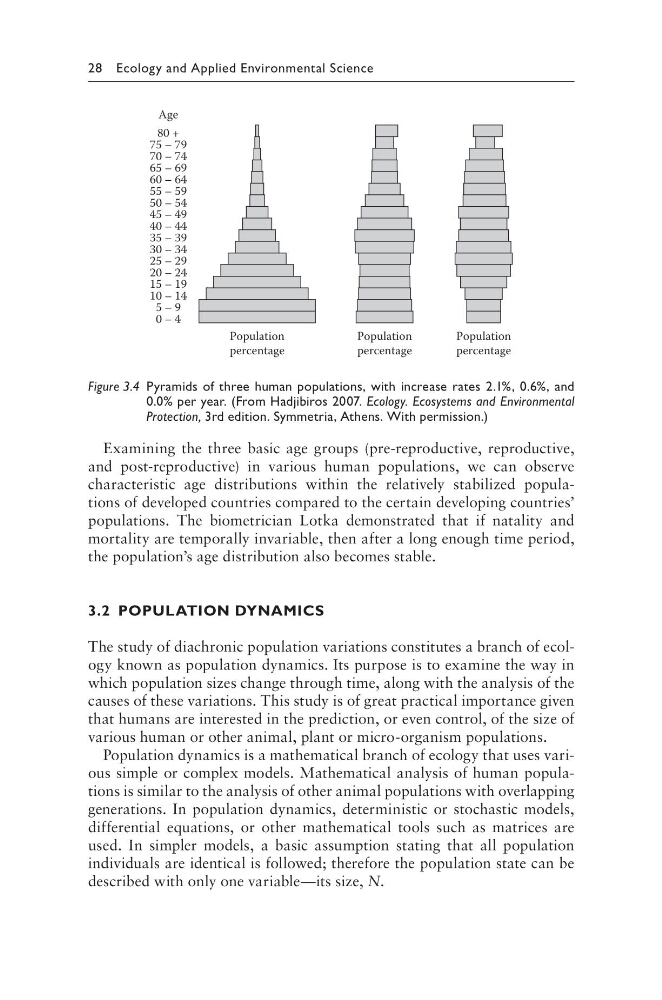
Examining the three basic age groups (pre-reproductive, reproductive,
and post-reproductive) in various human populations, we can observe
characteristic age distributions within the relatively stabilized populations of developed countries compared to the certain developing countries’
populations. The biometrician Lotka demonstrated that if natality and
mortality are temporally invariable, then after a long enough time period,
the population’s age distribution also becomes stable.
3.2 PoPulation dynaMicS
The study of diachronic population variations constitutes a branch of ecology known as population dynamics. Its purpose is to examine the way in
which population sizes change through time, along with the analysis of the
causes of these variations. This study is of great practical importance given
that humans are interested in the prediction, or even control, of the size of
various human or other animal, plant or micro-organism populations.
ous simple or complex models. Mathematical analysis of human populations is similar to the analysis of other animal populations with overlapping
generations. In population dynamics, deterministic or stochastic models,
differential equations, or other mathematical tools such as matrices are
used. In simpler models, a basic assumption stating that all population
individuals are identical is followed; therefore the population state can be
described with only one variable—its size, N.
Population
percentage
Population
percentage
Population
percentage
Age
80 +
75 – 79
70 – 74
65 – 69
60 – 64
55 – 59
50 – 54
45 – 49
40 – 44
35 – 39
30 – 34
25 – 29
20 – 24
15 – 19
10 – 14
5 – 9
0 – 4
Figure 3.4 Pyramids of three human populations, with increase rates 2.1%, 0.6%, and
0.0% per year. (From Hadjibiros 2007. Ecology. Ecosystems and Environmental
Protection, 3rd edition. Symmetria, Athens. With permission.)
Examining the three basic age groups (pre-reproductive, reproductive,
and post-reproductive) in various human populations, we can observe
characteristic age distributions within the relatively stabilized populations of developed countries compared to the certain developing countries’
populations. The biometrician Lotka demonstrated that if natality and
mortality are temporally invariable, then after a long enough time period,
the population’s age distribution also becomes stable.
3.2 PoPulation dynaMicS
The study of diachronic population variations constitutes a branch of ecology known as population dynamics. Its purpose is to examine the way in
which population sizes change through time, along with the analysis of the
causes of these variations. This study is of great practical importance given
that humans are interested in the prediction, or even control, of the size of
various human or other animal, plant or micro-organism populations.
ous simple or complex models. Mathematical analysis of human populations is similar to the analysis of other animal populations with overlapping
generations. In population dynamics, deterministic or stochastic models,
differential equations, or other mathematical tools such as matrices are
used. In simpler models, a basic assumption stating that all population
individuals are identical is followed; therefore the population state can be
described with only one variable—its size, N.
Population
percentage
Population
percentage
Population
percentage
Age
80 +
75 – 79
70 – 74
65 – 69
60 – 64
55 – 59
50 – 54
45 – 49
40 – 44
35 – 39
30 – 34
25 – 29
20 – 24
15 – 19
10 – 14
5 – 9
0 – 4
Figure 3.4 Pyramids of three human populations, with increase rates 2.1%, 0.6%, and
0.0% per year. (From Hadjibiros 2007. Ecology. Ecosystems and Environmental
Protection, 3rd edition. Symmetria, Athens. With permission.)