

30 Ecology and Applied Environmental Science
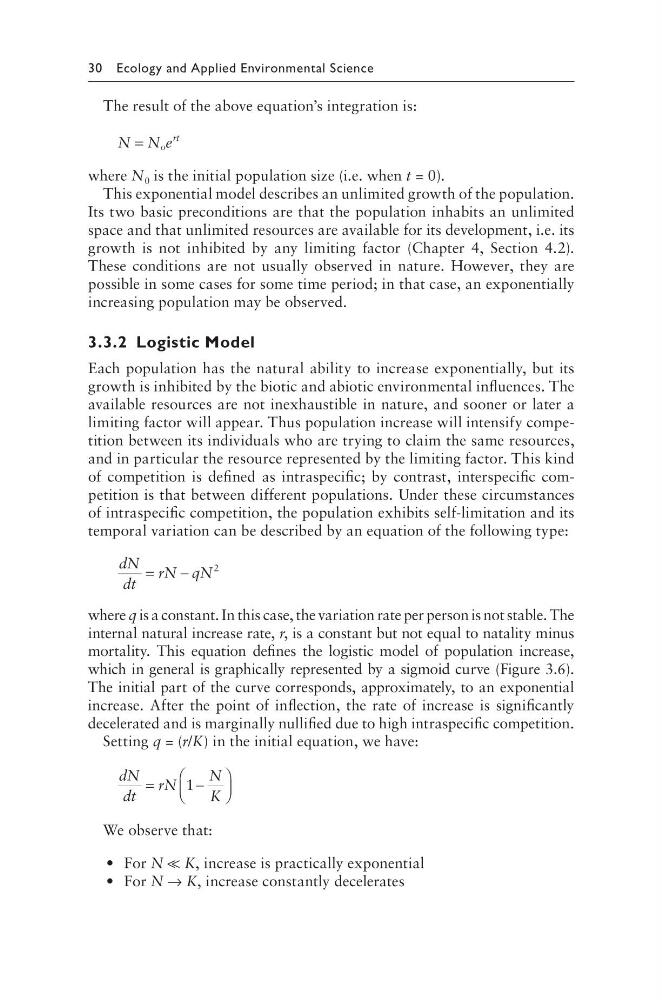
The result of the above equation’s integration is:
N N e
o
rt
=
where N 0 is the initial population size (i.e. when t = 0).
This exponential model describes an unlimited growth of the population.
Its two basic preconditions are that the population inhabits an unlimited
space and that unlimited resources are available for its development, i.e. its
growth is not inhibited by any limiting factor (Chapter 4, Section 4.2).
These conditions are not usually observed in nature. However, they are
possible in some cases for some time period; in that case, an exponentially
increasing population may be observed.
3.3.2 logistic Model
Each population has the natural ability to increase exponentially, but its
growth is inhibited by the biotic and abiotic environmental influences. The
available resources are not inexhaustible in nature, and sooner or later a
limiting factor will appear. Thus population increase will intensify competition between its individuals who are trying to claim the same resources,
and in particular the resource represented by the limiting factor. This kind
of competition is defined as intraspecific; by contrast, interspecific competition is that between different populations. Under these circumstances
of intraspecific competition, the population exhibits self-limitation and its
temporal variation can be described by an equation of the following type:
dN
dt
rN qN
=
−
2
where q is a constant. In this case, the variation rate per person is not stable. The
internal natural increase rate, r, is a constant but not equal to natality minus
mortality. This equation defines the logistic model of population increase,
which in general is graphically represented by a sigmoid curve (Figure 3.6).
The initial part of the curve corresponds, approximately, to an exponential
increase. After the point of inflection, the rate of increase is significantly
decelerated and is marginally nullified due to high intraspecific competition.
Setting q = (r/K) in the initial equation, we have:
dN
dt
rN
N
K
=
−
1
We observe that:
• For N K, increase is practically exponential
• For N → K, increase constantly decelerates
The result of the above equation’s integration is:
N N e
o
rt
=
where N 0 is the initial population size (i.e. when t = 0).
This exponential model describes an unlimited growth of the population.
Its two basic preconditions are that the population inhabits an unlimited
space and that unlimited resources are available for its development, i.e. its
growth is not inhibited by any limiting factor (Chapter 4, Section 4.2).
These conditions are not usually observed in nature. However, they are
possible in some cases for some time period; in that case, an exponentially
increasing population may be observed.
3.3.2 logistic Model
Each population has the natural ability to increase exponentially, but its
growth is inhibited by the biotic and abiotic environmental influences. The
available resources are not inexhaustible in nature, and sooner or later a
limiting factor will appear. Thus population increase will intensify competition between its individuals who are trying to claim the same resources,
and in particular the resource represented by the limiting factor. This kind
of competition is defined as intraspecific; by contrast, interspecific competition is that between different populations. Under these circumstances
of intraspecific competition, the population exhibits self-limitation and its
temporal variation can be described by an equation of the following type:
dN
dt
rN qN
=
−
2
where q is a constant. In this case, the variation rate per person is not stable. The
internal natural increase rate, r, is a constant but not equal to natality minus
mortality. This equation defines the logistic model of population increase,
which in general is graphically represented by a sigmoid curve (Figure 3.6).
The initial part of the curve corresponds, approximately, to an exponential
increase. After the point of inflection, the rate of increase is significantly
decelerated and is marginally nullified due to high intraspecific competition.
Setting q = (r/K) in the initial equation, we have:
dN
dt
rN
N
K
=
−
1
We observe that:
• For N K, increase is practically exponential
• For N → K, increase constantly decelerates