

Organisms and Environmental Factors 21
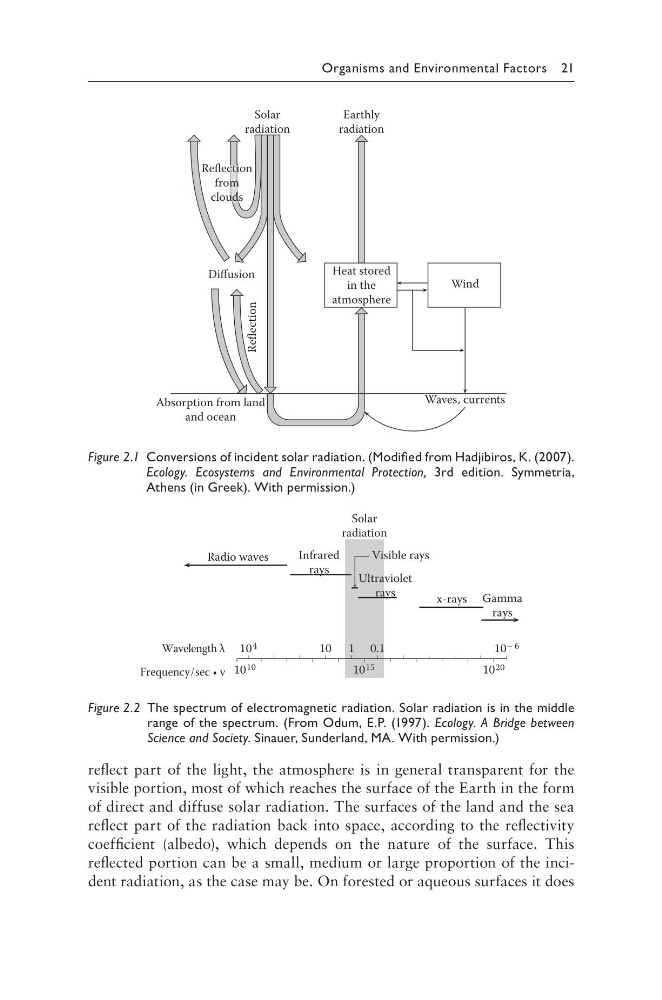
reflect part of the light, the atmosphere is in general transparent for the
visible portion, most of which reaches the surface of the Earth in the form
of direct and diffuse solar radiation. The surfaces of the land and the sea
reflect part of the radiation back into space, according to the reflectivity
coefficient (albedo), which depends on the nature of the surface. This
reflected portion can be a small, medium or large proportion of the incident radiation, as the case may be. On forested or aqueous surfaces it does
Heat stored
in the
atmosphere
Wind
Solar
radiation
Earthly
radiation
Waves, currents
Diffusion
Absorption from land
and ocean
Reflection
Reflection
from
clouds
Figure 2.1 Conversions of incident solar radiation. (Modified from Hadjibiros, K. (2007).
Ecology. Ecosystems and Environmental Protection, 3rd edition. Symmetria,
Athens (in Greek). With permission.)
10 4
10 1 0.1
10 – 6
10 10
10 15
10 20
Solar
radiation
x-rays Gamma
rays
Infrared
rays
Radio waves
Wavelength λ
Frequency/sec • ν
Visible rays
Ultraviolet
rays
Figure 2.2 The spectrum of electromagnetic radiation. Solar radiation is in the middle
range of the spectrum. (From Odum, E.P. (1997). Ecology. A Bridge between
Science and Society. Sinauer, Sunderland, MA. With permission.)
reflect part of the light, the atmosphere is in general transparent for the
visible portion, most of which reaches the surface of the Earth in the form
of direct and diffuse solar radiation. The surfaces of the land and the sea
reflect part of the radiation back into space, according to the reflectivity
coefficient (albedo), which depends on the nature of the surface. This
reflected portion can be a small, medium or large proportion of the incident radiation, as the case may be. On forested or aqueous surfaces it does
Heat stored
in the
atmosphere
Wind
Solar
radiation
Earthly
radiation
Waves, currents
Diffusion
Absorption from land
and ocean
Reflection
Reflection
from
clouds
Figure 2.1 Conversions of incident solar radiation. (Modified from Hadjibiros, K. (2007).
Ecology. Ecosystems and Environmental Protection, 3rd edition. Symmetria,
Athens (in Greek). With permission.)
10 4
10 1 0.1
10 – 6
10 10
10 15
10 20
Solar
radiation
x-rays Gamma
rays
Infrared
rays
Radio waves
Wavelength λ
Frequency/sec • ν
Visible rays
Ultraviolet
rays
Figure 2.2 The spectrum of electromagnetic radiation. Solar radiation is in the middle
range of the spectrum. (From Odum, E.P. (1997). Ecology. A Bridge between
Science and Society. Sinauer, Sunderland, MA. With permission.)