

22 Ecology and Applied Environmental Science
not exceed 3–5%. On the surface of freshly fallen snow it can be as high as
95%. Reflection is also greatly dependent on the angle of incidence. That is,
when the sun is at its zenith, 5% is reflected by an aqueous surface, whereas
when the sun is low (5 o above the horizon) 95% is reflected.
Part of solar radiation is reflected from the surface of the water or
from bodies floating or suspended at shallow depths. The rest enters the
body of water but is gradually absorbed by the H 2 O molecules, aquatic
organisms and dissolved or suspended substances; as a result its intensity
rapidly decreases with depth. Part of the light is absorbed by algae through
photo synthesis. When the water is turbid (e.g. in lakes, coastal areas), the
decrease is much greater. Even in clear water, sunlight is greatly weakened
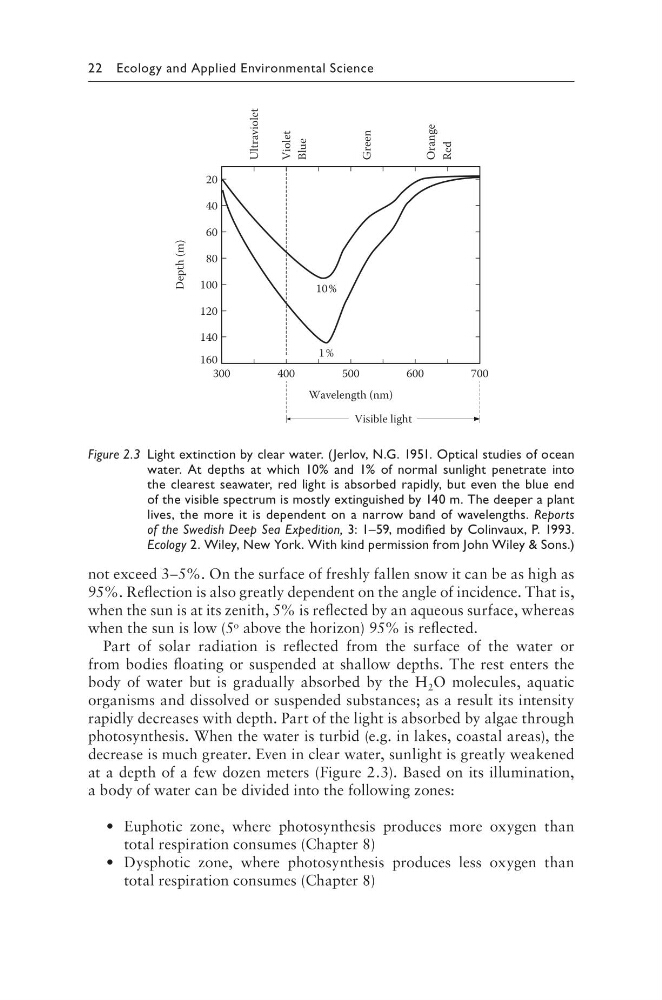
at a depth of a few dozen meters (Figure 2.3). Based on its illumination,
a body of water can be divided into the following zones:
• Euphotic zone, where photosynthesis produces more oxygen than
total respiration consumes (Chapter 8)
• Dysphotic zone, where photosynthesis produces less oxygen than
total respiration consumes (Chapter 8)
300
400
1%
10%
500
Wavelength (nm)
Depth (m)
Ultraviolet
Violet
Blue
Green
Red
Orange
600
700
140
160
120
100
80
60
40
20
Visible light
Figure 2.3 Light extinction by clear water. (Jerlov, N.G. 1951. Optical studies of ocean
water. At depths at which 10% and 1% of normal sunlight penetrate into
the clearest seawater, red light is absorbed rapidly, but even the blue end
of the visible spectrum is mostly extinguished by 140 m. The deeper a plant
lives, the more it is dependent on a narrow band of wavelengths. Reports
of the Swedish Deep Sea Expedition, 3: 1–59, modified by Colinvaux, P. 1993.
Ecology 2. Wiley, New York. With kind permission from John Wiley & Sons.)
not exceed 3–5%. On the surface of freshly fallen snow it can be as high as
95%. Reflection is also greatly dependent on the angle of incidence. That is,
when the sun is at its zenith, 5% is reflected by an aqueous surface, whereas
when the sun is low (5 o above the horizon) 95% is reflected.
Part of solar radiation is reflected from the surface of the water or
from bodies floating or suspended at shallow depths. The rest enters the
body of water but is gradually absorbed by the H 2 O molecules, aquatic
organisms and dissolved or suspended substances; as a result its intensity
rapidly decreases with depth. Part of the light is absorbed by algae through
photo synthesis. When the water is turbid (e.g. in lakes, coastal areas), the
decrease is much greater. Even in clear water, sunlight is greatly weakened
at a depth of a few dozen meters (Figure 2.3). Based on its illumination,
a body of water can be divided into the following zones:
• Euphotic zone, where photosynthesis produces more oxygen than
total respiration consumes (Chapter 8)
• Dysphotic zone, where photosynthesis produces less oxygen than
total respiration consumes (Chapter 8)
300
400
1%
10%
500
Wavelength (nm)
Depth (m)
Ultraviolet
Violet
Blue
Green
Red
Orange
600
700
140
160
120
100
80
60
40
20
Visible light
Figure 2.3 Light extinction by clear water. (Jerlov, N.G. 1951. Optical studies of ocean
water. At depths at which 10% and 1% of normal sunlight penetrate into
the clearest seawater, red light is absorbed rapidly, but even the blue end
of the visible spectrum is mostly extinguished by 140 m. The deeper a plant
lives, the more it is dependent on a narrow band of wavelengths. Reports
of the Swedish Deep Sea Expedition, 3: 1–59, modified by Colinvaux, P. 1993.
Ecology 2. Wiley, New York. With kind permission from John Wiley & Sons.)