

20 Ecology and Applied Environmental Science
• Ultraviolet radiation (wavelength <0.4 μ)
• Roentgen or x-rays (wavelength <10 –2 μ)
• Gamma rays (wavelength <10 –4 μ), which belong to the category
of ionising radiation, together with alpha and beta radioactivity
(Chapter 7)
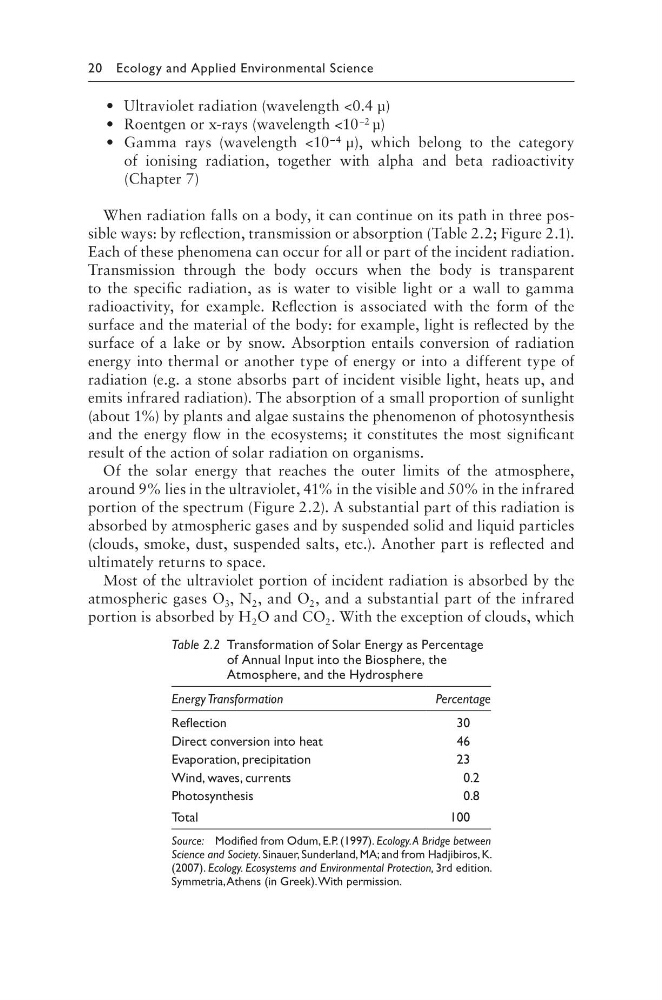
When radiation falls on a body, it can continue on its path in three possible ways: by reflection, transmission or absorption (Table 2.2; Figure 2.1).
Each of these phenomena can occur for all or part of the incident radiation .
Transmission through the body occurs when the body is transparent
to the specific radiation, as is water to visible light or a wall to gamma
radioactivity , for example. Reflection is associated with the form of the
surface and the material of the body: for example, light is reflected by the
surface of a lake or by snow. Absorption entails conversion of radiation
energy into thermal or another type of energy or into a different type of
radiation (e.g. a stone absorbs part of incident visible light, heats up, and
emits infrared radiation). The absorption of a small proportion of sunlight
(about 1%) by plants and algae sustains the phenomenon of photosynthesis
and the energy flow in the ecosystems; it constitutes the most significant
result of the action of solar radiation on organisms.
Of the solar energy that reaches the outer limits of the atmosphere,
around 9% lies in the ultraviolet, 41% in the visible and 50% in the infrared
portion of the spectrum (Figure 2.2). A substantial part of this radiation is
absorbed by atmospheric gases and by suspended solid and liquid particles
(clouds, smoke, dust, suspended salts, etc.). Another part is reflected and
ultimately returns to space.
Most of the ultraviolet portion of incident radiation is absorbed by the
atmospheric gases O 3 , N 2 , and O 2 , and a substantial part of the infrared
portion is absorbed by H 2 O and CO 2 . With the exception of clouds, which
Table 2.2 Transformation of Solar Energy as Percentage
of Annual Input into the Biosphere, the
Atmosphere, and the Hydrosphere
Energy Transformation
Percentage
Reflection
30
Direct conversion into heat
46
Evaporation, precipitation
23
Wind, waves, currents
0.2
Photosynthesis
0.8
Total
100
Source: Modified from Odum, E.P. (1997). Ecology. A Bridge between
Science and Society. Sinauer, Sunderland, MA; and from Hadjibiros, K.
(2007). Ecology. Ecosystems and Environmental Protection, 3rd edition.
Symmetria, Athens (in Greek). With permission.
• Ultraviolet radiation (wavelength <0.4 μ)
• Roentgen or x-rays (wavelength <10 –2 μ)
• Gamma rays (wavelength <10 –4 μ), which belong to the category
of ionising radiation, together with alpha and beta radioactivity
(Chapter 7)
When radiation falls on a body, it can continue on its path in three possible ways: by reflection, transmission or absorption (Table 2.2; Figure 2.1).
Each of these phenomena can occur for all or part of the incident radiation .
Transmission through the body occurs when the body is transparent
to the specific radiation, as is water to visible light or a wall to gamma
radioactivity , for example. Reflection is associated with the form of the
surface and the material of the body: for example, light is reflected by the
surface of a lake or by snow. Absorption entails conversion of radiation
energy into thermal or another type of energy or into a different type of
radiation (e.g. a stone absorbs part of incident visible light, heats up, and
emits infrared radiation). The absorption of a small proportion of sunlight
(about 1%) by plants and algae sustains the phenomenon of photosynthesis
and the energy flow in the ecosystems; it constitutes the most significant
result of the action of solar radiation on organisms.
Of the solar energy that reaches the outer limits of the atmosphere,
around 9% lies in the ultraviolet, 41% in the visible and 50% in the infrared
portion of the spectrum (Figure 2.2). A substantial part of this radiation is
absorbed by atmospheric gases and by suspended solid and liquid particles
(clouds, smoke, dust, suspended salts, etc.). Another part is reflected and
ultimately returns to space.
Most of the ultraviolet portion of incident radiation is absorbed by the
atmospheric gases O 3 , N 2 , and O 2 , and a substantial part of the infrared
portion is absorbed by H 2 O and CO 2 . With the exception of clouds, which
Table 2.2 Transformation of Solar Energy as Percentage
of Annual Input into the Biosphere, the
Atmosphere, and the Hydrosphere
Energy Transformation
Percentage
Reflection
30
Direct conversion into heat
46
Evaporation, precipitation
23
Wind, waves, currents
0.2
Photosynthesis
0.8
Total
100
Source: Modified from Odum, E.P. (1997). Ecology. A Bridge between
Science and Society. Sinauer, Sunderland, MA; and from Hadjibiros, K.
(2007). Ecology. Ecosystems and Environmental Protection, 3rd edition.
Symmetria, Athens (in Greek). With permission.