

92
acid is present in the form of α-pyranose hydroxyl group of C1 and C4 and forms a
long chain. Therefore, the pectin backbone is composed of major constituent of
polygalacturonic acid chain or monomer of D-galacturonic acid (GalA) and also
represents a significant carbon source for bacteria or fungi living on the decaying
plant material (Martens-Uzunova and Schaap 2008). D-Galacturonic acid (GalA) is
an aldose sugar with an acid group or called as a uranic acid (Richard and Hilditch
2009). About 80% of the carboxyl group of D-galacturonic acid will change into
methanol in nature and the ratio of methylated D-galacturonic acid will decrease
during the extraction of pectin (Richard and Hilditch 2009).
In nature, the pectic substances are omnipresent in the plant kingdom and will
form the large components of the middle lamella, and the material that is found
between the primary cell walls side by side of young plant cells is comprised of a
thin layer of extracellular adhesive (Hoondal et al. 2002). Study conducted by
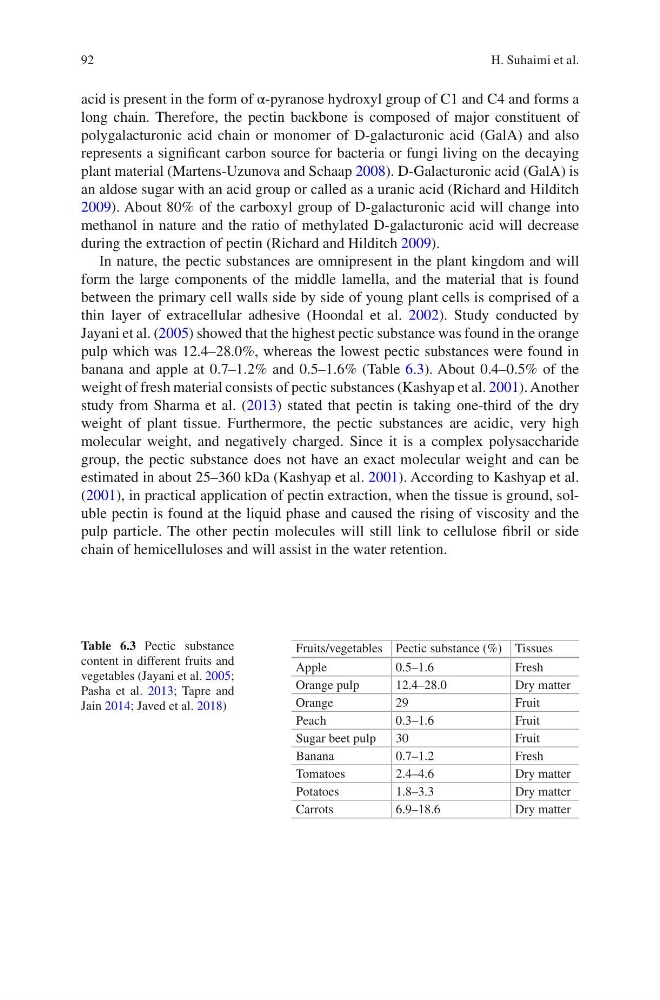
Jayani et al. (2005) showed that the highest pectic substance was found in the orange
pulp which was 12.4–28.0%, whereas the lowest pectic substances were found in
banana and apple at 0.7–1.2% and 0.5–1.6% (Table 6.3). About 0.4–0.5% of the
weight of fresh material consists of pectic substances (Kashyap et al. 2001). Another
study from Sharma et al. (2013) stated that pectin is taking one-third of the dry
weight of plant tissue. Furthermore, the pectic substances are acidic, very high
molecular weight, and negatively charged. Since it is a complex polysaccharide
group, the pectic substance does not have an exact molecular weight and can be
estimated in about 25–360 kDa (Kashyap et al. 2001). According to Kashyap et al.
(2001), in practical application of pectin extraction, when the tissue is ground, soluble pectin is found at the liquid phase and caused the rising of viscosity and the
pulp particle. The other pectin molecules will still link to cellulose fibril or side
chain of hemicelluloses and will assist in the water retention.
Table 6.3 Pectic substance
content in different fruits and
vegetables (Jayani et al. 2005;
Pasha et al. 2013; Tapre and
Jain 2014; Javed et al. 2018)
Fruits/vegetables Pectic substance (%) Tissues
Apple
0.5–1.6
Fresh
Orange pulp
12.4–28.0
Dry matter
Orange
29
Fruit
Peach
0.3–1.6
Fruit
Sugar beet pulp
30
Fruit
Banana
0.7–1.2
Fresh
Tomatoes
2.4–4.6
Dry matter
Potatoes
1.8–3.3
Dry matter
Carrots
6.9–18.6
Dry matter
H. Suhaimi et al.
acid is present in the form of α-pyranose hydroxyl group of C1 and C4 and forms a
long chain. Therefore, the pectin backbone is composed of major constituent of
polygalacturonic acid chain or monomer of D-galacturonic acid (GalA) and also
represents a significant carbon source for bacteria or fungi living on the decaying
plant material (Martens-Uzunova and Schaap 2008). D-Galacturonic acid (GalA) is
an aldose sugar with an acid group or called as a uranic acid (Richard and Hilditch
2009). About 80% of the carboxyl group of D-galacturonic acid will change into
methanol in nature and the ratio of methylated D-galacturonic acid will decrease
during the extraction of pectin (Richard and Hilditch 2009).
In nature, the pectic substances are omnipresent in the plant kingdom and will
form the large components of the middle lamella, and the material that is found
between the primary cell walls side by side of young plant cells is comprised of a
thin layer of extracellular adhesive (Hoondal et al. 2002). Study conducted by
Jayani et al. (2005) showed that the highest pectic substance was found in the orange
pulp which was 12.4–28.0%, whereas the lowest pectic substances were found in
banana and apple at 0.7–1.2% and 0.5–1.6% (Table 6.3). About 0.4–0.5% of the
weight of fresh material consists of pectic substances (Kashyap et al. 2001). Another
study from Sharma et al. (2013) stated that pectin is taking one-third of the dry
weight of plant tissue. Furthermore, the pectic substances are acidic, very high
molecular weight, and negatively charged. Since it is a complex polysaccharide
group, the pectic substance does not have an exact molecular weight and can be
estimated in about 25–360 kDa (Kashyap et al. 2001). According to Kashyap et al.
(2001), in practical application of pectin extraction, when the tissue is ground, soluble pectin is found at the liquid phase and caused the rising of viscosity and the
pulp particle. The other pectin molecules will still link to cellulose fibril or side
chain of hemicelluloses and will assist in the water retention.
Table 6.3 Pectic substance
content in different fruits and
vegetables (Jayani et al. 2005;
Pasha et al. 2013; Tapre and
Jain 2014; Javed et al. 2018)
Fruits/vegetables Pectic substance (%) Tissues
Apple
0.5–1.6
Fresh
Orange pulp
12.4–28.0
Dry matter
Orange
29
Fruit
Peach
0.3–1.6
Fruit
Sugar beet pulp
30
Fruit
Banana
0.7–1.2
Fresh
Tomatoes
2.4–4.6
Dry matter
Potatoes
1.8–3.3
Dry matter
Carrots
6.9–18.6
Dry matter
H. Suhaimi et al.