

93
6.3 Pectinase Production by Microbial Cell
6.3.1 Fungal Bioprocessing for Pectinase Production
Over the centuries, biotechnology is emerging with respect to the processes that
involved living organisms. A study by Wainwright (1992) revealed the potential and
capability of true filamentous fungi with different species in the processes such as
production of antibiotics, organic acid, enzyme, traditional food, and others. The
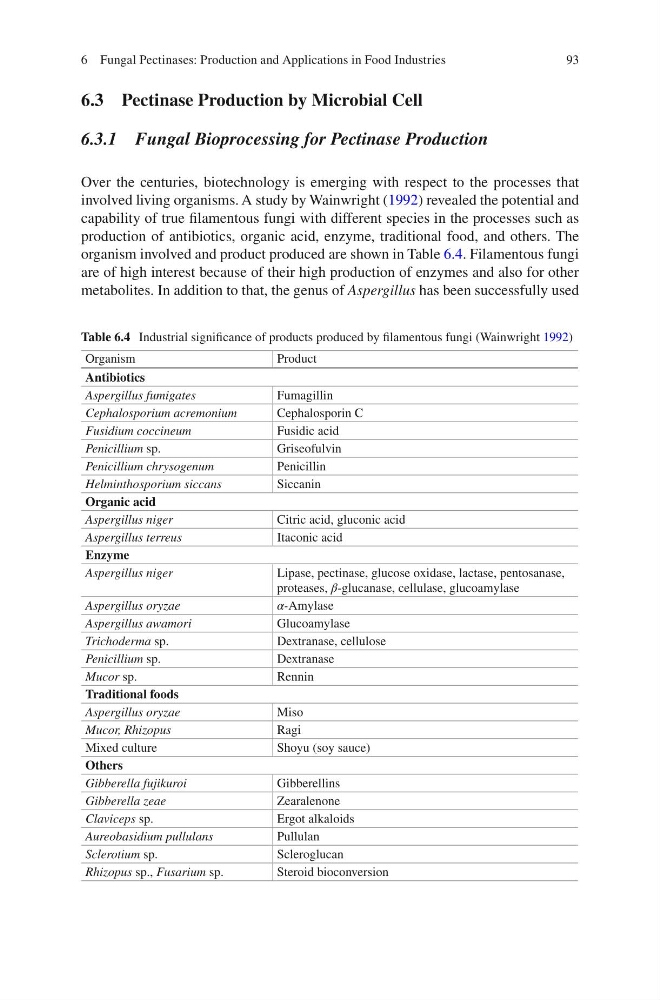
organism involved and product produced are shown in Table 6.4. Filamentous fungi
are of high interest because of their high production of enzymes and also for other
metabolites. In addition to that, the genus of Aspergillus has been successfully used
Table 6.4 Industrial significance of products produced by filamentous fungi (Wainwright 1992)
Organism
Product
Antibiotics
Aspergillus fumigates
Fumagillin
Cephalosporium acremonium
Cephalosporin C
Fusidium coccineum
Fusidic acid
Penicillium sp.
Griseofulvin
Penicillium chrysogenum
Penicillin
Helminthosporium siccans
Siccanin
Organic acid
Aspergillus niger
Citric acid, gluconic acid
Aspergillus terreus
Itaconic acid
Enzyme
Aspergillus niger
Lipase, pectinase, glucose oxidase, lactase, pentosanase,
proteases, β-glucanase, cellulase, glucoamylase
Aspergillus oryzae
α-Amylase
Aspergillus awamori
Glucoamylase
Trichoderma sp.
Dextranase, cellulose
Penicillium sp.
Dextranase
Mucor sp.
Rennin
Traditional foods
Aspergillus oryzae
Miso
Mucor, Rhizopus
Ragi
Mixed culture
Shoyu (soy sauce)
Others
Gibberella fujikuroi
Gibberellins
Gibberella zeae
Zearalenone
Claviceps sp.
Ergot alkaloids
Aureobasidium pullulans
Pullulan
Sclerotium sp.
Scleroglucan
Rhizopus sp., Fusarium sp.
Steroid bioconversion
6 Fungal Pectinases: Production and Applications in Food Industries
6.3 Pectinase Production by Microbial Cell
6.3.1 Fungal Bioprocessing for Pectinase Production
Over the centuries, biotechnology is emerging with respect to the processes that
involved living organisms. A study by Wainwright (1992) revealed the potential and
capability of true filamentous fungi with different species in the processes such as
production of antibiotics, organic acid, enzyme, traditional food, and others. The
organism involved and product produced are shown in Table 6.4. Filamentous fungi
are of high interest because of their high production of enzymes and also for other
metabolites. In addition to that, the genus of Aspergillus has been successfully used
Table 6.4 Industrial significance of products produced by filamentous fungi (Wainwright 1992)
Organism
Product
Antibiotics
Aspergillus fumigates
Fumagillin
Cephalosporium acremonium
Cephalosporin C
Fusidium coccineum
Fusidic acid
Penicillium sp.
Griseofulvin
Penicillium chrysogenum
Penicillin
Helminthosporium siccans
Siccanin
Organic acid
Aspergillus niger
Citric acid, gluconic acid
Aspergillus terreus
Itaconic acid
Enzyme
Aspergillus niger
Lipase, pectinase, glucose oxidase, lactase, pentosanase,
proteases, β-glucanase, cellulase, glucoamylase
Aspergillus oryzae
α-Amylase
Aspergillus awamori
Glucoamylase
Trichoderma sp.
Dextranase, cellulose
Penicillium sp.
Dextranase
Mucor sp.
Rennin
Traditional foods
Aspergillus oryzae
Miso
Mucor, Rhizopus
Ragi
Mixed culture
Shoyu (soy sauce)
Others
Gibberella fujikuroi
Gibberellins
Gibberella zeae
Zearalenone
Claviceps sp.
Ergot alkaloids
Aureobasidium pullulans
Pullulan
Sclerotium sp.
Scleroglucan
Rhizopus sp., Fusarium sp.
Steroid bioconversion
6 Fungal Pectinases: Production and Applications in Food Industries