

• How many genes does this mutation affect?
• Where did I fail to collect sequence coverage?
• Is my favorite feature significantly correlated with some other feature?
To ensure a safe handling with the program the following tutorial is recommended:
http://quinlanlab.org/tutorials/bedtools/bedtools.html.
7.2.8 BedGraph
The BedGraph (*.bg) format is based on the BED format with a few differences and allows
display of continuous-valued data in track format. This display type is useful for probability
scores and transcriptome data. The data are preceded by a track definition line, which adds
a number of options for controlling the default display of this track. The fourth column of
this file format provides information about regions of the genome with sufficient read
coverage [9]. Thus, after converting this format into a bigWig (a binary indexed version) it
is suitable for visualizing sequencing data in the UCSC Genome Browser (https://genome.
ucsc.edu/).
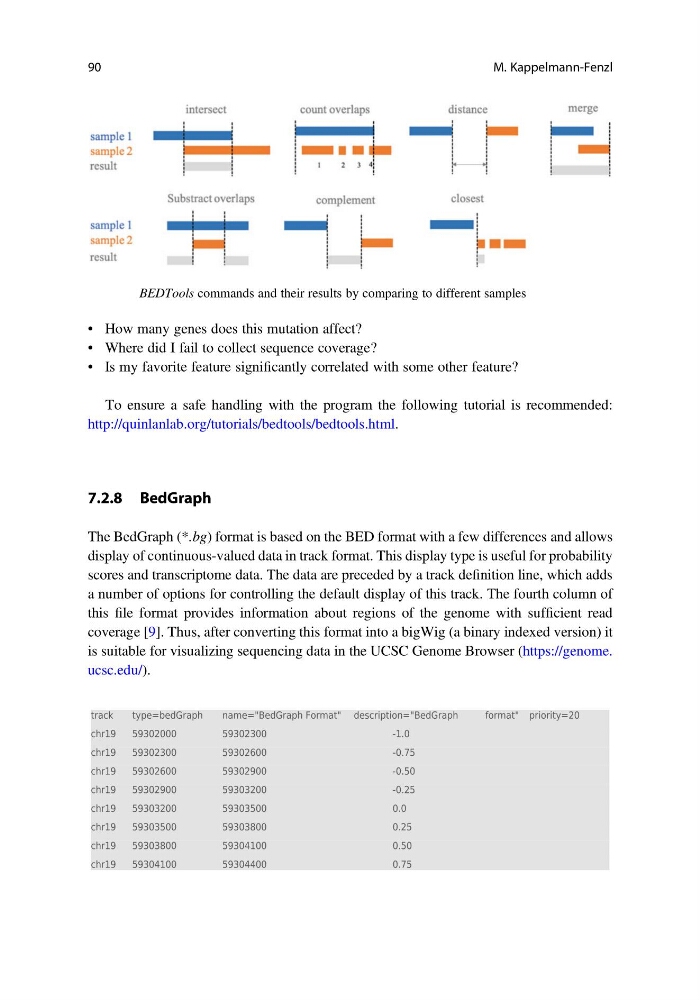
Fig. 7.4 BEDTools commands and their results by comparing to different samples
90
M. Kappelmann-Fenzl
• Where did I fail to collect sequence coverage?
• Is my favorite feature significantly correlated with some other feature?
To ensure a safe handling with the program the following tutorial is recommended:
http://quinlanlab.org/tutorials/bedtools/bedtools.html.
7.2.8 BedGraph
The BedGraph (*.bg) format is based on the BED format with a few differences and allows
display of continuous-valued data in track format. This display type is useful for probability
scores and transcriptome data. The data are preceded by a track definition line, which adds
a number of options for controlling the default display of this track. The fourth column of
this file format provides information about regions of the genome with sufficient read
coverage [9]. Thus, after converting this format into a bigWig (a binary indexed version) it
is suitable for visualizing sequencing data in the UCSC Genome Browser (https://genome.
ucsc.edu/).
Fig. 7.4 BEDTools commands and their results by comparing to different samples
90
M. Kappelmann-Fenzl