

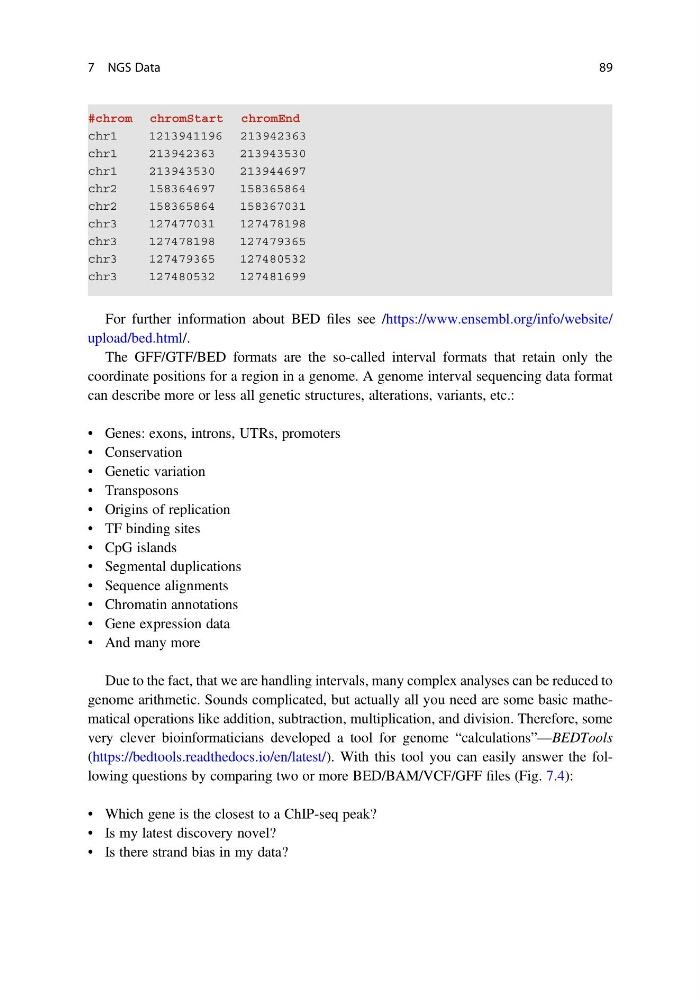
For further information about BED files see /https://www.ensembl.org/info/website/
upload/bed.html/.
The GFF/GTF/BED formats are the so-called interval formats that retain only the
coordinate positions for a region in a genome. A genome interval sequencing data format
can describe more or less all genetic structures, alterations, variants, etc.:
• Genes: exons, introns, UTRs, promoters
• Conservation
• Genetic variation
• Transposons
• Origins of replication
• TF binding sites
• CpG islands
• Segmental duplications
• Sequence alignments
• Chromatin annotations
• Gene expression data
• And many more
Due to the fact, that we are handling intervals, many complex analyses can be reduced to
genome arithmetic. Sounds complicated, but actually all you need are some basic mathematical operations like addition, subtraction, multiplication, and division. Therefore, some
very clever bioinformaticians developed a tool for genome “calculations”—BEDTools
(https://bedtools.readthedocs.io/en/latest/). With this tool you can easily answer the following questions by comparing two or more BED/BAM/VCF/GFF files (Fig. 7.4):
• Which gene is the closest to a ChIP-seq peak?
• Is my latest discovery novel?
• Is there strand bias in my data?
7 NGS Data
89
upload/bed.html/.
The GFF/GTF/BED formats are the so-called interval formats that retain only the
coordinate positions for a region in a genome. A genome interval sequencing data format
can describe more or less all genetic structures, alterations, variants, etc.:
• Genes: exons, introns, UTRs, promoters
• Conservation
• Genetic variation
• Transposons
• Origins of replication
• TF binding sites
• CpG islands
• Segmental duplications
• Sequence alignments
• Chromatin annotations
• Gene expression data
• And many more
Due to the fact, that we are handling intervals, many complex analyses can be reduced to
genome arithmetic. Sounds complicated, but actually all you need are some basic mathematical operations like addition, subtraction, multiplication, and division. Therefore, some
very clever bioinformaticians developed a tool for genome “calculations”—BEDTools
(https://bedtools.readthedocs.io/en/latest/). With this tool you can easily answer the following questions by comparing two or more BED/BAM/VCF/GFF files (Fig. 7.4):
• Which gene is the closest to a ChIP-seq peak?
• Is my latest discovery novel?
• Is there strand bias in my data?
7 NGS Data
89