

Take Home Message
• The term NGS is used to summarize second- and third-generation sequencing
methods.
• Basically, a distinction can be made between first-generation sequencing (Sanger
sequencing), second-generation sequencing (massively parallel sequencing), and
third-generation sequencing (single-molecule sequencing).
• With regard to sequencing technologies, one also differentiates between shortand long-read sequencing.
• The different NGS technologies entail different preprocessing and analysis steps
and are applied depending on the scientific or clinical question to the
resulting data.
• Each NGS technology can be characterized by its input template, read length,
error rate, sequencing scheme, visualization method, sequencing principle, and
amount of data output.
Further Reading
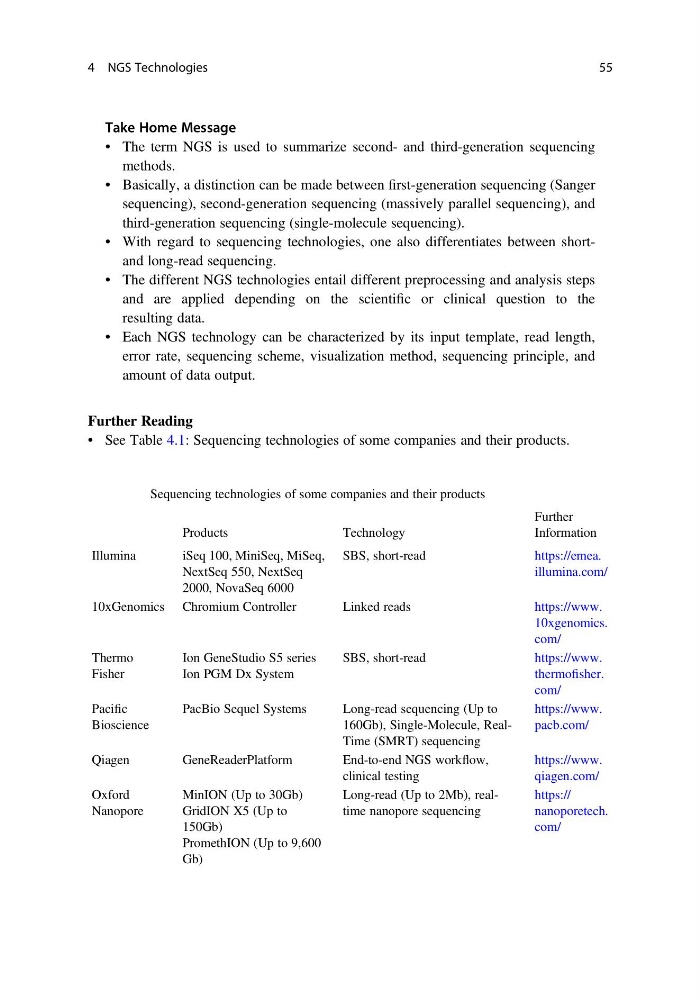
• See Table 4.1: Sequencing technologies of some companies and their products.
Table 4.1 Sequencing technologies of some companies and their products
Products
Technology
Further
Information
Illumina
iSeq 100, MiniSeq, MiSeq,
NextSeq 550, NextSeq
2000, NovaSeq 6000
SBS, short-read
https://emea.
illumina.com/
10xGenomics Chromium Controller
Linked reads
https://www.
10xgenomics.
com/
Thermo
Fisher
Ion GeneStudio S5 series
Ion PGM Dx System
SBS, short-read
https://www.
thermofisher.
com/
Pacific
Bioscience
PacBio Sequel Systems
Long-read sequencing (Up to
160Gb), Single-Molecule, RealTime (SMRT) sequencing
https://www.
pacb.com/
Qiagen
GeneReaderPlatform
End-to-end NGS workflow,
clinical testing
https://www.
qiagen.com/
Oxford
Nanopore
MinION (Up to 30Gb)
GridION X5 (Up to
150Gb)
PromethION (Up to 9,600
Gb)
Long-read (Up to 2Mb), realtime nanopore sequencing
https://
nanoporetech.
com/
4 NGS Technologies
55
• The term NGS is used to summarize second- and third-generation sequencing
methods.
• Basically, a distinction can be made between first-generation sequencing (Sanger
sequencing), second-generation sequencing (massively parallel sequencing), and
third-generation sequencing (single-molecule sequencing).
• With regard to sequencing technologies, one also differentiates between shortand long-read sequencing.
• The different NGS technologies entail different preprocessing and analysis steps
and are applied depending on the scientific or clinical question to the
resulting data.
• Each NGS technology can be characterized by its input template, read length,
error rate, sequencing scheme, visualization method, sequencing principle, and
amount of data output.
Further Reading
• See Table 4.1: Sequencing technologies of some companies and their products.
Table 4.1 Sequencing technologies of some companies and their products
Products
Technology
Further
Information
Illumina
iSeq 100, MiniSeq, MiSeq,
NextSeq 550, NextSeq
2000, NovaSeq 6000
SBS, short-read
https://emea.
illumina.com/
10xGenomics Chromium Controller
Linked reads
https://www.
10xgenomics.
com/
Thermo
Fisher
Ion GeneStudio S5 series
Ion PGM Dx System
SBS, short-read
https://www.
thermofisher.
com/
Pacific
Bioscience
PacBio Sequel Systems
Long-read sequencing (Up to
160Gb), Single-Molecule, RealTime (SMRT) sequencing
https://www.
pacb.com/
Qiagen
GeneReaderPlatform
End-to-end NGS workflow,
clinical testing
https://www.
qiagen.com/
Oxford
Nanopore
MinION (Up to 30Gb)
GridION X5 (Up to
150Gb)
PromethION (Up to 9,600
Gb)
Long-read (Up to 2Mb), realtime nanopore sequencing
https://
nanoporetech.
com/
4 NGS Technologies
55