

single-layer graphene membrane, however, up to this point (2020) the protein channels are
superior to the solid-state channels [8].
As mentioned earlier, biomolecules that pass through the pore generate the signal by
partially blocking the flow of ions, which can then be translated into the sequence and
epigenetic modifications. Nevertheless, ions lining up at the membrane, together with the
counterions on the opposite site of the membrane, also contribute to the signal, generating
noise. These noise fluctuations increase with bandwidths, which limits the time resolution
in experiments. Apart from shorter measurement times, a common way to compensate the
noise is achieved by using analog or digital low-pass filters. Still, the generation of noise,
introducing error-prone data, might be the biggest struggle Oxford Nanopore Technology
has yet to overcome.
Big advantages of this sequencing technology compared to others on the market are its
portability and price tag. Oxford Nanopores’ smallest device, the MinION is controlled and
powered by an USB cable and is just slightly bigger than a regular USB stick. Depending
on the experiment (DNA or RNA), Oxford Nanopore devices do not need an amplification
step (PCR) prior to the sequencing. Theoretically, the only limitation in sequencing length
is the time and therefore the induced noise. So far, the maximum of usable read length is
around 100 kilobases [9]. However, longer reads result in less accurate data [10].
4.6
NGS Technologies: An Overview
A more detailed overview of the major NGS platforms and their general properties [10] are
listed in the Table in the Appendix section (Table 13.1: Major NGS platforms and their
general properties.)
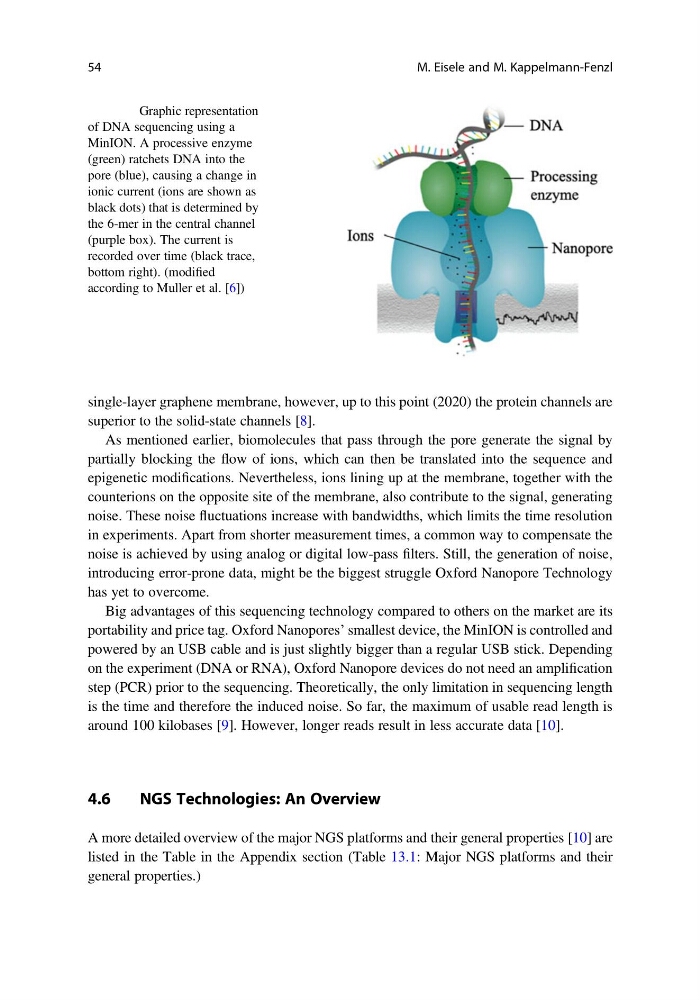
Fig. 4.4 Graphic representation
of DNA sequencing using a
MinION. A processive enzyme
(green) ratchets DNA into the
pore (blue), causing a change in
ionic current (ions are shown as
black dots) that is determined by
the 6-mer in the central channel
(purple box). The current is
recorded over time (black trace,
bottom right). (modified
according to Muller et al. [6])
54
M. Eisele and M. Kappelmann-Fenzl
superior to the solid-state channels [8].
As mentioned earlier, biomolecules that pass through the pore generate the signal by
partially blocking the flow of ions, which can then be translated into the sequence and
epigenetic modifications. Nevertheless, ions lining up at the membrane, together with the
counterions on the opposite site of the membrane, also contribute to the signal, generating
noise. These noise fluctuations increase with bandwidths, which limits the time resolution
in experiments. Apart from shorter measurement times, a common way to compensate the
noise is achieved by using analog or digital low-pass filters. Still, the generation of noise,
introducing error-prone data, might be the biggest struggle Oxford Nanopore Technology
has yet to overcome.
Big advantages of this sequencing technology compared to others on the market are its
portability and price tag. Oxford Nanopores’ smallest device, the MinION is controlled and
powered by an USB cable and is just slightly bigger than a regular USB stick. Depending
on the experiment (DNA or RNA), Oxford Nanopore devices do not need an amplification
step (PCR) prior to the sequencing. Theoretically, the only limitation in sequencing length
is the time and therefore the induced noise. So far, the maximum of usable read length is
around 100 kilobases [9]. However, longer reads result in less accurate data [10].
4.6
NGS Technologies: An Overview
A more detailed overview of the major NGS platforms and their general properties [10] are
listed in the Table in the Appendix section (Table 13.1: Major NGS platforms and their
general properties.)
Fig. 4.4 Graphic representation
of DNA sequencing using a
MinION. A processive enzyme
(green) ratchets DNA into the
pore (blue), causing a change in
ionic current (ions are shown as
black dots) that is determined by
the 6-mer in the central channel
(purple box). The current is
recorded over time (black trace,
bottom right). (modified
according to Muller et al. [6])
54
M. Eisele and M. Kappelmann-Fenzl