

Answer to Question 2
Tumor suppressors are characterized by an evenly distributed pattern of inactivating
mutations, so their mutational pattern would more or less look flat. However, the key
here is that a large fraction of mutations tending to be stop-gain, frameshift-inducing, or
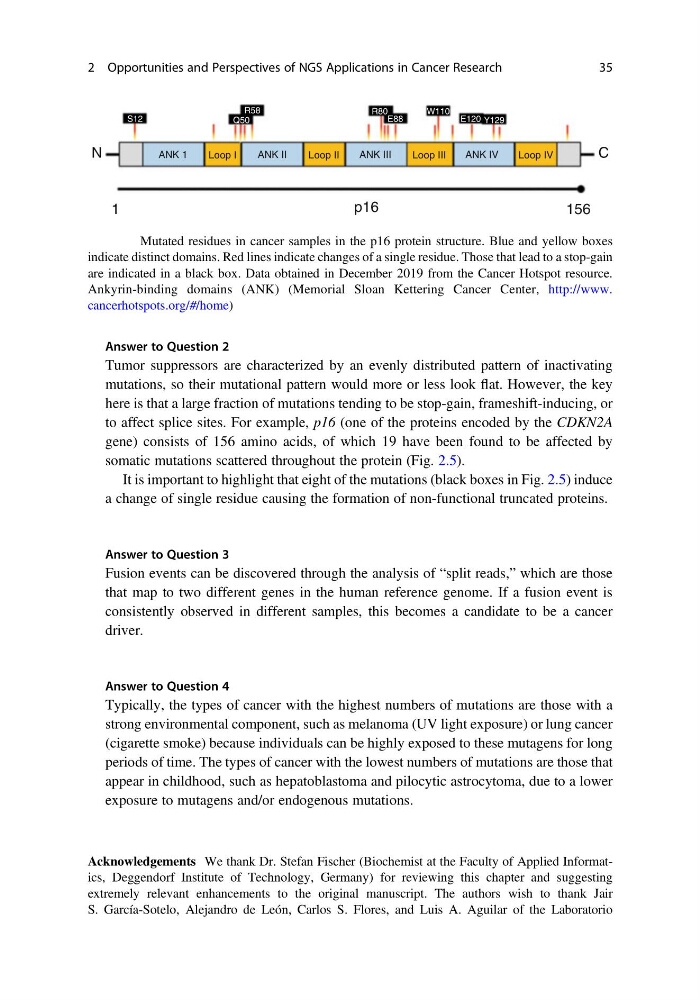
to affect splice sites. For example, p16 (one of the proteins encoded by the CDKN2A
gene) consists of 156 amino acids, of which 19 have been found to be affected by
somatic mutations scattered throughout the protein (Fig. 2.5).
It is important to highlight that eight of the mutations (black boxes in Fig. 2.5) induce
a change of single residue causing the formation of non-functional truncated proteins.
Answer to Question 3
Fusion events can be discovered through the analysis of “split reads,” which are those
that map to two different genes in the human reference genome. If a fusion event is
consistently observed in different samples, this becomes a candidate to be a cancer
driver.
Answer to Question 4
Typically, the types of cancer with the highest numbers of mutations are those with a
strong environmental component, such as melanoma (UV light exposure) or lung cancer
(cigarette smoke) because individuals can be highly exposed to these mutagens for long
periods of time. The types of cancer with the lowest numbers of mutations are those that
appear in childhood, such as hepatoblastoma and pilocytic astrocytoma, due to a lower
exposure to mutagens and/or endogenous mutations.
Acknowledgements We thank Dr. Stefan Fischer (Biochemist at the Faculty of Applied Informatics, Deggendorf Institute of Technology, Germany) for reviewing this chapter and suggesting
extremely relevant enhancements to the original manuscript. The authors wish to thank Jair
S. García-Sotelo, Alejandro de León, Carlos S. Flores, and Luis A. Aguilar of the Laboratorio
S12
Q50
R58
R80
E88
W110
E120 Y129
Loop IV
Loop III
Loop II
Loop I
ANK IV
ANK III
ANK II
C
N
1
156
p16
ANK 1
Fig. 2.5 Mutated residues in cancer samples in the p16 protein structure. Blue and yellow boxes
indicate distinct domains. Red lines indicate changes of a single residue. Those that lead to a stop-gain
are indicated in a black box. Data obtained in December 2019 from the Cancer Hotspot resource.
Ankyrin-binding domains (ANK) (Memorial Sloan Kettering Cancer Center, http://www.
cancerhotspots.org/#/home)
2 Opportunities and Perspectives of NGS Applications in Cancer Research
35
Tumor suppressors are characterized by an evenly distributed pattern of inactivating
mutations, so their mutational pattern would more or less look flat. However, the key
here is that a large fraction of mutations tending to be stop-gain, frameshift-inducing, or
to affect splice sites. For example, p16 (one of the proteins encoded by the CDKN2A
gene) consists of 156 amino acids, of which 19 have been found to be affected by
somatic mutations scattered throughout the protein (Fig. 2.5).
It is important to highlight that eight of the mutations (black boxes in Fig. 2.5) induce
a change of single residue causing the formation of non-functional truncated proteins.
Answer to Question 3
Fusion events can be discovered through the analysis of “split reads,” which are those
that map to two different genes in the human reference genome. If a fusion event is
consistently observed in different samples, this becomes a candidate to be a cancer
driver.
Answer to Question 4
Typically, the types of cancer with the highest numbers of mutations are those with a
strong environmental component, such as melanoma (UV light exposure) or lung cancer
(cigarette smoke) because individuals can be highly exposed to these mutagens for long
periods of time. The types of cancer with the lowest numbers of mutations are those that
appear in childhood, such as hepatoblastoma and pilocytic astrocytoma, due to a lower
exposure to mutagens and/or endogenous mutations.
Acknowledgements We thank Dr. Stefan Fischer (Biochemist at the Faculty of Applied Informatics, Deggendorf Institute of Technology, Germany) for reviewing this chapter and suggesting
extremely relevant enhancements to the original manuscript. The authors wish to thank Jair
S. García-Sotelo, Alejandro de León, Carlos S. Flores, and Luis A. Aguilar of the Laboratorio
S12
Q50
R58
R80
E88
W110
E120 Y129
Loop IV
Loop III
Loop II
Loop I
ANK IV
ANK III
ANK II
C
N
1
156
p16
ANK 1
Fig. 2.5 Mutated residues in cancer samples in the p16 protein structure. Blue and yellow boxes
indicate distinct domains. Red lines indicate changes of a single residue. Those that lead to a stop-gain
are indicated in a black box. Data obtained in December 2019 from the Cancer Hotspot resource.
Ankyrin-binding domains (ANK) (Memorial Sloan Kettering Cancer Center, http://www.
cancerhotspots.org/#/home)
2 Opportunities and Perspectives of NGS Applications in Cancer Research
35