

• Genome sequencing is becoming paramount in cancer treatment, allowing the
identification of druggable targets and biomarkers for immunotherapy response
and aiding the development of novel treatment strategies.
Answer to Question 1
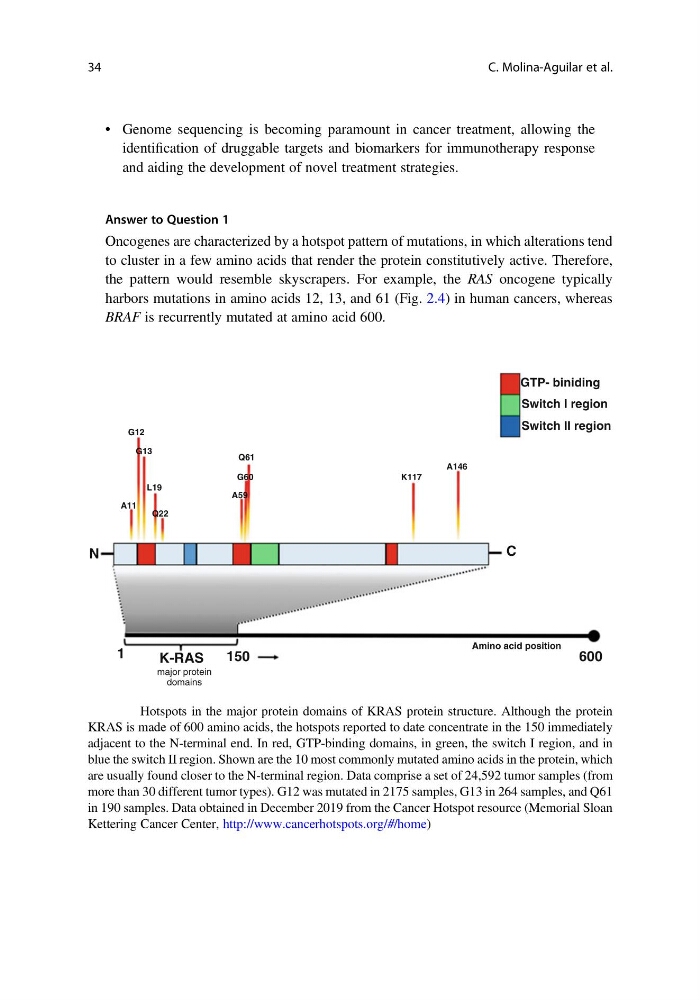
Oncogenes are characterized by a hotspot pattern of mutations, in which alterations tend
to cluster in a few amino acids that render the protein constitutively active. Therefore,
the pattern would resemble skyscrapers. For example, the RAS oncogene typically
harbors mutations in amino acids 12, 13, and 61 (Fig. 2.4) in human cancers, whereas
BRAF is recurrently mutated at amino acid 600.
G12
G13
L19
A11
Q22
A59
G60
Q61
K117
A146
C
1
K-RAS
150
600
Amino acid position
major protein
domains
GTP- biniding
Switch I region
Switch II region
N
Fig. 2.4 Hotspots in the major protein domains of KRAS protein structure. Although the protein
KRAS is made of 600 amino acids, the hotspots reported to date concentrate in the 150 immediately
adjacent to the N-terminal end. In red, GTP-binding domains, in green, the switch I region, and in
blue the switch II region. Shown are the 10 most commonly mutated amino acids in the protein, which
are usually found closer to the N-terminal region. Data comprise a set of 24,592 tumor samples (from
more than 30 different tumor types). G12 was mutated in 2175 samples, G13 in 264 samples, and Q61
in 190 samples. Data obtained in December 2019 from the Cancer Hotspot resource (Memorial Sloan
Kettering Cancer Center, http://www.cancerhotspots.org/#/home)
34
C. Molina-Aguilar et al.
identification of druggable targets and biomarkers for immunotherapy response
and aiding the development of novel treatment strategies.
Answer to Question 1
Oncogenes are characterized by a hotspot pattern of mutations, in which alterations tend
to cluster in a few amino acids that render the protein constitutively active. Therefore,
the pattern would resemble skyscrapers. For example, the RAS oncogene typically
harbors mutations in amino acids 12, 13, and 61 (Fig. 2.4) in human cancers, whereas
BRAF is recurrently mutated at amino acid 600.
G12
G13
L19
A11
Q22
A59
G60
Q61
K117
A146
C
1
K-RAS
150
600
Amino acid position
major protein
domains
GTP- biniding
Switch I region
Switch II region
N
Fig. 2.4 Hotspots in the major protein domains of KRAS protein structure. Although the protein
KRAS is made of 600 amino acids, the hotspots reported to date concentrate in the 150 immediately
adjacent to the N-terminal end. In red, GTP-binding domains, in green, the switch I region, and in
blue the switch II region. Shown are the 10 most commonly mutated amino acids in the protein, which
are usually found closer to the N-terminal region. Data comprise a set of 24,592 tumor samples (from
more than 30 different tumor types). G12 was mutated in 2175 samples, G13 in 264 samples, and Q61
in 190 samples. Data obtained in December 2019 from the Cancer Hotspot resource (Memorial Sloan
Kettering Cancer Center, http://www.cancerhotspots.org/#/home)
34
C. Molina-Aguilar et al.