

benzoyl chloride
64
b
benzoyl chloride See benzenecarbonyl chloride.
benzoylecgonine (BZ) A primary
metabolite of cocaine, used in drug
testing. It can be detected in the
urine up to 48 hours after taking cocaine. BZ is tested for by immunoassay or by gas chromatography/mass
spectrometry.
benzoyl group See benzenecarbonyl group.
benzpyrene A pale yellow solid,
C 20 H 12 , m.p. 179°C, whose molecules
consist of Üve fused benzene rings. It
occurs in tars from coal and tobacco
smoke and is a *carcinogen.
benzvalene A valence isomer of
benzene, C 6 H 6 , with a bridged structure.
benzyl alcohol See phenylmethanol.
benzylamine (α-aminotoluene,
phenylmethylamine) A colourless liquid, C 6 H 5 CH 2 NH 2 ; r.d. 0.981; b.p.
185°C. It behaves in the same way as
primary aliphatic amines.
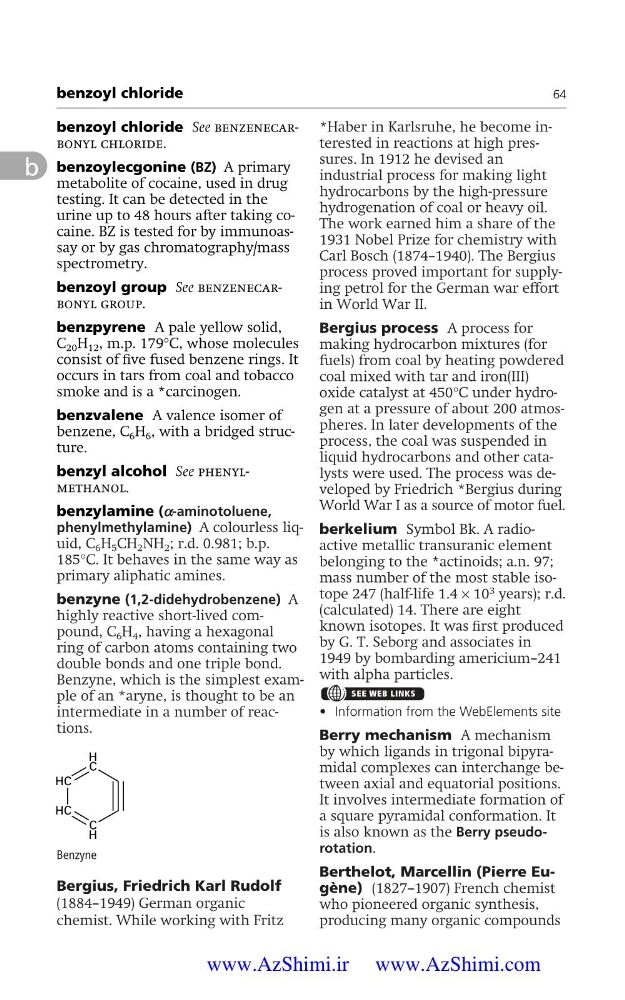
benzyne (1,2-didehydrobenzene) A
highly reactive short-lived compound, C 6 H 4 , having a hexagonal
ring of carbon atoms containing two
double bonds and one triple bond.
Benzyne, which is the simplest example of an *aryne, is thought to be an
intermediate in a number of reactions.
C
H
C
H
C
H
C
H
Benzyne
Bergius, Friedrich Karl Rudolf
(1884–1949) German organic
chemist. While working with Fritz
*Haber in Karlsruhe, he become interested in reactions at high pressures. In 1912 he devised an
industrial process for making light
hydrocarbons by the high-pressure
hydrogenation of coal or heavy oil.
The work earned him a share of the
1931 Nobel Prize for chemistry with
Carl Bosch (1874–1940). The Bergius
process proved important for supplying petrol for the German war effort
in World War II.
Bergius process A process for
making hydrocarbon mixtures (for
fuels) from coal by heating powdered
coal mixed with tar and iron(III)
oxide catalyst at 450°C under hydrogen at a pressure of about 200 atmospheres. In later developments of the
process, the coal was suspended in
liquid hydrocarbons and other catalysts were used. The process was developed by Friedrich *Bergius during
World War I as a source of motor fuel.
berkelium Symbol Bk. A radioactive metallic transuranic element
belonging to the *actinoids; a.n. 97;
mass number of the most stable isotope 247 (half-life 1.4 × 10
3 years); r.d.
(calculated) 14. There are eight
known isotopes. It was Ürst produced
by G. T. Seborg and associates in
1949 by bombarding americium–241
with alpha particles.
A
• Information from the WebElements site
Berry mechanism A mechanism
by which ligands in trigonal bipyramidal complexes can interchange between axial and equatorial positions.
It involves intermediate formation of
a square pyramidal conformation. It
is also known as the Berry pseudorotation.
Berthelot, Marcellin (Pierre Eugène) (1827–1907) French chemist
who pioneered organic synthesis,
producing many organic compounds
www.AzShimi.ir www.AzShimi.com
64
b
benzoyl chloride See benzenecarbonyl chloride.
benzoylecgonine (BZ) A primary
metabolite of cocaine, used in drug
testing. It can be detected in the
urine up to 48 hours after taking cocaine. BZ is tested for by immunoassay or by gas chromatography/mass
spectrometry.
benzoyl group See benzenecarbonyl group.
benzpyrene A pale yellow solid,
C 20 H 12 , m.p. 179°C, whose molecules
consist of Üve fused benzene rings. It
occurs in tars from coal and tobacco
smoke and is a *carcinogen.
benzvalene A valence isomer of
benzene, C 6 H 6 , with a bridged structure.
benzyl alcohol See phenylmethanol.
benzylamine (α-aminotoluene,
phenylmethylamine) A colourless liquid, C 6 H 5 CH 2 NH 2 ; r.d. 0.981; b.p.
185°C. It behaves in the same way as
primary aliphatic amines.
benzyne (1,2-didehydrobenzene) A
highly reactive short-lived compound, C 6 H 4 , having a hexagonal
ring of carbon atoms containing two
double bonds and one triple bond.
Benzyne, which is the simplest example of an *aryne, is thought to be an
intermediate in a number of reactions.
C
H
C
H
C
H
C
H
Benzyne
Bergius, Friedrich Karl Rudolf
(1884–1949) German organic
chemist. While working with Fritz
*Haber in Karlsruhe, he become interested in reactions at high pressures. In 1912 he devised an
industrial process for making light
hydrocarbons by the high-pressure
hydrogenation of coal or heavy oil.
The work earned him a share of the
1931 Nobel Prize for chemistry with
Carl Bosch (1874–1940). The Bergius
process proved important for supplying petrol for the German war effort
in World War II.
Bergius process A process for
making hydrocarbon mixtures (for
fuels) from coal by heating powdered
coal mixed with tar and iron(III)
oxide catalyst at 450°C under hydrogen at a pressure of about 200 atmospheres. In later developments of the
process, the coal was suspended in
liquid hydrocarbons and other catalysts were used. The process was developed by Friedrich *Bergius during
World War I as a source of motor fuel.
berkelium Symbol Bk. A radioactive metallic transuranic element
belonging to the *actinoids; a.n. 97;
mass number of the most stable isotope 247 (half-life 1.4 × 10
3 years); r.d.
(calculated) 14. There are eight
known isotopes. It was Ürst produced
by G. T. Seborg and associates in
1949 by bombarding americium–241
with alpha particles.
A
• Information from the WebElements site
Berry mechanism A mechanism
by which ligands in trigonal bipyramidal complexes can interchange between axial and equatorial positions.
It involves intermediate formation of
a square pyramidal conformation. It
is also known as the Berry pseudorotation.
Berthelot, Marcellin (Pierre Eugène) (1827–1907) French chemist
who pioneered organic synthesis,
producing many organic compounds
www.AzShimi.ir www.AzShimi.com