

63
benzoylation
b
benzilic acid rearrangement An
organic rearrangement reaction in
which benzil (1,2-diphenylethan-1,2dione) is treated with hydroxide and
then acid to give benzilic acid (2-hydroxy-2,2-diphenylethanoic acid):
C 6 H 5 .CO.CO.C 6 H 5 →
(C 6 H 5 ) 2 C(OH).COOH
In the reaction a phenyl group
(C 6 H 5 –) migrates from one carbon
atom to another. The reaction was
discovered in 1828 by Justus von
*Liebig; it was the Ürst rearrangement reaction to be described.
benzoate See benzenecarboxylate.
benzodiazepines A group of related psychotic drugs that affect the
central nervous system. They are
used medically in the treatment of
anxiety, insomnia, convulsions, and
alcohol withdrawal. All are addictive
and available only as prescription
drugs in the UK. Common examples
are *diazepam (Valium) and *Ûunitrazepam (Rohypnol).
benzoic acid See benzenecarboxylic acid.
benzoin A colourless crystalline
compound, C 6 H 5 CHOHCOC 6 H 5 ; m.p.
137°C. It is a condensation product of
*benzenecarbaldehyde (benzaldehyde), made by the action of sodium
cyanide on benzenecarbaldehyde in
alcoholic solution. It also occurs naturally as the resin of a tropical tree. It
is both a secondary alcohol and a ketone, and gives reactions characteristic of both types of compound.
benzopyrene A crystalline aromatic hydrocarbon, C 20 H 12 ; m.p.
179°C. It is found in coal tar and is
highly carcinogenic.
1
2
3
4
5
6
7
8
9
10
11
12
2a
5a
7a
8a
12a
Benzopyrene
1
1
1*
1
1*
Benzilic acid rearrangement
1
1
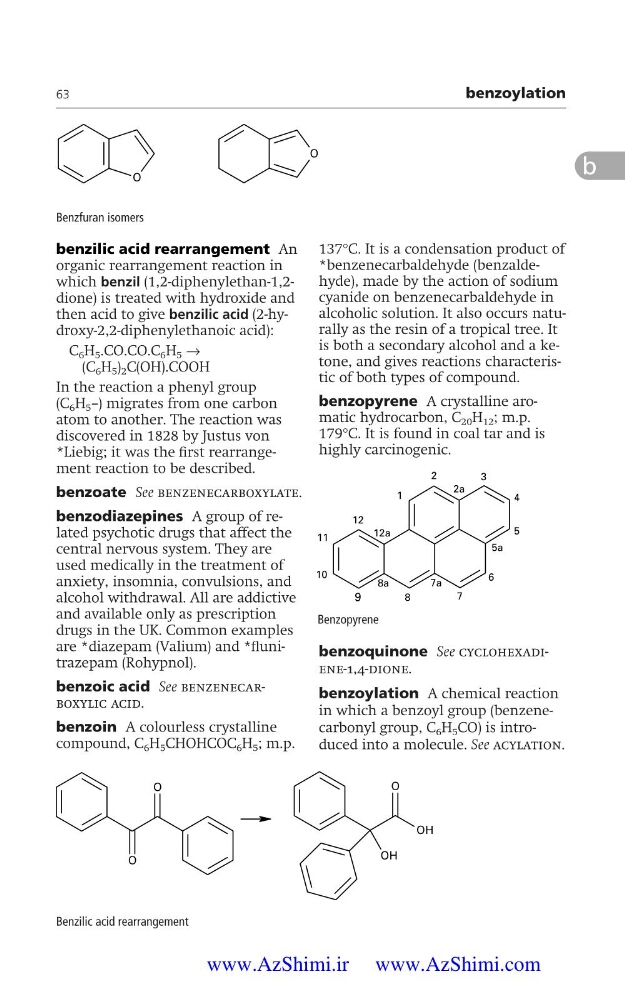
Benzfuran isomers
benzoquinone See cyclohexadiene-1,4-dione.
benzoylation A chemical reaction
in which a benzoyl group (benzenecarbonyl group, C 6 H 5 CO) is introduced into a molecule. See acylation.
www.AzShimi.ir www.AzShimi.com
benzoylation
b
benzilic acid rearrangement An
organic rearrangement reaction in
which benzil (1,2-diphenylethan-1,2dione) is treated with hydroxide and
then acid to give benzilic acid (2-hydroxy-2,2-diphenylethanoic acid):
C 6 H 5 .CO.CO.C 6 H 5 →
(C 6 H 5 ) 2 C(OH).COOH
In the reaction a phenyl group
(C 6 H 5 –) migrates from one carbon
atom to another. The reaction was
discovered in 1828 by Justus von
*Liebig; it was the Ürst rearrangement reaction to be described.
benzoate See benzenecarboxylate.
benzodiazepines A group of related psychotic drugs that affect the
central nervous system. They are
used medically in the treatment of
anxiety, insomnia, convulsions, and
alcohol withdrawal. All are addictive
and available only as prescription
drugs in the UK. Common examples
are *diazepam (Valium) and *Ûunitrazepam (Rohypnol).
benzoic acid See benzenecarboxylic acid.
benzoin A colourless crystalline
compound, C 6 H 5 CHOHCOC 6 H 5 ; m.p.
137°C. It is a condensation product of
*benzenecarbaldehyde (benzaldehyde), made by the action of sodium
cyanide on benzenecarbaldehyde in
alcoholic solution. It also occurs naturally as the resin of a tropical tree. It
is both a secondary alcohol and a ketone, and gives reactions characteristic of both types of compound.
benzopyrene A crystalline aromatic hydrocarbon, C 20 H 12 ; m.p.
179°C. It is found in coal tar and is
highly carcinogenic.
1
2
3
4
5
6
7
8
9
10
11
12
2a
5a
7a
8a
12a
Benzopyrene
1
1
1*
1
1*
Benzilic acid rearrangement
1
1
Benzfuran isomers
benzoquinone See cyclohexadiene-1,4-dione.
benzoylation A chemical reaction
in which a benzoyl group (benzenecarbonyl group, C 6 H 5 CO) is introduced into a molecule. See acylation.
www.AzShimi.ir www.AzShimi.com