

benzenecarbaldehyde
62
b
saturated molecule, yet will not readily undergo addition reactions. On
the other hand, it does undergo substitution reactions in which hydrogen atoms are replaced by other
atoms or groups. This behaviour occurs because of delocalization of pelectrons over the benzene ring, and
all the C–C bonds in benzene are
equivalent and intermediate in
length between single and double
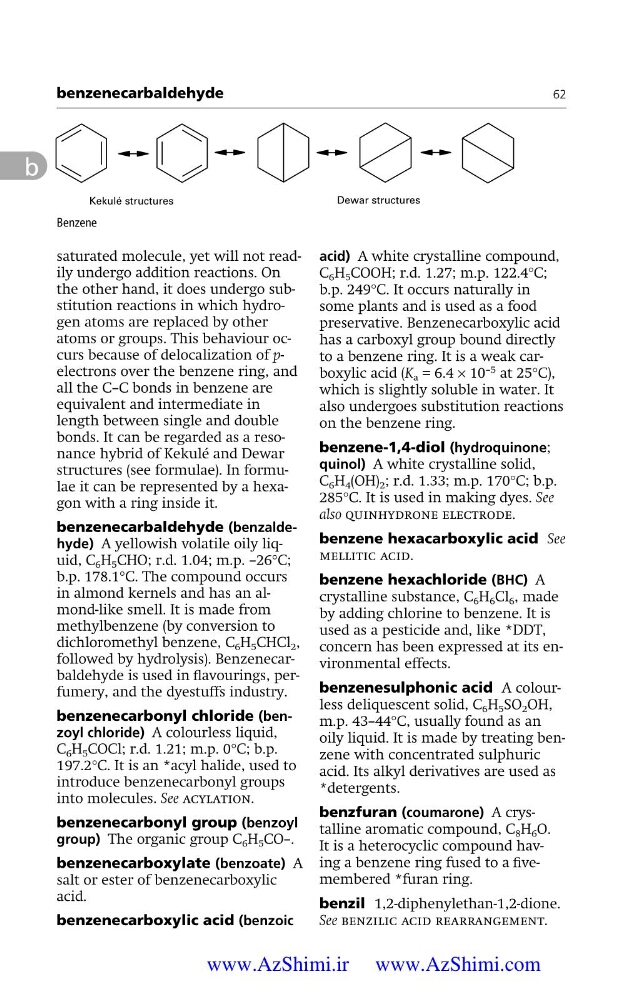
bonds. It can be regarded as a resonance hybrid of Kekulé and Dewar
structures (see formulae). In formulae it can be represented by a hexagon with a ring inside it.
benzenecarbaldehyde (benzaldehyde) A yellowish volatile oily liquid, C 6 H 5 CHO; r.d. 1.04; m.p. –26°C;
b.p. 178.1°C. The compound occurs
in almond kernels and has an almond-like smell. It is made from
methylbenzene (by conversion to
dichloromethyl benzene, C 6 H 5 CHCl 2 ,
followed by hydrolysis). Benzenecarbaldehyde is used in Ûavourings, perfumery, and the dyestuffs industry.
benzenecarbonyl chloride (benzoyl chloride) A colourless liquid,
C 6 H 5 COCl; r.d. 1.21; m.p. 0°C; b.p.
197.2°C. It is an *acyl halide, used to
introduce benzenecarbonyl groups
into molecules. See acylation.
benzenecarbonyl group (benzoyl
group) The organic group C 6 H 5 CO–.
benzenecarboxylate (benzoate) A
salt or ester of benzenecarboxylic
acid.
benzenecarboxylic acid (benzoic
acid) A white crystalline compound,
C 6 H 5 COOH; r.d. 1.27; m.p. 122.4°C;
b.p. 249°C. It occurs naturally in
some plants and is used as a food
preservative. Benzenecarboxylic acid
has a carboxyl group bound directly
to a benzene ring. It is a weak carboxylic acid (K a = 6.4 × 10
–5 at 25°C),
which is slightly soluble in water. It
also undergoes substitution reactions
on the benzene ring.
benzene-1,4-diol (hydroquinone;
quinol) A white crystalline solid,
C 6 H 4 (OH) 2 ; r.d. 1.33; m.p. 170°C; b.p.
285°C. It is used in making dyes. See
also quinhydrone electrode.
benzene hexacarboxylic acid See
mellitic acid.
benzene hexachloride (BHC) A
crystalline substance, C 6 H 6 Cl 6 , made
by adding chlorine to benzene. It is
used as a pesticide and, like *DDT,
concern has been expressed at its environmental effects.
benzenesulphonic acid A colourless deliquescent solid, C 6 H 5 SO 2 OH,
m.p. 43–44°C, usually found as an
oily liquid. It is made by treating benzene with concentrated sulphuric
acid. Its alkyl derivatives are used as
*detergents.
benzfuran (coumarone) A crystalline aromatic compound, C 8 H 6 O.
It is a heterocyclic compound having a benzene ring fused to a Üvemembered *furan ring.
benzil 1,2-diphenylethan-1,2-dione.
See benzilic acid rearrangement.
Kekulé structures
Dewar structures
Benzene
www.AzShimi.ir www.AzShimi.com
62
b
saturated molecule, yet will not readily undergo addition reactions. On
the other hand, it does undergo substitution reactions in which hydrogen atoms are replaced by other
atoms or groups. This behaviour occurs because of delocalization of pelectrons over the benzene ring, and
all the C–C bonds in benzene are
equivalent and intermediate in
length between single and double
bonds. It can be regarded as a resonance hybrid of Kekulé and Dewar
structures (see formulae). In formulae it can be represented by a hexagon with a ring inside it.
benzenecarbaldehyde (benzaldehyde) A yellowish volatile oily liquid, C 6 H 5 CHO; r.d. 1.04; m.p. –26°C;
b.p. 178.1°C. The compound occurs
in almond kernels and has an almond-like smell. It is made from
methylbenzene (by conversion to
dichloromethyl benzene, C 6 H 5 CHCl 2 ,
followed by hydrolysis). Benzenecarbaldehyde is used in Ûavourings, perfumery, and the dyestuffs industry.
benzenecarbonyl chloride (benzoyl chloride) A colourless liquid,
C 6 H 5 COCl; r.d. 1.21; m.p. 0°C; b.p.
197.2°C. It is an *acyl halide, used to
introduce benzenecarbonyl groups
into molecules. See acylation.
benzenecarbonyl group (benzoyl
group) The organic group C 6 H 5 CO–.
benzenecarboxylate (benzoate) A
salt or ester of benzenecarboxylic
acid.
benzenecarboxylic acid (benzoic
acid) A white crystalline compound,
C 6 H 5 COOH; r.d. 1.27; m.p. 122.4°C;
b.p. 249°C. It occurs naturally in
some plants and is used as a food
preservative. Benzenecarboxylic acid
has a carboxyl group bound directly
to a benzene ring. It is a weak carboxylic acid (K a = 6.4 × 10
–5 at 25°C),
which is slightly soluble in water. It
also undergoes substitution reactions
on the benzene ring.
benzene-1,4-diol (hydroquinone;
quinol) A white crystalline solid,
C 6 H 4 (OH) 2 ; r.d. 1.33; m.p. 170°C; b.p.
285°C. It is used in making dyes. See
also quinhydrone electrode.
benzene hexacarboxylic acid See
mellitic acid.
benzene hexachloride (BHC) A
crystalline substance, C 6 H 6 Cl 6 , made
by adding chlorine to benzene. It is
used as a pesticide and, like *DDT,
concern has been expressed at its environmental effects.
benzenesulphonic acid A colourless deliquescent solid, C 6 H 5 SO 2 OH,
m.p. 43–44°C, usually found as an
oily liquid. It is made by treating benzene with concentrated sulphuric
acid. Its alkyl derivatives are used as
*detergents.
benzfuran (coumarone) A crystalline aromatic compound, C 8 H 6 O.
It is a heterocyclic compound having a benzene ring fused to a Üvemembered *furan ring.
benzil 1,2-diphenylethan-1,2-dione.
See benzilic acid rearrangement.
Kekulé structures
Dewar structures
Benzene
www.AzShimi.ir www.AzShimi.com