

from simple starting materials.
Berthelot was also one of the Ürst to
investigate thermochemistry.
Berthelot equation An *equation
of state that relates the pressure, volume, and temperature of a gas and
the gas constant. It is given by:
PV = RT[1 + 9PT c (1 – 6T c
2
/T
2 )/128P c T],
where P is the pressure, V is the volume, R is the gas constant, T is the
thermodynamic temperature, and T c
and P c are the critical temperature
and pressure of the gas. The Berthelot equation can be derived from
the *Clapeyron–Clausius equation.
Berthollide compound A solid
compound with slight variations in
chemical composition (see nonstoichiometric compound). Berthollide
compounds are named after the
French inorganic chemist Claude
Louis Berthollet (1748–1822), who attacked the law of constant composition.
beryl A hexagonal mineral form of
beryllium aluminium silicate,
Be 3 Al 2 Si 6 O 18 ; the chief ore of beryllium. It may be green, blue, yellow,
or white and has long been used as a
gemstone. Beryl occurs throughout
the world in granite and pegmatites.
*Emerald, the green gem variety, occurs more rarely and is of great
value. Important sources of beryl are
found in Brazil, Madagascar, and the
USA.
beryllate A compound formed in
solution when beryllium metal, or
the oxide or hydroxide, dissolves in
strong alkali. The reaction (for the
metal) is often written
Be + 2OH
– (aq) → BeO 2
2– (aq) + H 2 (g)
The ion BeO 2
2– is the beryllate ion. In
fact, as with the *aluminates, the
ions present are probably hydroxy
ions of the type Be(OH) 4
2– (the
tetrahydroxoberyllate(II) ion) together with polymeric ions.
beryllia See beryllium oxide.
beryllium Symbol Be. A grey metallic element of *group 2 (formerly IIA)
of the periodic table; a.n. 4; r.a.m.
9.012; r.d. 1.85; m.p. 1278°C; b.p.
2970°C. Beryllium occurs as beryl
(3BeO.Al 2 O 3 .6SiO 2 ) and chrysoberyl
(BeO.Al 2 O 3 ). The metal is extracted
from a fused mixture of BeF 2 /NaF by
electrolysis or by magnesium reduction of BeF 2 . It is used to manufacture Be–Cu alloys, which are used in
nuclear reactors as reÛectors and
moderators because of their low absorption cross section. Beryllium
oxide is used in ceramics and in nuclear reactors. Beryllium and its compounds are toxic and can cause
serious lung diseases and dermatitis.
The metal is resistant to oxidation by
air because of the formation of an
oxide layer, but will react with dilute
hydrochloric and sulphuric acids.
Beryllium compounds show high covalent character. The element was
isolated independently by F. *Wöhler
and A. A. Bussy in 1828.
A
• Information from the WebElements site
beryllium bronze A hard, strong
65
beryllium bronze
b
/
#
#
$
$
$
/
#
#
$
$
$
/
$
$
$
#
#
/
#
#
$
$
$
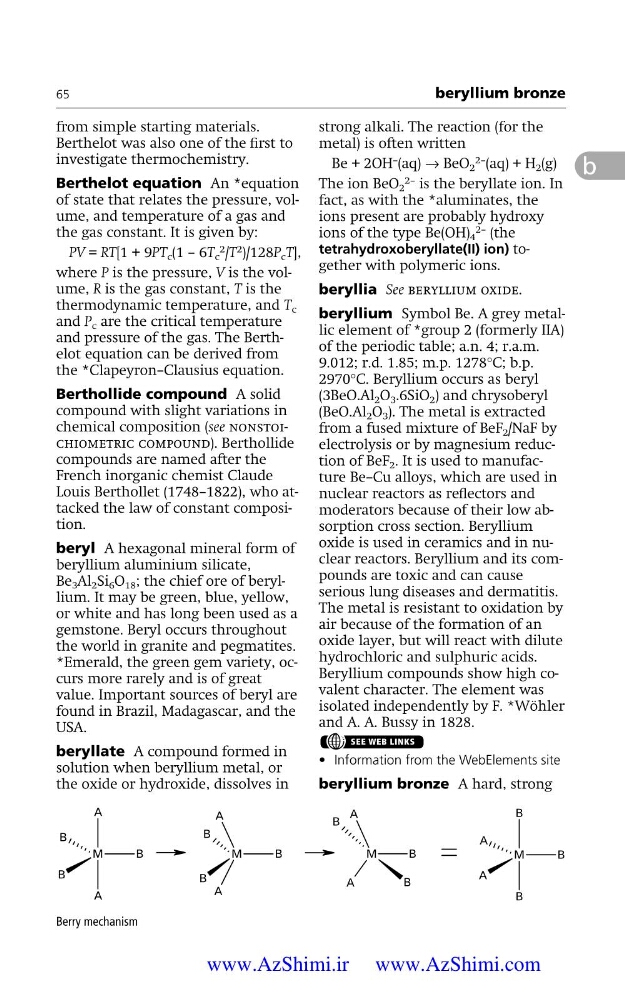
Berry mechanism
www.AzShimi.ir www.AzShimi.com
Berthelot was also one of the Ürst to
investigate thermochemistry.
Berthelot equation An *equation
of state that relates the pressure, volume, and temperature of a gas and
the gas constant. It is given by:
PV = RT[1 + 9PT c (1 – 6T c
2
/T
2 )/128P c T],
where P is the pressure, V is the volume, R is the gas constant, T is the
thermodynamic temperature, and T c
and P c are the critical temperature
and pressure of the gas. The Berthelot equation can be derived from
the *Clapeyron–Clausius equation.
Berthollide compound A solid
compound with slight variations in
chemical composition (see nonstoichiometric compound). Berthollide
compounds are named after the
French inorganic chemist Claude
Louis Berthollet (1748–1822), who attacked the law of constant composition.
beryl A hexagonal mineral form of
beryllium aluminium silicate,
Be 3 Al 2 Si 6 O 18 ; the chief ore of beryllium. It may be green, blue, yellow,
or white and has long been used as a
gemstone. Beryl occurs throughout
the world in granite and pegmatites.
*Emerald, the green gem variety, occurs more rarely and is of great
value. Important sources of beryl are
found in Brazil, Madagascar, and the
USA.
beryllate A compound formed in
solution when beryllium metal, or
the oxide or hydroxide, dissolves in
strong alkali. The reaction (for the
metal) is often written
Be + 2OH
– (aq) → BeO 2
2– (aq) + H 2 (g)
The ion BeO 2
2– is the beryllate ion. In
fact, as with the *aluminates, the
ions present are probably hydroxy
ions of the type Be(OH) 4
2– (the
tetrahydroxoberyllate(II) ion) together with polymeric ions.
beryllia See beryllium oxide.
beryllium Symbol Be. A grey metallic element of *group 2 (formerly IIA)
of the periodic table; a.n. 4; r.a.m.
9.012; r.d. 1.85; m.p. 1278°C; b.p.
2970°C. Beryllium occurs as beryl
(3BeO.Al 2 O 3 .6SiO 2 ) and chrysoberyl
(BeO.Al 2 O 3 ). The metal is extracted
from a fused mixture of BeF 2 /NaF by
electrolysis or by magnesium reduction of BeF 2 . It is used to manufacture Be–Cu alloys, which are used in
nuclear reactors as reÛectors and
moderators because of their low absorption cross section. Beryllium
oxide is used in ceramics and in nuclear reactors. Beryllium and its compounds are toxic and can cause
serious lung diseases and dermatitis.
The metal is resistant to oxidation by
air because of the formation of an
oxide layer, but will react with dilute
hydrochloric and sulphuric acids.
Beryllium compounds show high covalent character. The element was
isolated independently by F. *Wöhler
and A. A. Bussy in 1828.
A
• Information from the WebElements site
beryllium bronze A hard, strong
65
beryllium bronze
b
/
#
#
$
$
$
/
#
#
$
$
$
/
$
$
$
#
#
/
#
#
$
$
$
Berry mechanism
www.AzShimi.ir www.AzShimi.com