

came a professor at Cambridge University in 1884. He is best known for
his work on cathode rays, which led
to his discovery of the electron in
1897. He went on to study the conduction of electricity through gases,
and it is for this work that he was
awarded the Nobel Prize for physics
in 1906. His son, Sir George Paget
Thomson (1892–1975), discovered
*electron diffraction, for which he
shared the 1937 Nobel Prize for
physics with Clinton J. Davisson
(1881–1958), who independently
made the same discovery.
Thomson, Sir William See kelvin,
lord.
thoria See thorium.
thorium Symbol Th. A grey radioactive metallic element belonging to
the *actinoids; a.n. 90; r.a.m.
232.038; r.d. 11.5–11.9 (17°C); m.p.
1740–1760°C; b.p. 4780–4800°C. It occurs in monazite sand in Brazil,
India, and USA. The isotopes of thorium have mass numbers from 223
to 234 inclusive; the most stable isotope, thorium–232, has a half-life of
1.39 × 10
10 years. It has an oxidation
state of (+4) and its chemistry resembles that of the other actinoids. It can
be used as a nuclear fuel for breeder
reactors as thorium–232 captures
slow neutrons to breed uranium–233.
Thorium dioxide (thoria, ThO 2 ) is
used on gas mantles and in special
refractories. The element was discovered by J. J. *Berzelius in 1829.
A
• Information from the WebElements site
thorium series See radioactive series.
three-body problem See manybody problem.
threnardite A mineral form of
*sodium sulphate, Na 2 SO 4 .
threonine See amino acid.
thulium Symbol Tm. A soft grey
metallic element belonging to the
*lanthanoids; a.n. 69; r.a.m. 168.934;
r.d. 9.321 (20°C); m.p. 1545°C; b.p.
1947°C. It occurs in apatite and xenotime. There is one natural isotope,
thulium–169, and seventeen artiÜcial
isotopes have been produced. There
are no uses for the element, which
was discovered by Per Cleve (1840–
1905) in 1879.
A
• Information from the WebElements site
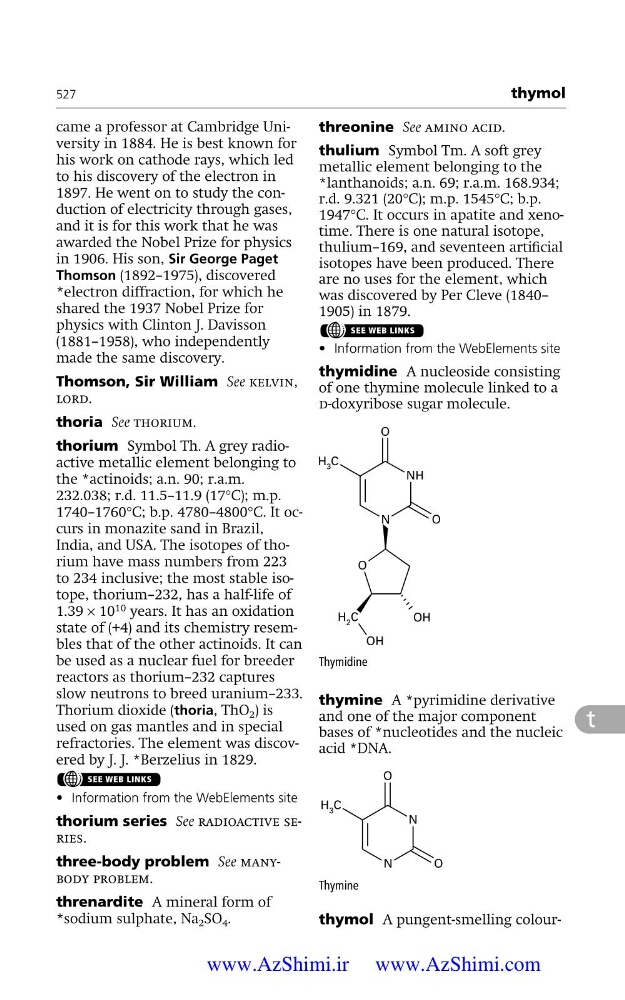
thymidine A nucleoside consisting
of one thymine molecule linked to a
d-doxyribose sugar molecule.
thymine A *pyrimidine derivative
and one of the major component
bases of *nucleotides and the nucleic
acid *DNA.
527
thymol
t
thymol A pungent-smelling colourN
N
O
O
C
H 3
Thymine
OH
O
C
H 2
OH
N
NH
O
O
C
H 3
Thymidine
www.AzShimi.ir www.AzShimi.com
his work on cathode rays, which led
to his discovery of the electron in
1897. He went on to study the conduction of electricity through gases,
and it is for this work that he was
awarded the Nobel Prize for physics
in 1906. His son, Sir George Paget
Thomson (1892–1975), discovered
*electron diffraction, for which he
shared the 1937 Nobel Prize for
physics with Clinton J. Davisson
(1881–1958), who independently
made the same discovery.
Thomson, Sir William See kelvin,
lord.
thoria See thorium.
thorium Symbol Th. A grey radioactive metallic element belonging to
the *actinoids; a.n. 90; r.a.m.
232.038; r.d. 11.5–11.9 (17°C); m.p.
1740–1760°C; b.p. 4780–4800°C. It occurs in monazite sand in Brazil,
India, and USA. The isotopes of thorium have mass numbers from 223
to 234 inclusive; the most stable isotope, thorium–232, has a half-life of
1.39 × 10
10 years. It has an oxidation
state of (+4) and its chemistry resembles that of the other actinoids. It can
be used as a nuclear fuel for breeder
reactors as thorium–232 captures
slow neutrons to breed uranium–233.
Thorium dioxide (thoria, ThO 2 ) is
used on gas mantles and in special
refractories. The element was discovered by J. J. *Berzelius in 1829.
A
• Information from the WebElements site
thorium series See radioactive series.
three-body problem See manybody problem.
threnardite A mineral form of
*sodium sulphate, Na 2 SO 4 .
threonine See amino acid.
thulium Symbol Tm. A soft grey
metallic element belonging to the
*lanthanoids; a.n. 69; r.a.m. 168.934;
r.d. 9.321 (20°C); m.p. 1545°C; b.p.
1947°C. It occurs in apatite and xenotime. There is one natural isotope,
thulium–169, and seventeen artiÜcial
isotopes have been produced. There
are no uses for the element, which
was discovered by Per Cleve (1840–
1905) in 1879.
A
• Information from the WebElements site
thymidine A nucleoside consisting
of one thymine molecule linked to a
d-doxyribose sugar molecule.
thymine A *pyrimidine derivative
and one of the major component
bases of *nucleotides and the nucleic
acid *DNA.
527
thymol
t
thymol A pungent-smelling colourN
N
O
O
C
H 3
Thymine
OH
O
C
H 2
OH
N
NH
O
O
C
H 3
Thymidine
www.AzShimi.ir www.AzShimi.com