

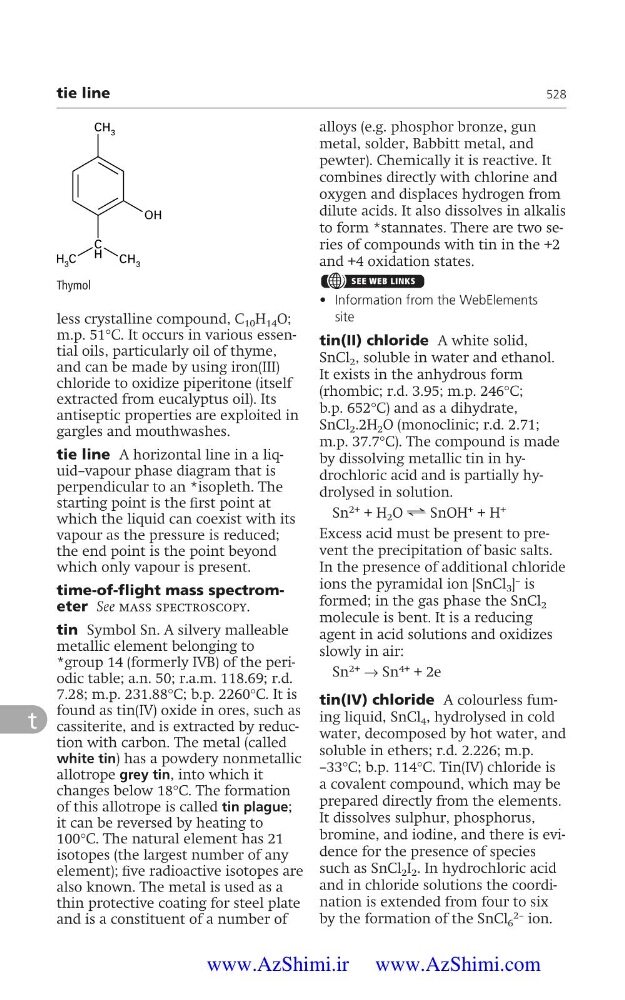
less crystalline compound, C 10 H 14 O;
m.p. 51°C. It occurs in various essential oils, particularly oil of thyme,
and can be made by using iron(III)
chloride to oxidize piperitone (itself
extracted from eucalyptus oil). Its
antiseptic properties are exploited in
gargles and mouthwashes.
tie line A horizontal line in a liquid–vapour phase diagram that is
perpendicular to an *isopleth. The
starting point is the Ürst point at
which the liquid can coexist with its
vapour as the pressure is reduced;
the end point is the point beyond
which only vapour is present.
time-of-Ûight mass spectrometer See mass spectroscopy.
tin Symbol Sn. A silvery malleable
metallic element belonging to
*group 14 (formerly IVB) of the periodic table; a.n. 50; r.a.m. 118.69; r.d.
7.28; m.p. 231.88°C; b.p. 2260°C. It is
found as tin(IV) oxide in ores, such as
cassiterite, and is extracted by reduction with carbon. The metal (called
white tin) has a powdery nonmetallic
allotrope grey tin, into which it
changes below 18°C. The formation
of this allotrope is called tin plague;
it can be reversed by heating to
100°C. The natural element has 21
isotopes (the largest number of any
element); Üve radioactive isotopes are
also known. The metal is used as a
thin protective coating for steel plate
and is a constituent of a number of
alloys (e.g. phosphor bronze, gun
metal, solder, Babbitt metal, and
pewter). Chemically it is reactive. It
combines directly with chlorine and
oxygen and displaces hydrogen from
dilute acids. It also dissolves in alkalis
to form *stannates. There are two series of compounds with tin in the +2
and +4 oxidation states.
A
• Information from the WebElements
site
tin(II) chloride A white solid,
SnCl 2 , soluble in water and ethanol.
It exists in the anhydrous form
(rhombic; r.d. 3.95; m.p. 246°C;
b.p. 652°C) and as a dihydrate,
SnCl 2 .2H 2 O (monoclinic; r.d. 2.71;
m.p. 37.7°C). The compound is made
by dissolving metallic tin in hydrochloric acid and is partially hydrolysed in solution.
Sn
2+ + H 2 O ˆ SnOH
+ + H
+
Excess acid must be present to prevent the precipitation of basic salts.
In the presence of additional chloride
ions the pyramidal ion [SnCl 3 ]
– is
formed; in the gas phase the SnCl 2
molecule is bent. It is a reducing
agent in acid solutions and oxidizes
slowly in air:
Sn
2+
→ Sn
4+ + 2e
tin(IV) chloride A colourless fuming liquid, SnCl 4 , hydrolysed in cold
water, decomposed by hot water, and
soluble in ethers; r.d. 2.226; m.p.
–33°C; b.p. 114°C. Tin(IV) chloride is
a covalent compound, which may be
prepared directly from the elements.
It dissolves sulphur, phosphorus,
bromine, and iodine, and there is evidence for the presence of species
such as SnCl 2 I 2 . In hydrochloric acid
and in chloride solutions the coordination is extended from four to six
by the formation of the SnCl 6
2– ion.
tie line
528
t
OH
C
H
C
H 3
CH 3
CH 3
Thymol
www.AzShimi.ir www.AzShimi.com
m.p. 51°C. It occurs in various essential oils, particularly oil of thyme,
and can be made by using iron(III)
chloride to oxidize piperitone (itself
extracted from eucalyptus oil). Its
antiseptic properties are exploited in
gargles and mouthwashes.
tie line A horizontal line in a liquid–vapour phase diagram that is
perpendicular to an *isopleth. The
starting point is the Ürst point at
which the liquid can coexist with its
vapour as the pressure is reduced;
the end point is the point beyond
which only vapour is present.
time-of-Ûight mass spectrometer See mass spectroscopy.
tin Symbol Sn. A silvery malleable
metallic element belonging to
*group 14 (formerly IVB) of the periodic table; a.n. 50; r.a.m. 118.69; r.d.
7.28; m.p. 231.88°C; b.p. 2260°C. It is
found as tin(IV) oxide in ores, such as
cassiterite, and is extracted by reduction with carbon. The metal (called
white tin) has a powdery nonmetallic
allotrope grey tin, into which it
changes below 18°C. The formation
of this allotrope is called tin plague;
it can be reversed by heating to
100°C. The natural element has 21
isotopes (the largest number of any
element); Üve radioactive isotopes are
also known. The metal is used as a
thin protective coating for steel plate
and is a constituent of a number of
alloys (e.g. phosphor bronze, gun
metal, solder, Babbitt metal, and
pewter). Chemically it is reactive. It
combines directly with chlorine and
oxygen and displaces hydrogen from
dilute acids. It also dissolves in alkalis
to form *stannates. There are two series of compounds with tin in the +2
and +4 oxidation states.
A
• Information from the WebElements
site
tin(II) chloride A white solid,
SnCl 2 , soluble in water and ethanol.
It exists in the anhydrous form
(rhombic; r.d. 3.95; m.p. 246°C;
b.p. 652°C) and as a dihydrate,
SnCl 2 .2H 2 O (monoclinic; r.d. 2.71;
m.p. 37.7°C). The compound is made
by dissolving metallic tin in hydrochloric acid and is partially hydrolysed in solution.
Sn
2+ + H 2 O ˆ SnOH
+ + H
+
Excess acid must be present to prevent the precipitation of basic salts.
In the presence of additional chloride
ions the pyramidal ion [SnCl 3 ]
– is
formed; in the gas phase the SnCl 2
molecule is bent. It is a reducing
agent in acid solutions and oxidizes
slowly in air:
Sn
2+
→ Sn
4+ + 2e
tin(IV) chloride A colourless fuming liquid, SnCl 4 , hydrolysed in cold
water, decomposed by hot water, and
soluble in ethers; r.d. 2.226; m.p.
–33°C; b.p. 114°C. Tin(IV) chloride is
a covalent compound, which may be
prepared directly from the elements.
It dissolves sulphur, phosphorus,
bromine, and iodine, and there is evidence for the presence of species
such as SnCl 2 I 2 . In hydrochloric acid
and in chloride solutions the coordination is extended from four to six
by the formation of the SnCl 6
2– ion.
tie line
528
t
OH
C
H
C
H 3
CH 3
CH 3
Thymol
www.AzShimi.ir www.AzShimi.com