

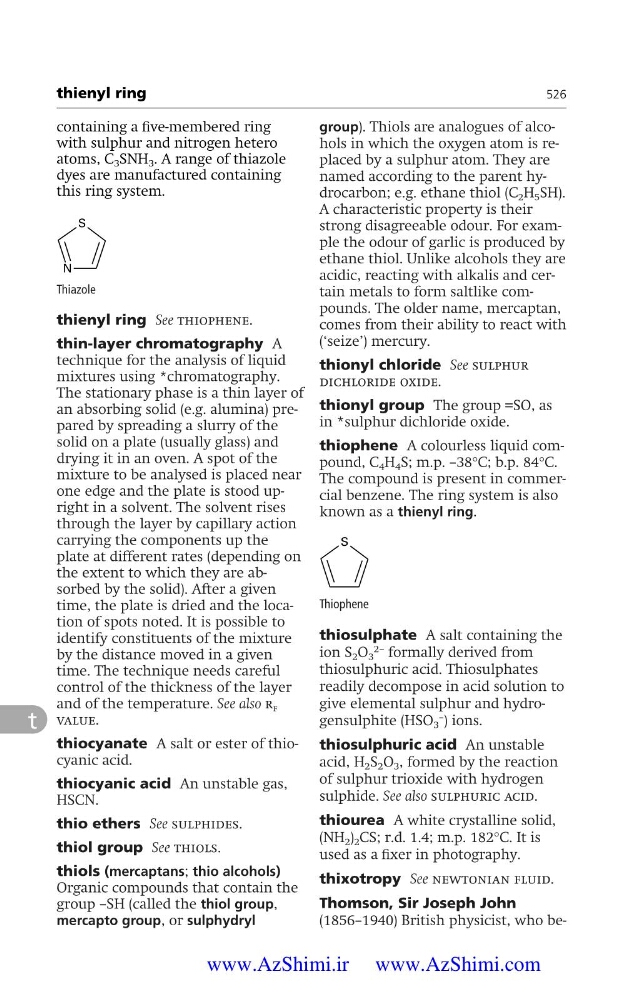
containing a Üve-membered ring
with sulphur and nitrogen hetero
atoms, C 3 SNH 3 . A range of thiazole
dyes are manufactured containing
this ring system.
thienyl ring
526
t
S
N
Thiazole
S
Thiophene
thienyl ring See thiophene.
thin-layer chromatography A
technique for the analysis of liquid
mixtures using *chromatography.
The stationary phase is a thin layer of
an absorbing solid (e.g. alumina) prepared by spreading a slurry of the
solid on a plate (usually glass) and
drying it in an oven. A spot of the
mixture to be analysed is placed near
one edge and the plate is stood upright in a solvent. The solvent rises
through the layer by capillary action
carrying the components up the
plate at different rates (depending on
the extent to which they are absorbed by the solid). After a given
time, the plate is dried and the location of spots noted. It is possible to
identify constituents of the mixture
by the distance moved in a given
time. The technique needs careful
control of the thickness of the layer
and of the temperature. See also r f
value.
thiocyanate A salt or ester of thiocyanic acid.
thiocyanic acid An unstable gas,
HSCN.
thio ethers See sulphides.
thiol group See thiols.
thiols (mercaptans; thio alcohols)
Organic compounds that contain the
group –SH (called the thiol group,
mercapto group, or sulphydryl
group). Thiols are analogues of alcohols in which the oxygen atom is replaced by a sulphur atom. They are
named according to the parent hydrocarbon; e.g. ethane thiol (C 2 H 5 SH).
A characteristic property is their
strong disagreeable odour. For example the odour of garlic is produced by
ethane thiol. Unlike alcohols they are
acidic, reacting with alkalis and certain metals to form saltlike compounds. The older name, mercaptan,
comes from their ability to react with
(‘seize’) mercury.
thionyl chloride See sulphur
dichloride oxide.
thionyl group The group =SO, as
in *sulphur dichloride oxide.
thiophene A colourless liquid compound, C 4 H 4 S; m.p. –38°C; b.p. 84°C.
The compound is present in commercial benzene. The ring system is also
known as a thienyl ring.
thiosulphate A salt containing the
ion S 2 O 3
2– formally derived from
thiosulphuric acid. Thiosulphates
readily decompose in acid solution to
give elemental sulphur and hydrogensulphite (HSO 3
– ) ions.
thiosulphuric acid An unstable
acid, H 2 S 2 O 3 , formed by the reaction
of sulphur trioxide with hydrogen
sulphide. See also sulphuric acid.
thiourea A white crystalline solid,
(NH 2 ) 2 CS; r.d. 1.4; m.p. 182°C. It is
used as a Üxer in photography.
thixotropy See newtonian fluid.
Thomson, Sir Joseph John
(1856–1940) British physicist, who bewww.AzShimi.ir www.AzShimi.com
with sulphur and nitrogen hetero
atoms, C 3 SNH 3 . A range of thiazole
dyes are manufactured containing
this ring system.
thienyl ring
526
t
S
N
Thiazole
S
Thiophene
thienyl ring See thiophene.
thin-layer chromatography A
technique for the analysis of liquid
mixtures using *chromatography.
The stationary phase is a thin layer of
an absorbing solid (e.g. alumina) prepared by spreading a slurry of the
solid on a plate (usually glass) and
drying it in an oven. A spot of the
mixture to be analysed is placed near
one edge and the plate is stood upright in a solvent. The solvent rises
through the layer by capillary action
carrying the components up the
plate at different rates (depending on
the extent to which they are absorbed by the solid). After a given
time, the plate is dried and the location of spots noted. It is possible to
identify constituents of the mixture
by the distance moved in a given
time. The technique needs careful
control of the thickness of the layer
and of the temperature. See also r f
value.
thiocyanate A salt or ester of thiocyanic acid.
thiocyanic acid An unstable gas,
HSCN.
thio ethers See sulphides.
thiol group See thiols.
thiols (mercaptans; thio alcohols)
Organic compounds that contain the
group –SH (called the thiol group,
mercapto group, or sulphydryl
group). Thiols are analogues of alcohols in which the oxygen atom is replaced by a sulphur atom. They are
named according to the parent hydrocarbon; e.g. ethane thiol (C 2 H 5 SH).
A characteristic property is their
strong disagreeable odour. For example the odour of garlic is produced by
ethane thiol. Unlike alcohols they are
acidic, reacting with alkalis and certain metals to form saltlike compounds. The older name, mercaptan,
comes from their ability to react with
(‘seize’) mercury.
thionyl chloride See sulphur
dichloride oxide.
thionyl group The group =SO, as
in *sulphur dichloride oxide.
thiophene A colourless liquid compound, C 4 H 4 S; m.p. –38°C; b.p. 84°C.
The compound is present in commercial benzene. The ring system is also
known as a thienyl ring.
thiosulphate A salt containing the
ion S 2 O 3
2– formally derived from
thiosulphuric acid. Thiosulphates
readily decompose in acid solution to
give elemental sulphur and hydrogensulphite (HSO 3
– ) ions.
thiosulphuric acid An unstable
acid, H 2 S 2 O 3 , formed by the reaction
of sulphur trioxide with hydrogen
sulphide. See also sulphuric acid.
thiourea A white crystalline solid,
(NH 2 ) 2 CS; r.d. 1.4; m.p. 182°C. It is
used as a Üxer in photography.
thixotropy See newtonian fluid.
Thomson, Sir Joseph John
(1856–1940) British physicist, who bewww.AzShimi.ir www.AzShimi.com