

SOCl 2 ; m.p. –105°C; b.p. 78.8°C. It hydrolyses rapidly in water but is soluble in benzene. It may be prepared
by the direct action of sulphur on
chlorine monoxide or, more commonly, by the reaction of phosphorus(V) chloride with sulphur dioxide.
It is used as a chlorinating agent in
synthetic organic chemistry (replacing –OH groups with Cl).
sulphur dioxide (sulphur(IV) oxide)
A colourless liquid or pungent gas,
SO 2 , formed by sulphur burning in
air; r.d. 1.43 (liquid); m.p. –72.7°C;
b.p. –10°C. It can be made by heating
iron sulphide (pyrites) in air. The
compound is a reducing agent and is
used in bleaching and as a fumigant
and food preservative. Large quantities are also used in the *contact
process for manufacturing sulphuric
acid. It dissolves in water to give a
mixture of sulphuric and sulphurous
acids. See also acid rain.
sulphuretted hydrogen See hydrogen sulphide.
sulphuric acid (oil of vitriol) A
colourless oily liquid, H 2 SO 4 ; r.d.
1.84; m.p. 10.36°C; b.p. 338°C. The
pure acid is rarely used; it is commonly available as a 96–98% solution
(m.p. 3.0°C). The compound also
forms a range of hydrates: H 2 SO 4 .H 2 O
(m.p. 8.62°C); H 2 SO 4 .2H 2 O (m.p.
–38/39°C); H 2 SO 4 .6H 2 O (m.p. –54°C);
H 2 SO 4 .8H 2 O (m.p. –62°C). Its full systematic name is tetraoxosulphuric(VI)
acid.
Until the 1930s, sulphuric acid was
manufactured by the *lead-chamber
process, but this has now been replaced by the *contact process (catalytic oxidation of sulphur dioxide).
More sulphuric acid is made in the
UK than any other chemical product;
production levels (UK) are commonly
12 000 to 13 000 tonnes per day. It is
extensively used in industry, the
main applications being fertilizers
(32%), chemicals (16%), paints and
pigments (15%), detergents (11%), and
Übres (9%).
In concentrated sulphuric acid
there is extensive hydrogen bonding
and several competing equilibria, to
give species such as H 3 O
+
, HSO 4
– ,
H 3 SO 4
+ , and H 2 S 2 O 7 . Apart from
being a powerful protonating agent
(it protonates chlorides and nitrates
producing hydrogen chloride and nitric acid), the compound is a moderately strong oxidizing agent. Thus, it
will dissolve copper:
Cu(s) + H 2 SO 4 (l) → CuO(s) + H 2 O(l) +
SO 2 (g)
511
sulphuric acid
s
HO S OH
O
H 2 SO 3
sulphurous acid
(in sulphites)
HO S OH
O
O
H 2 SO 4
sulphuric(VI) acid
H 2 S 2 O 3
thiosulphuric acid
O
HO S OH
S
H 2 S 2 O 7
disulphuric(VI) acid
(pyrosulphuric)
HO S O
O
O
OH
O
O
S
H 2 S 2 O 4
sulphinic acid
(dithionous or
hyposulphurous)
HO S S
O O
OH
H 2 S n+2 O 6
polythionic acids
HO S (S) n
O
O
OH
O
O
S
HO S S
O O
OH
O O
H 2 S 2 O 6
dithionic acid
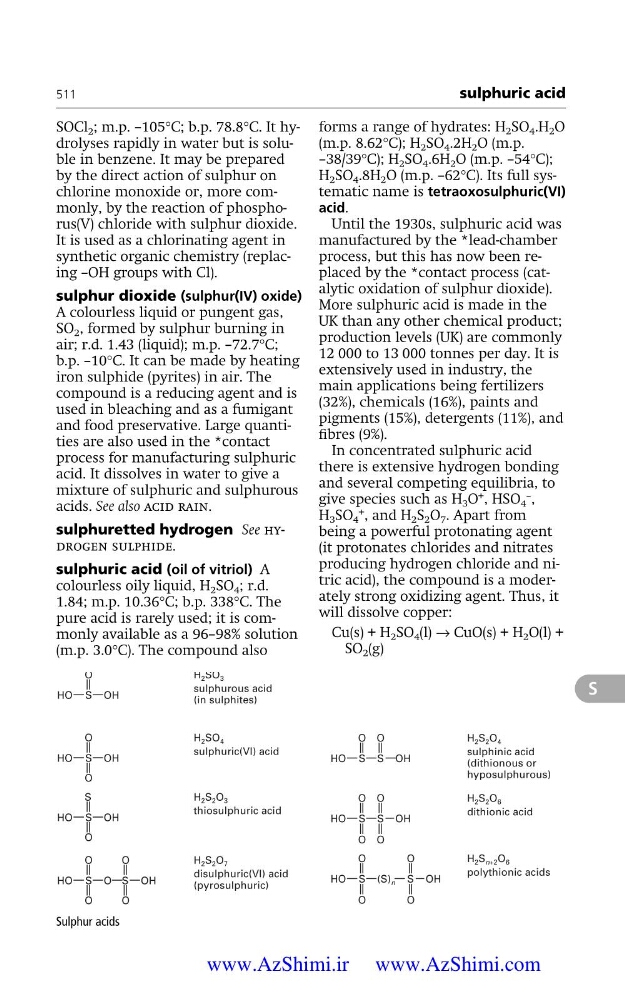
Sulphur acids
www.AzShimi.ir www.AzShimi.com
by the direct action of sulphur on
chlorine monoxide or, more commonly, by the reaction of phosphorus(V) chloride with sulphur dioxide.
It is used as a chlorinating agent in
synthetic organic chemistry (replacing –OH groups with Cl).
sulphur dioxide (sulphur(IV) oxide)
A colourless liquid or pungent gas,
SO 2 , formed by sulphur burning in
air; r.d. 1.43 (liquid); m.p. –72.7°C;
b.p. –10°C. It can be made by heating
iron sulphide (pyrites) in air. The
compound is a reducing agent and is
used in bleaching and as a fumigant
and food preservative. Large quantities are also used in the *contact
process for manufacturing sulphuric
acid. It dissolves in water to give a
mixture of sulphuric and sulphurous
acids. See also acid rain.
sulphuretted hydrogen See hydrogen sulphide.
sulphuric acid (oil of vitriol) A
colourless oily liquid, H 2 SO 4 ; r.d.
1.84; m.p. 10.36°C; b.p. 338°C. The
pure acid is rarely used; it is commonly available as a 96–98% solution
(m.p. 3.0°C). The compound also
forms a range of hydrates: H 2 SO 4 .H 2 O
(m.p. 8.62°C); H 2 SO 4 .2H 2 O (m.p.
–38/39°C); H 2 SO 4 .6H 2 O (m.p. –54°C);
H 2 SO 4 .8H 2 O (m.p. –62°C). Its full systematic name is tetraoxosulphuric(VI)
acid.
Until the 1930s, sulphuric acid was
manufactured by the *lead-chamber
process, but this has now been replaced by the *contact process (catalytic oxidation of sulphur dioxide).
More sulphuric acid is made in the
UK than any other chemical product;
production levels (UK) are commonly
12 000 to 13 000 tonnes per day. It is
extensively used in industry, the
main applications being fertilizers
(32%), chemicals (16%), paints and
pigments (15%), detergents (11%), and
Übres (9%).
In concentrated sulphuric acid
there is extensive hydrogen bonding
and several competing equilibria, to
give species such as H 3 O
+
, HSO 4
– ,
H 3 SO 4
+ , and H 2 S 2 O 7 . Apart from
being a powerful protonating agent
(it protonates chlorides and nitrates
producing hydrogen chloride and nitric acid), the compound is a moderately strong oxidizing agent. Thus, it
will dissolve copper:
Cu(s) + H 2 SO 4 (l) → CuO(s) + H 2 O(l) +
SO 2 (g)
511
sulphuric acid
s
HO S OH
O
H 2 SO 3
sulphurous acid
(in sulphites)
HO S OH
O
O
H 2 SO 4
sulphuric(VI) acid
H 2 S 2 O 3
thiosulphuric acid
O
HO S OH
S
H 2 S 2 O 7
disulphuric(VI) acid
(pyrosulphuric)
HO S O
O
O
OH
O
O
S
H 2 S 2 O 4
sulphinic acid
(dithionous or
hyposulphurous)
HO S S
O O
OH
H 2 S n+2 O 6
polythionic acids
HO S (S) n
O
O
OH
O
O
S
HO S S
O O
OH
O O
H 2 S 2 O 6
dithionic acid
Sulphur acids
www.AzShimi.ir www.AzShimi.com