

sulphuric(IV) acid
512
s
CuO(s) + H 2 SO 4 (l) → CuSO 4 (aq) +
H 2 O(l)
It is also a powerful dehydrating
agent, capable of removing H 2 O from
many organic compounds (as in the
production of acid *anhydrides). In
dilute solution it is a strong dibasic
acid forming two series of salts, the
sulphates and the hydrogensulphates.
sulphuric(IV) acid See sulphurous
acid.
sulphur monochloride See disulphur dichloride.
sulphur mustard A chemical warfare agent, C 4 H 8 Cl 2 S; r.d. 1.27; m.p.
14.4°C; b.p. 217°C. It is a potent blistering agent, Ürst used in 1915 by
Germany in World War I. It is often
known simply as mustard gas, although it is an oily liquid, which can
be dispersed as an aerosol. It was one
of the early chemicals used in chemotherapy treatment of cancer. The systematic name is bis(2-chlorethyl)
sulphide. See also nitrogen mustard.
sulphurous acid (sulphuric(IV) acid)
A weak dibasic acid, H 2 SO 3 , known in
the form of its salts: the sulphites
and hydrogensulphites. It is considered to be formed (along with sulphuric acid) when sulphur dioxide is
dissolved in water. It is probable,
however, that the molecule H 2 SO 3 is
not present and that the solution
contains hydrated SO 2 . It is a reducing agent. The systematic name is
trioxosulphuric(IV) acid. See also sulphuric acid.
sulphur(IV) oxide See sulphur
dioxide.
sulphur(VI) oxide See sulphur
trioxide.
sulphur trioxide (sulphur(VI)
oxide) A colourless fuming solid,
SO 3 , which has three crystalline
modiÜcations. In decreasing order of
stability these are: α, r.d. 1.97; m.p.
16.83°C; b.p. 44.8°C; β, m.p. 16.24°C;
sublimes at 50°C; r.d. 2.29; γ, m.p.
16.8°C; b.p. 44.8°C. All are polymeric,
with linked SO 4 tetrahedra: the γform has an icelike structure and is
obtained by rapid quenching of the
vapour; the β-form has inÜnite helical chains; and the α-form has inÜnite chains with some cross-linking
of the SO 4 tetrahedra. Even in the
vapour, there are polymeric species,
and not discrete sulphur trioxide
molecules (hence the compound is
more correctly called by its systematic name sulphur(VI) oxide).
Sulphur trioxide is prepared by the
oxidation of sulphur dioxide with
oxygen in the presence of a vanadium(V) oxide catalyst. It may be prepared in the laboratory by distilling a
mixture of concentrated sulphuric
acid and phosphorus(V) oxide. It reacts violently with water to give sulphuric(VI) acid and is an important
intermediate in the preparation of
sulphuric acid and oleum.
sulphuryl chloride See sulphur
dichloride dioxide.
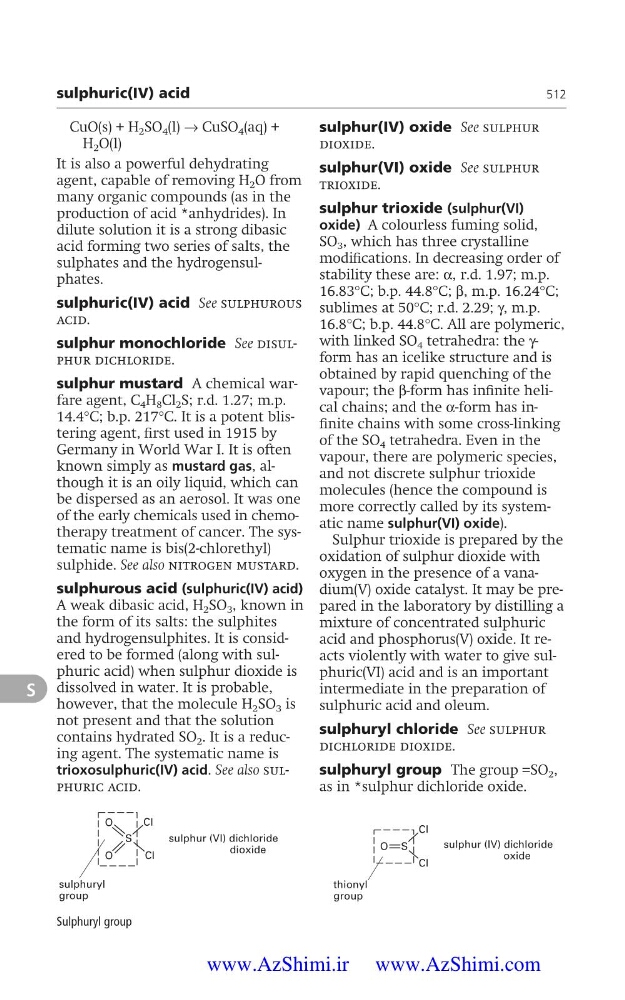
sulphuryl group The group =SO 2 ,
as in *sulphur dichloride oxide.
O
O
S
Cl
Cl
sulphuryl
group
sulphur (VI) dichloride
dioxide
O
Cl
Cl
sulphur (IV) dichloride
oxide
S
thionyl
group
Sulphuryl group
www.AzShimi.ir www.AzShimi.com
512
s
CuO(s) + H 2 SO 4 (l) → CuSO 4 (aq) +
H 2 O(l)
It is also a powerful dehydrating
agent, capable of removing H 2 O from
many organic compounds (as in the
production of acid *anhydrides). In
dilute solution it is a strong dibasic
acid forming two series of salts, the
sulphates and the hydrogensulphates.
sulphuric(IV) acid See sulphurous
acid.
sulphur monochloride See disulphur dichloride.
sulphur mustard A chemical warfare agent, C 4 H 8 Cl 2 S; r.d. 1.27; m.p.
14.4°C; b.p. 217°C. It is a potent blistering agent, Ürst used in 1915 by
Germany in World War I. It is often
known simply as mustard gas, although it is an oily liquid, which can
be dispersed as an aerosol. It was one
of the early chemicals used in chemotherapy treatment of cancer. The systematic name is bis(2-chlorethyl)
sulphide. See also nitrogen mustard.
sulphurous acid (sulphuric(IV) acid)
A weak dibasic acid, H 2 SO 3 , known in
the form of its salts: the sulphites
and hydrogensulphites. It is considered to be formed (along with sulphuric acid) when sulphur dioxide is
dissolved in water. It is probable,
however, that the molecule H 2 SO 3 is
not present and that the solution
contains hydrated SO 2 . It is a reducing agent. The systematic name is
trioxosulphuric(IV) acid. See also sulphuric acid.
sulphur(IV) oxide See sulphur
dioxide.
sulphur(VI) oxide See sulphur
trioxide.
sulphur trioxide (sulphur(VI)
oxide) A colourless fuming solid,
SO 3 , which has three crystalline
modiÜcations. In decreasing order of
stability these are: α, r.d. 1.97; m.p.
16.83°C; b.p. 44.8°C; β, m.p. 16.24°C;
sublimes at 50°C; r.d. 2.29; γ, m.p.
16.8°C; b.p. 44.8°C. All are polymeric,
with linked SO 4 tetrahedra: the γform has an icelike structure and is
obtained by rapid quenching of the
vapour; the β-form has inÜnite helical chains; and the α-form has inÜnite chains with some cross-linking
of the SO 4 tetrahedra. Even in the
vapour, there are polymeric species,
and not discrete sulphur trioxide
molecules (hence the compound is
more correctly called by its systematic name sulphur(VI) oxide).
Sulphur trioxide is prepared by the
oxidation of sulphur dioxide with
oxygen in the presence of a vanadium(V) oxide catalyst. It may be prepared in the laboratory by distilling a
mixture of concentrated sulphuric
acid and phosphorus(V) oxide. It reacts violently with water to give sulphuric(VI) acid and is an important
intermediate in the preparation of
sulphuric acid and oleum.
sulphuryl chloride See sulphur
dichloride dioxide.
sulphuryl group The group =SO 2 ,
as in *sulphur dichloride oxide.
O
O
S
Cl
Cl
sulphuryl
group
sulphur (VI) dichloride
dioxide
O
Cl
Cl
sulphur (IV) dichloride
oxide
S
thionyl
group
Sulphuryl group
www.AzShimi.ir www.AzShimi.com