

sulphur cycle
510
s
the sulphur atoms form chains and
the liquid becomes more viscous and
dark brown. If the molten sulphur is
cooled quickly from this temperature
(e.g. by pouring into cold water) a
reddish-brown solid known as plastic
sulphur is obtained. Above 200°C the
viscosity decreases. Sulphur vapour
contains a mixture of S 2 , S 4 , S 6 , and
S 8 molecules. Flowers of sulphur is a
yellow powder obtained by subliming the vapour. It is used as a plant
fungicide. The element is also used to
produce sulphuric acid and other sulphur compounds.
Sulphur is an *essential element in
living organisms, occurring in the
amino acids cysteine and methionine
and therefore in many proteins. It is
also a constituent of various cell
metabolites, e.g. coenzyme A. Sulphur is absorbed by plants from the
soil as the sulphate ion (SO 4
2– ). See
sulphur cycle.
A
• Information from the WebElements site
sulphur cycle The cycling of sulphur between the biotic (living) and
abiotic (nonliving) components of the
environment. Most of the sulphur in
the abiotic environment is found in
rocks, although a small amount is
present in the atmosphere as sulphur
dioxide (SO 2 ), produced by combustion of fossil fuels. Sulphate (SO 4
2– ),
derived from the weathering and oxidation of rocks, is taken up by plants
and incorporated into sulphur-containing proteins. In this form sulphur
is passed along food chains to animals. Decomposition of dead organic
matter and faeces by anaerobic sulphate-reducing bacteria returns sulphur to the abiotic environment in
the form of hydrogen sulphide (H 2 S).
Hydrogen sulphide can be converted
back to sulphate or to elemental sulphur by the action of different groups
of photosynthetic and sulphide-oxidizing bacteria. Elemental sulphur
becomes incorporated into rocks.
sulphur dichloride See disulphur
dichloride.
sulphur dichloride dioxide (sulphuryl chloride) A colourless liquid,
SO 2 Cl 2 ; r.d. 1.67; m.p. –54.1°C; b.p.
69°C. It decomposes in water but is
soluble in benzene. The compound is
formed by the action of chlorine on
sulphur dioxide in the presence of an
iron(III) chloride catalyst or sunlight.
It is used as a chlorinating agent and
a source of the related Ûuoride,
SO 2 F 2 .
sulphur dichloride oxide (thionyl
chloride) A colourless fuming liquid,
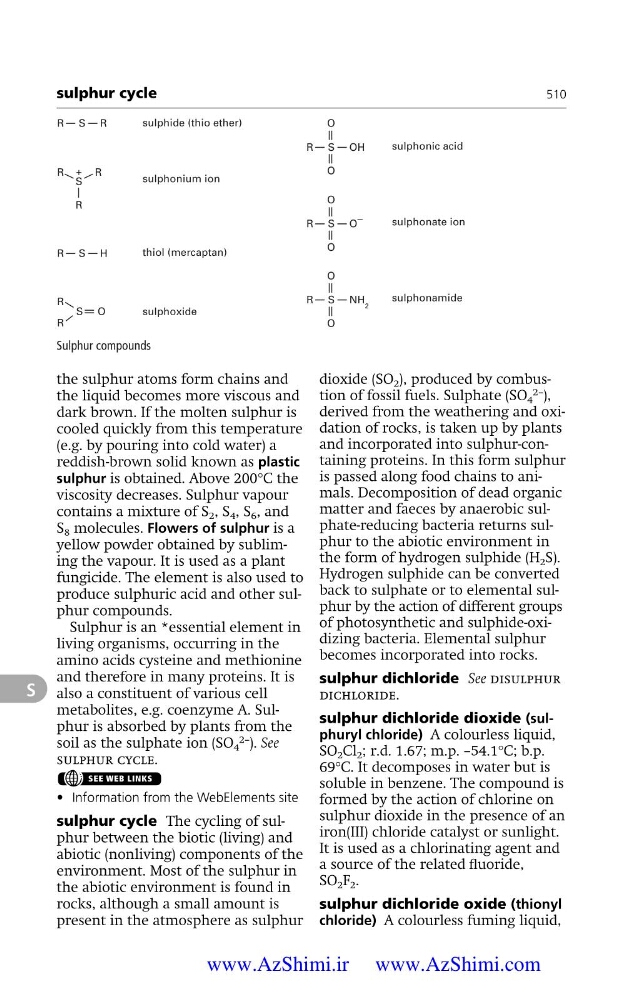
sulphide (thio ether)
sulphonium ion
thiol (mercaptan)
sulphoxide
sulphonic acid
sulphonate ion
sulphonamide
R S R
R
R
S
R
+
R S H
R
R
S O
R S OH
O
O
R S O –
O
O
R S NH 2
O
O
Sulphur compounds
www.AzShimi.ir www.AzShimi.com
510
s
the sulphur atoms form chains and
the liquid becomes more viscous and
dark brown. If the molten sulphur is
cooled quickly from this temperature
(e.g. by pouring into cold water) a
reddish-brown solid known as plastic
sulphur is obtained. Above 200°C the
viscosity decreases. Sulphur vapour
contains a mixture of S 2 , S 4 , S 6 , and
S 8 molecules. Flowers of sulphur is a
yellow powder obtained by subliming the vapour. It is used as a plant
fungicide. The element is also used to
produce sulphuric acid and other sulphur compounds.
Sulphur is an *essential element in
living organisms, occurring in the
amino acids cysteine and methionine
and therefore in many proteins. It is
also a constituent of various cell
metabolites, e.g. coenzyme A. Sulphur is absorbed by plants from the
soil as the sulphate ion (SO 4
2– ). See
sulphur cycle.
A
• Information from the WebElements site
sulphur cycle The cycling of sulphur between the biotic (living) and
abiotic (nonliving) components of the
environment. Most of the sulphur in
the abiotic environment is found in
rocks, although a small amount is
present in the atmosphere as sulphur
dioxide (SO 2 ), produced by combustion of fossil fuels. Sulphate (SO 4
2– ),
derived from the weathering and oxidation of rocks, is taken up by plants
and incorporated into sulphur-containing proteins. In this form sulphur
is passed along food chains to animals. Decomposition of dead organic
matter and faeces by anaerobic sulphate-reducing bacteria returns sulphur to the abiotic environment in
the form of hydrogen sulphide (H 2 S).
Hydrogen sulphide can be converted
back to sulphate or to elemental sulphur by the action of different groups
of photosynthetic and sulphide-oxidizing bacteria. Elemental sulphur
becomes incorporated into rocks.
sulphur dichloride See disulphur
dichloride.
sulphur dichloride dioxide (sulphuryl chloride) A colourless liquid,
SO 2 Cl 2 ; r.d. 1.67; m.p. –54.1°C; b.p.
69°C. It decomposes in water but is
soluble in benzene. The compound is
formed by the action of chlorine on
sulphur dioxide in the presence of an
iron(III) chloride catalyst or sunlight.
It is used as a chlorinating agent and
a source of the related Ûuoride,
SO 2 F 2 .
sulphur dichloride oxide (thionyl
chloride) A colourless fuming liquid,
sulphide (thio ether)
sulphonium ion
thiol (mercaptan)
sulphoxide
sulphonic acid
sulphonate ion
sulphonamide
R S R
R
R
S
R
+
R S H
R
R
S O
R S OH
O
O
R S O –
O
O
R S NH 2
O
O
Sulphur compounds
www.AzShimi.ir www.AzShimi.com