

are the two *frontier orbitals of the
molecule.
high frequency (HF) A radio frequency in the range 3–30 megahertz;
i.e. having a wavelength in the range
10–100 metres.
high-performance liquid chromatography (HPLC) A sensitive
technique for separating or analysing
mixtures, in which the sample is
forced through the chromatography
column under pressure.
high-resolution electron-loss
spectroscopy (HRELS) A technique
for obtaining information about molecules absorbed on a surface by inelastic scattering of electrons.
high-speed steel A steel that will
remain hard at dull red heat and can
therefore be used in cutting tools for
high-speed lathes. It usually contains 12–22% tungsten, up to 5%
chromium, and 0.4–0.7% carbon. It
may also contain small amounts of
vanadium, molybdenum, and other
metals.
Hilbert space A linear vector space
that can have an inÜnite number of
dimensions. The concept is of interest in physics because the state of a
system in *quantum mechanics is
represented by a vector in Hilbert
space. The dimension of the Hilbert
space has nothing to do with the
physical dimension of the system.
The Hilbert space formulation of
quantum mechanics was put forward
by the Hungarian-born US mathematician John von Neumann
(1903–57) in 1927. Other formulations of quantum mechanics, such as
*matrix mechanics and *wave mechanics, can be deduced from the
Hilbert space formulation. It is
named after the German mathematician David Hilbert (1862–1943), who
invented the concept early in the
20th century.
Hildebrand rule If the density of
the vapour phase above a liquid is
constant, the molar entropy of vaporization is constant. This law does not
hold if molecular association takes
place in the liquid or if the liquid is
subject to quantum-mechanical
effects, e.g. as in superÛuidity. The
rule is named after the US chemist
Joel Henry Hildebrand (1881–1983).
Hill reaction The release of oxygen
from isolated illuminated chloroplasts when suitable electron acceptors (e.g. potassium ferricyanide) are
added to the surrounding water. The
reaction was discovered by Robert
Hill (1899–1991) in 1939; the electron
acceptors substitute for NADP
+ , the
natural acceptor for the light-dependent reactions of *photosynthesis.
histidine See amino acid.
histochemistry The study of the
distribution of the chemical constituents of tissues by means of their
chemical reactions. It utilizes such
techniques as staining, light and electron microscopy, autoradiography,
and chromatography.
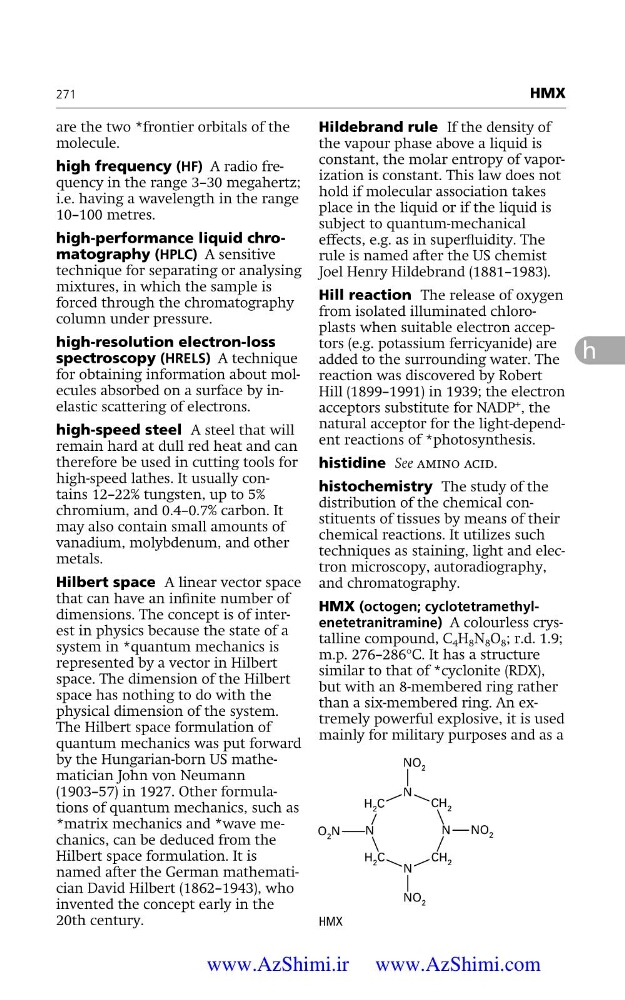
HMX (octogen; cyclotetramethylenetetranitramine) A colourless crystalline compound, C 4 H 8 N 8 O 8 ; r.d. 1.9;
m.p. 276–286°C. It has a structure
similar to that of *cyclonite (RDX),
but with an 8-membered ring rather
than a six-membered ring. An extremely powerful explosive, it is used
mainly for military purposes and as a
271
HMX
h
CH 2
N
CH 2
N
C
H 2
N
C
H 2
N
NO 2
NO 2
NO 2
O 2 N
HMX
www.AzShimi.ir www.AzShimi.com
molecule.
high frequency (HF) A radio frequency in the range 3–30 megahertz;
i.e. having a wavelength in the range
10–100 metres.
high-performance liquid chromatography (HPLC) A sensitive
technique for separating or analysing
mixtures, in which the sample is
forced through the chromatography
column under pressure.
high-resolution electron-loss
spectroscopy (HRELS) A technique
for obtaining information about molecules absorbed on a surface by inelastic scattering of electrons.
high-speed steel A steel that will
remain hard at dull red heat and can
therefore be used in cutting tools for
high-speed lathes. It usually contains 12–22% tungsten, up to 5%
chromium, and 0.4–0.7% carbon. It
may also contain small amounts of
vanadium, molybdenum, and other
metals.
Hilbert space A linear vector space
that can have an inÜnite number of
dimensions. The concept is of interest in physics because the state of a
system in *quantum mechanics is
represented by a vector in Hilbert
space. The dimension of the Hilbert
space has nothing to do with the
physical dimension of the system.
The Hilbert space formulation of
quantum mechanics was put forward
by the Hungarian-born US mathematician John von Neumann
(1903–57) in 1927. Other formulations of quantum mechanics, such as
*matrix mechanics and *wave mechanics, can be deduced from the
Hilbert space formulation. It is
named after the German mathematician David Hilbert (1862–1943), who
invented the concept early in the
20th century.
Hildebrand rule If the density of
the vapour phase above a liquid is
constant, the molar entropy of vaporization is constant. This law does not
hold if molecular association takes
place in the liquid or if the liquid is
subject to quantum-mechanical
effects, e.g. as in superÛuidity. The
rule is named after the US chemist
Joel Henry Hildebrand (1881–1983).
Hill reaction The release of oxygen
from isolated illuminated chloroplasts when suitable electron acceptors (e.g. potassium ferricyanide) are
added to the surrounding water. The
reaction was discovered by Robert
Hill (1899–1991) in 1939; the electron
acceptors substitute for NADP
+ , the
natural acceptor for the light-dependent reactions of *photosynthesis.
histidine See amino acid.
histochemistry The study of the
distribution of the chemical constituents of tissues by means of their
chemical reactions. It utilizes such
techniques as staining, light and electron microscopy, autoradiography,
and chromatography.
HMX (octogen; cyclotetramethylenetetranitramine) A colourless crystalline compound, C 4 H 8 N 8 O 8 ; r.d. 1.9;
m.p. 276–286°C. It has a structure
similar to that of *cyclonite (RDX),
but with an 8-membered ring rather
than a six-membered ring. An extremely powerful explosive, it is used
mainly for military purposes and as a
271
HMX
h
CH 2
N
CH 2
N
C
H 2
N
C
H 2
N
NO 2
NO 2
NO 2
O 2 N
HMX
www.AzShimi.ir www.AzShimi.com