

rocket propellant. The name comes
from ‘High Molecular Weight RDX’.
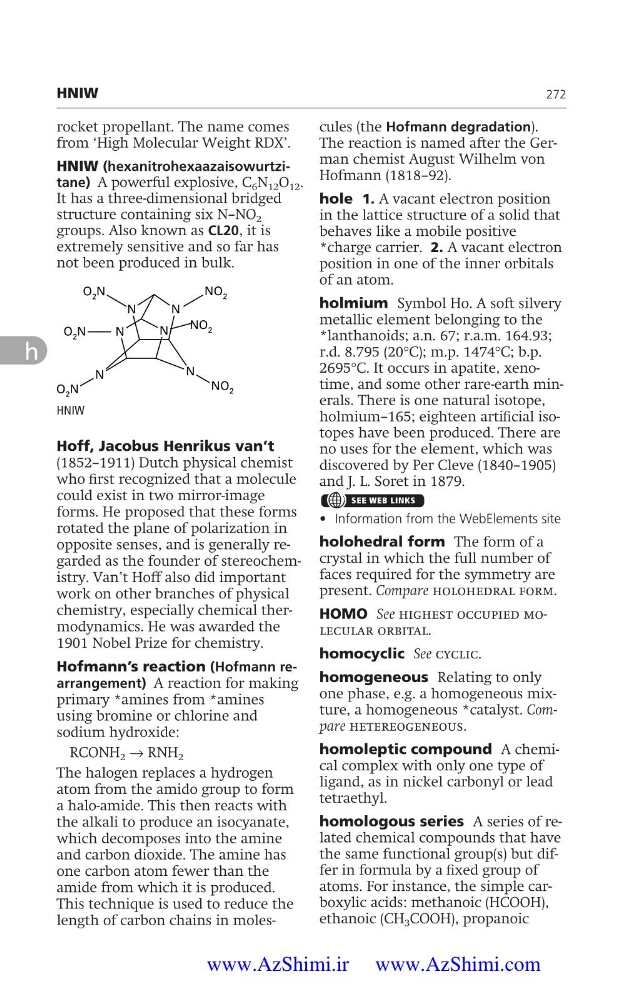
HNIW (hexanitrohexaazaisowurtzitane) A powerful explosive, C 6 N 12 O 12 .
It has a three-dimensional bridged
structure containing six N–NO 2
groups. Also known as CL20, it is
extremely sensitive and so far has
not been produced in bulk.
HNIW
272
h
N
N
N
N
N
N
NO 2
O 2 N
O 2 N
O 2 N
NO 2
NO 2
HNIW
Hoff, Jacobus Henrikus van’t
(1852–1911) Dutch physical chemist
who Ürst recognized that a molecule
could exist in two mirror-image
forms. He proposed that these forms
rotated the plane of polarization in
opposite senses, and is generally regarded as the founder of stereochemistry. Van’t Hoff also did important
work on other branches of physical
chemistry, especially chemical thermodynamics. He was awarded the
1901 Nobel Prize for chemistry.
Hofmann’s reaction (Hofmann rearrangement) A reaction for making
primary *amines from *amines
using bromine or chlorine and
sodium hydroxide:
RCONH 2 → RNH 2
The halogen replaces a hydrogen
atom from the amido group to form
a halo-amide. This then reacts with
the alkali to produce an isocyanate,
which decomposes into the amine
and carbon dioxide. The amine has
one carbon atom fewer than the
amide from which it is produced.
This technique is used to reduce the
length of carbon chains in molescules (the Hofmann degradation).
The reaction is named after the German chemist August Wilhelm von
Hofmann (1818–92).
hole 1. A vacant electron position
in the lattice structure of a solid that
behaves like a mobile positive
*charge carrier. 2. A vacant electron
position in one of the inner orbitals
of an atom.
holmium Symbol Ho. A soft silvery
metallic element belonging to the
*lanthanoids; a.n. 67; r.a.m. 164.93;
r.d. 8.795 (20°C); m.p. 1474°C; b.p.
2695°C. It occurs in apatite, xenotime, and some other rare-earth minerals. There is one natural isotope,
holmium–165; eighteen artiÜcial isotopes have been produced. There are
no uses for the element, which was
discovered by Per Cleve (1840–1905)
and J. L. Soret in 1879.
A
• Information from the WebElements site
holohedral form The form of a
crystal in which the full number of
faces required for the symmetry are
present. Compare holohedral form.
HOMO See highest occupied molecular orbital.
homocyclic See cyclic.
homogeneous Relating to only
one phase, e.g. a homogeneous mixture, a homogeneous *catalyst. Compare hetereogeneous.
homoleptic compound A chemical complex with only one type of
ligand, as in nickel carbonyl or lead
tetraethyl.
homologous series A series of related chemical compounds that have
the same functional group(s) but differ in formula by a Üxed group of
atoms. For instance, the simple carboxylic acids: methanoic (HCOOH),
ethanoic (CH 3 COOH), propanoic
www.AzShimi.ir www.AzShimi.com
from ‘High Molecular Weight RDX’.
HNIW (hexanitrohexaazaisowurtzitane) A powerful explosive, C 6 N 12 O 12 .
It has a three-dimensional bridged
structure containing six N–NO 2
groups. Also known as CL20, it is
extremely sensitive and so far has
not been produced in bulk.
HNIW
272
h
N
N
N
N
N
N
NO 2
O 2 N
O 2 N
O 2 N
NO 2
NO 2
HNIW
Hoff, Jacobus Henrikus van’t
(1852–1911) Dutch physical chemist
who Ürst recognized that a molecule
could exist in two mirror-image
forms. He proposed that these forms
rotated the plane of polarization in
opposite senses, and is generally regarded as the founder of stereochemistry. Van’t Hoff also did important
work on other branches of physical
chemistry, especially chemical thermodynamics. He was awarded the
1901 Nobel Prize for chemistry.
Hofmann’s reaction (Hofmann rearrangement) A reaction for making
primary *amines from *amines
using bromine or chlorine and
sodium hydroxide:
RCONH 2 → RNH 2
The halogen replaces a hydrogen
atom from the amido group to form
a halo-amide. This then reacts with
the alkali to produce an isocyanate,
which decomposes into the amine
and carbon dioxide. The amine has
one carbon atom fewer than the
amide from which it is produced.
This technique is used to reduce the
length of carbon chains in molescules (the Hofmann degradation).
The reaction is named after the German chemist August Wilhelm von
Hofmann (1818–92).
hole 1. A vacant electron position
in the lattice structure of a solid that
behaves like a mobile positive
*charge carrier. 2. A vacant electron
position in one of the inner orbitals
of an atom.
holmium Symbol Ho. A soft silvery
metallic element belonging to the
*lanthanoids; a.n. 67; r.a.m. 164.93;
r.d. 8.795 (20°C); m.p. 1474°C; b.p.
2695°C. It occurs in apatite, xenotime, and some other rare-earth minerals. There is one natural isotope,
holmium–165; eighteen artiÜcial isotopes have been produced. There are
no uses for the element, which was
discovered by Per Cleve (1840–1905)
and J. L. Soret in 1879.
A
• Information from the WebElements site
holohedral form The form of a
crystal in which the full number of
faces required for the symmetry are
present. Compare holohedral form.
HOMO See highest occupied molecular orbital.
homocyclic See cyclic.
homogeneous Relating to only
one phase, e.g. a homogeneous mixture, a homogeneous *catalyst. Compare hetereogeneous.
homoleptic compound A chemical complex with only one type of
ligand, as in nickel carbonyl or lead
tetraethyl.
homologous series A series of related chemical compounds that have
the same functional group(s) but differ in formula by a Üxed group of
atoms. For instance, the simple carboxylic acids: methanoic (HCOOH),
ethanoic (CH 3 COOH), propanoic
www.AzShimi.ir www.AzShimi.com