

227°C. It is made by the chlorination
of benzene with an iron(III) chloride
catalyst or by treating hexachlorocyclohexane with chlorine in hexachloroethane. It is used to preserve
wood and dress seeds, and in the
manufacture of hexaÛuorobenzene.
hexacyanoferrate(II) (ferrocyanide) A complex iron-containing
anion, [Fe(CN 6 )]
4–
, used as a solution
of its potassium salt as a test for ferric iron (iron(III)), with which it
forms a dark blue precipitate of
Prussian blue. The sodium salt is
used as an anticaking agent in common salt.
hexacyanoferrate(III) (ferricyanide) A complex iron-containing
anion, [Fe(CN) 6 )]
3– , used as a solution
of its potassium salt as a test for ferrous iron (iron(II)), with which it
forms a dark blue precipitate of
Prussian blue.
hexadecane (cetane) A colourless
liquid straight-chain alkane hydrocarbon, C 16 H 34 , used in standardizing
*cetane numbers of Diesel fuel.
hexadecanoate See palmitate.
hexadecanoic acid See palmitic
acid.
hexagonal close packing See
close packing.
hexagonal crystal See crystal system.
hexahydrate A crystalline compound that has six moles of water
per mole of compound.
hexamethylenetetramine See
hexamine.
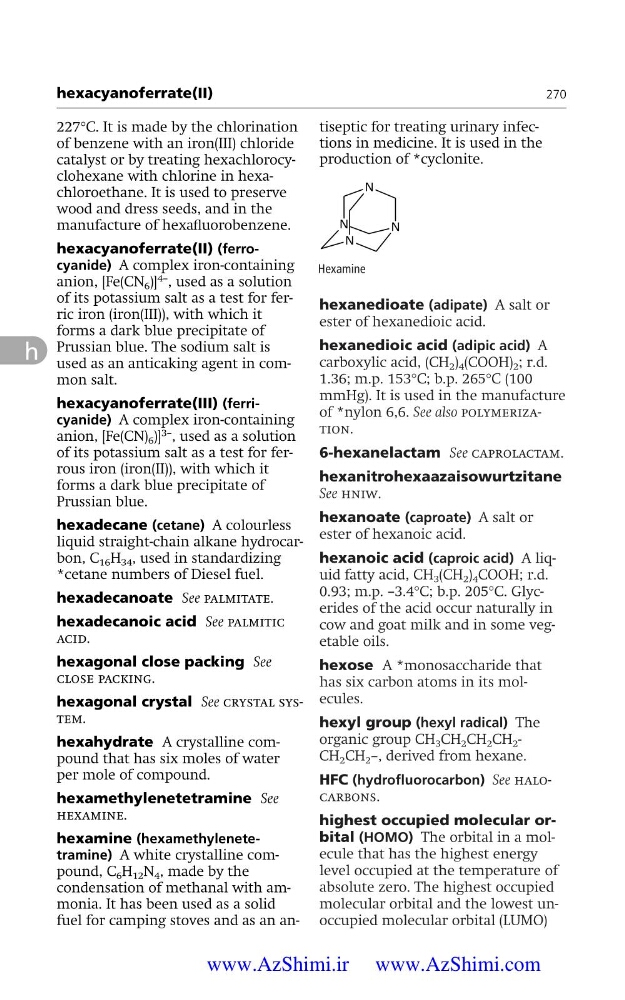
hexamine (hexamethylenetetramine) A white crystalline compound, C 6 H 12 N 4 , made by the
condensation of methanal with ammonia. It has been used as a solid
fuel for camping stoves and as an antiseptic for treating urinary infections in medicine. It is used in the
production of *cyclonite.
hexacyanoferrate(II)
270
h
N
N
N
N
Hexamine
hexanedioate (adipate) A salt or
ester of hexanedioic acid.
hexanedioic acid (adipic acid) A
carboxylic acid, (CH 2 ) 4 (COOH) 2 ; r.d.
1.36; m.p. 153°C; b.p. 265°C (100
mmHg). It is used in the manufacture
of *nylon 6,6. See also polymerization.
6-hexanelactam See caprolactam.
hexanitrohexaazaisowurtzitane
See hniw.
hexanoate (caproate) A salt or
ester of hexanoic acid.
hexanoic acid (caproic acid) A liquid fatty acid, CH 3 (CH 2 ) 4 COOH; r.d.
0.93; m.p. –3.4°C; b.p. 205°C. Glycerides of the acid occur naturally in
cow and goat milk and in some vegetable oils.
hexose A *monosaccharide that
has six carbon atoms in its molecules.
hexyl group (hexyl radical) The
organic group CH 3 CH 2 CH 2 CH 2 -
CH 2 CH 2 –, derived from hexane.
HFC (hydroÛuorocarbon) See halocarbons.
highest occupied molecular orbital (HOMO) The orbital in a molecule that has the highest energy
level occupied at the temperature of
absolute zero. The highest occupied
molecular orbital and the lowest unoccupied molecular orbital (LUMO)
www.AzShimi.ir www.AzShimi.com
of benzene with an iron(III) chloride
catalyst or by treating hexachlorocyclohexane with chlorine in hexachloroethane. It is used to preserve
wood and dress seeds, and in the
manufacture of hexaÛuorobenzene.
hexacyanoferrate(II) (ferrocyanide) A complex iron-containing
anion, [Fe(CN 6 )]
4–
, used as a solution
of its potassium salt as a test for ferric iron (iron(III)), with which it
forms a dark blue precipitate of
Prussian blue. The sodium salt is
used as an anticaking agent in common salt.
hexacyanoferrate(III) (ferricyanide) A complex iron-containing
anion, [Fe(CN) 6 )]
3– , used as a solution
of its potassium salt as a test for ferrous iron (iron(II)), with which it
forms a dark blue precipitate of
Prussian blue.
hexadecane (cetane) A colourless
liquid straight-chain alkane hydrocarbon, C 16 H 34 , used in standardizing
*cetane numbers of Diesel fuel.
hexadecanoate See palmitate.
hexadecanoic acid See palmitic
acid.
hexagonal close packing See
close packing.
hexagonal crystal See crystal system.
hexahydrate A crystalline compound that has six moles of water
per mole of compound.
hexamethylenetetramine See
hexamine.
hexamine (hexamethylenetetramine) A white crystalline compound, C 6 H 12 N 4 , made by the
condensation of methanal with ammonia. It has been used as a solid
fuel for camping stoves and as an antiseptic for treating urinary infections in medicine. It is used in the
production of *cyclonite.
hexacyanoferrate(II)
270
h
N
N
N
N
Hexamine
hexanedioate (adipate) A salt or
ester of hexanedioic acid.
hexanedioic acid (adipic acid) A
carboxylic acid, (CH 2 ) 4 (COOH) 2 ; r.d.
1.36; m.p. 153°C; b.p. 265°C (100
mmHg). It is used in the manufacture
of *nylon 6,6. See also polymerization.
6-hexanelactam See caprolactam.
hexanitrohexaazaisowurtzitane
See hniw.
hexanoate (caproate) A salt or
ester of hexanoic acid.
hexanoic acid (caproic acid) A liquid fatty acid, CH 3 (CH 2 ) 4 COOH; r.d.
0.93; m.p. –3.4°C; b.p. 205°C. Glycerides of the acid occur naturally in
cow and goat milk and in some vegetable oils.
hexose A *monosaccharide that
has six carbon atoms in its molecules.
hexyl group (hexyl radical) The
organic group CH 3 CH 2 CH 2 CH 2 -
CH 2 CH 2 –, derived from hexane.
HFC (hydroÛuorocarbon) See halocarbons.
highest occupied molecular orbital (HOMO) The orbital in a molecule that has the highest energy
level occupied at the temperature of
absolute zero. The highest occupied
molecular orbital and the lowest unoccupied molecular orbital (LUMO)
www.AzShimi.ir www.AzShimi.com