

elimination of another molecule (see
condensation reaction).
additive A substance added to another substance or material to improve its properties in some way.
Additives are often present in small
amounts and are used for a variety of
purposes, as in preventing corrosion,
stabilizing polymers, and preserving
and improving foods (see food additive).
adduct A compound formed by an
addition reaction. The term is used
particularly for compounds formed
by coordination between a Lewis acid
(acceptor) and a Lewis base (donor).
See acid.
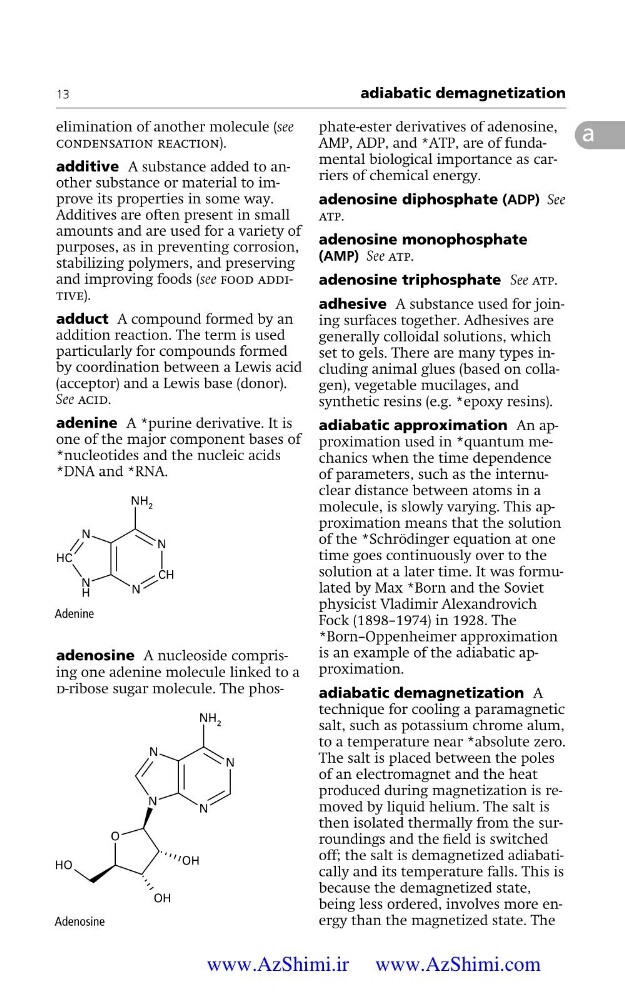
adenine A *purine derivative. It is
one of the major component bases of
*nucleotides and the nucleic acids
*DNA and *RNA.
13
adiabatic demagnetization
a
N
H
C
H
N
N
CH
N
NH 2
Adenine
N
O
N
N
OH
OH
N
NH 2
O
H
Adenosine
adenosine A nucleoside comprising one adenine molecule linked to a
d-ribose sugar molecule. The phosphate-ester derivatives of adenosine,
AMP, ADP, and *ATP, are of fundamental biological importance as carriers of chemical energy.
adenosine diphosphate (ADP) See
atp.
adenosine monophosphate
(AMP) See atp.
adenosine triphosphate See atp.
adhesive A substance used for joining surfaces together. Adhesives are
generally colloidal solutions, which
set to gels. There are many types including animal glues (based on collagen), vegetable mucilages, and
synthetic resins (e.g. *epoxy resins).
adiabatic approximation An approximation used in *quantum mechanics when the time dependence
of parameters, such as the internuclear distance between atoms in a
molecule, is slowly varying. This approximation means that the solution
of the *Schrödinger equation at one
time goes continuously over to the
solution at a later time. It was formulated by Max *Born and the Soviet
physicist Vladimir Alexandrovich
Fock (1898–1974) in 1928. The
*Born–Oppenheimer approximation
is an example of the adiabatic approximation.
adiabatic demagnetization A
technique for cooling a paramagnetic
salt, such as potassium chrome alum,
to a temperature near *absolute zero.
The salt is placed between the poles
of an electromagnet and the heat
produced during magnetization is removed by liquid helium. The salt is
then isolated thermally from the surroundings and the Üeld is switched
off; the salt is demagnetized adiabatically and its temperature falls. This is
because the demagnetized state,
being less ordered, involves more energy than the magnetized state. The
www.AzShimi.ir www.AzShimi.com
condensation reaction).
additive A substance added to another substance or material to improve its properties in some way.
Additives are often present in small
amounts and are used for a variety of
purposes, as in preventing corrosion,
stabilizing polymers, and preserving
and improving foods (see food additive).
adduct A compound formed by an
addition reaction. The term is used
particularly for compounds formed
by coordination between a Lewis acid
(acceptor) and a Lewis base (donor).
See acid.
adenine A *purine derivative. It is
one of the major component bases of
*nucleotides and the nucleic acids
*DNA and *RNA.
13
adiabatic demagnetization
a
N
H
C
H
N
N
CH
N
NH 2
Adenine
N
O
N
N
OH
OH
N
NH 2
O
H
Adenosine
adenosine A nucleoside comprising one adenine molecule linked to a
d-ribose sugar molecule. The phosphate-ester derivatives of adenosine,
AMP, ADP, and *ATP, are of fundamental biological importance as carriers of chemical energy.
adenosine diphosphate (ADP) See
atp.
adenosine monophosphate
(AMP) See atp.
adenosine triphosphate See atp.
adhesive A substance used for joining surfaces together. Adhesives are
generally colloidal solutions, which
set to gels. There are many types including animal glues (based on collagen), vegetable mucilages, and
synthetic resins (e.g. *epoxy resins).
adiabatic approximation An approximation used in *quantum mechanics when the time dependence
of parameters, such as the internuclear distance between atoms in a
molecule, is slowly varying. This approximation means that the solution
of the *Schrödinger equation at one
time goes continuously over to the
solution at a later time. It was formulated by Max *Born and the Soviet
physicist Vladimir Alexandrovich
Fock (1898–1974) in 1928. The
*Born–Oppenheimer approximation
is an example of the adiabatic approximation.
adiabatic demagnetization A
technique for cooling a paramagnetic
salt, such as potassium chrome alum,
to a temperature near *absolute zero.
The salt is placed between the poles
of an electromagnet and the heat
produced during magnetization is removed by liquid helium. The salt is
then isolated thermally from the surroundings and the Üeld is switched
off; the salt is demagnetized adiabatically and its temperature falls. This is
because the demagnetized state,
being less ordered, involves more energy than the magnetized state. The
www.AzShimi.ir www.AzShimi.com