

extra energy can come only from the
internal, or thermal, energy of the
substance.
adiabatic process Any process
that occurs without heat entering or
leaving a system. In general, an adiabatic change involves a fall or rise in
temperature of the system. For example, if a gas expands under adiabatic
conditions, its temperature falls
(work is done against the retreating
walls of the container). The adiabatic
equation describes the relationship
between the pressure (p) of an ideal
gas and its volume (V), i.e. pV
γ = K,
where γ is the ratio of the principal
speciÜc *heat capacities of the gas
and K is a constant.
adipic acid See hexanedioic acid.
ADP See atp.
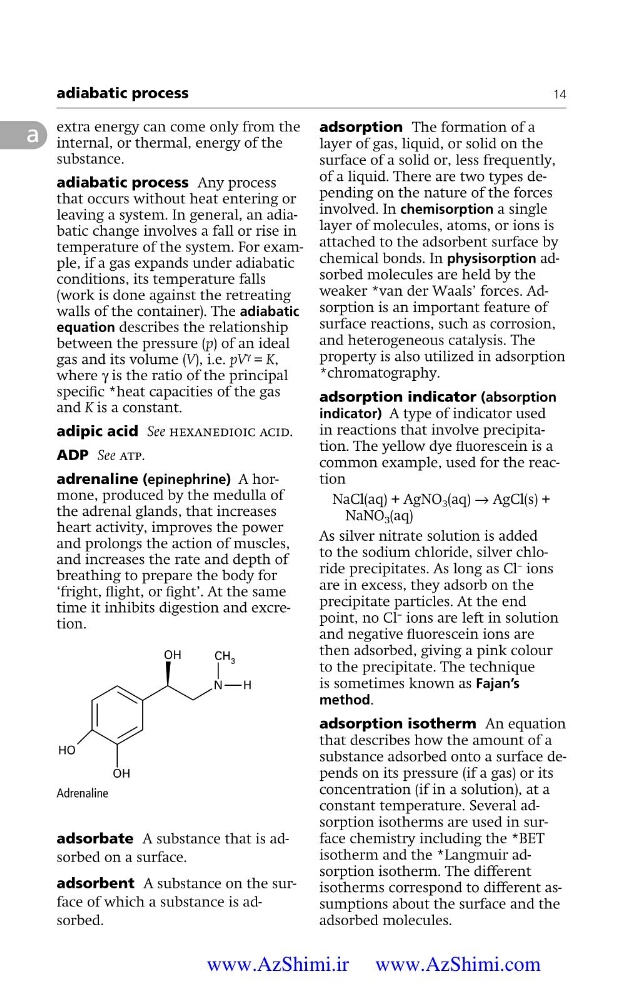
adrenaline (epinephrine) A hormone, produced by the medulla of
the adrenal glands, that increases
heart activity, improves the power
and prolongs the action of muscles,
and increases the rate and depth of
breathing to prepare the body for
‘fright, Ûight, or Üght’. At the same
time it inhibits digestion and excretion.
adiabatic process
14
a
adsorbate A substance that is adsorbed on a surface.
adsorbent A substance on the surface of which a substance is adsorbed.
adsorption The formation of a
layer of gas, liquid, or solid on the
surface of a solid or, less frequently,
of a liquid. There are two types depending on the nature of the forces
involved. In chemisorption a single
layer of molecules, atoms, or ions is
attached to the adsorbent surface by
chemical bonds. In physisorption adsorbed molecules are held by the
weaker *van der Waals’ forces. Adsorption is an important feature of
surface reactions, such as corrosion,
and heterogeneous catalysis. The
property is also utilized in adsorption
*chromatography.
adsorption indicator (absorption
indicator) A type of indicator used
in reactions that involve precipitation. The yellow dye Ûuorescein is a
common example, used for the reaction
NaCl(aq) + AgNO 3 (aq) → AgCl(s) +
NaNO 3 (aq)
As silver nitrate solution is added
to the sodium chloride, silver chloride precipitates. As long as Cl
– ions
are in excess, they adsorb on the
precipitate particles. At the end
point, no Cl
– ions are left in solution
and negative Ûuorescein ions are
then adsorbed, giving a pink colour
to the precipitate. The technique
is sometimes known as Fajan’s
method.
adsorption isotherm An equation
that describes how the amount of a
substance adsorbed onto a surface depends on its pressure (if a gas) or its
concentration (if in a solution), at a
constant temperature. Several adsorption isotherms are used in surface chemistry including the *BET
isotherm and the *Langmuir adsorption isotherm. The different
isotherms correspond to different assumptions about the surface and the
adsorbed molecules.
O
H
OH
N
H
CH 3
OH
Adrenaline
www.AzShimi.ir www.AzShimi.com
internal, or thermal, energy of the
substance.
adiabatic process Any process
that occurs without heat entering or
leaving a system. In general, an adiabatic change involves a fall or rise in
temperature of the system. For example, if a gas expands under adiabatic
conditions, its temperature falls
(work is done against the retreating
walls of the container). The adiabatic
equation describes the relationship
between the pressure (p) of an ideal
gas and its volume (V), i.e. pV
γ = K,
where γ is the ratio of the principal
speciÜc *heat capacities of the gas
and K is a constant.
adipic acid See hexanedioic acid.
ADP See atp.
adrenaline (epinephrine) A hormone, produced by the medulla of
the adrenal glands, that increases
heart activity, improves the power
and prolongs the action of muscles,
and increases the rate and depth of
breathing to prepare the body for
‘fright, Ûight, or Üght’. At the same
time it inhibits digestion and excretion.
adiabatic process
14
a
adsorbate A substance that is adsorbed on a surface.
adsorbent A substance on the surface of which a substance is adsorbed.
adsorption The formation of a
layer of gas, liquid, or solid on the
surface of a solid or, less frequently,
of a liquid. There are two types depending on the nature of the forces
involved. In chemisorption a single
layer of molecules, atoms, or ions is
attached to the adsorbent surface by
chemical bonds. In physisorption adsorbed molecules are held by the
weaker *van der Waals’ forces. Adsorption is an important feature of
surface reactions, such as corrosion,
and heterogeneous catalysis. The
property is also utilized in adsorption
*chromatography.
adsorption indicator (absorption
indicator) A type of indicator used
in reactions that involve precipitation. The yellow dye Ûuorescein is a
common example, used for the reaction
NaCl(aq) + AgNO 3 (aq) → AgCl(s) +
NaNO 3 (aq)
As silver nitrate solution is added
to the sodium chloride, silver chloride precipitates. As long as Cl
– ions
are in excess, they adsorb on the
precipitate particles. At the end
point, no Cl
– ions are left in solution
and negative Ûuorescein ions are
then adsorbed, giving a pink colour
to the precipitate. The technique
is sometimes known as Fajan’s
method.
adsorption isotherm An equation
that describes how the amount of a
substance adsorbed onto a surface depends on its pressure (if a gas) or its
concentration (if in a solution), at a
constant temperature. Several adsorption isotherms are used in surface chemistry including the *BET
isotherm and the *Langmuir adsorption isotherm. The different
isotherms correspond to different assumptions about the surface and the
adsorbed molecules.
O
H
OH
N
H
CH 3
OH
Adrenaline
www.AzShimi.ir www.AzShimi.com