

activity series See electromotive
series.
acyclic Describing a compound
that does not have a ring in its molecules.
acyl anhydrides See acid anhydrides.
acylation The process of introducing an acyl group (RCO–) into a compound. The usual method is to react
an alcohol with an acyl halide or a
carboxylic acid anhydride; e.g.
RCOCl + R′OH → RCOOR′ + HCl
The introduction of an acetyl group
(CH 3 CO–) is acetylation, a process
used for protecting –OH groups in organic synthesis.
acyl Üssion The breaking of the
carbon–oxygen bond in an acyl
group. It occurs in the hydrolysis of
an *ester to produce an alcohol and a
carboxylic acid.
acylglycerols See glycerides.
acyl group A group of the type
RCO–, where R is an organic group.
An example is the acetyl group
CH 3 CO–.
acyl halides (acid halides) Organic
compounds containing the group
–CO.X, where X is a halogen atom
(see formula). Acyl chlorides, for instance, have the general formula
RCOCl. The group RCO– is the acyl
group. In systematic chemical nomenclature acyl-halide names end in the
sufÜx -oyl; for example, ethanoyl
chloride, CH 3 COCl. Acyl halides react
readily with water, alcohols, phenols,
and amines and are used in *acylation reactions. They are made by
replacing the –OH group in a carboxylic acid by a halogen using a
halogenating agent such as PCl 5 .
A
• Information about IUPAC nomenclature
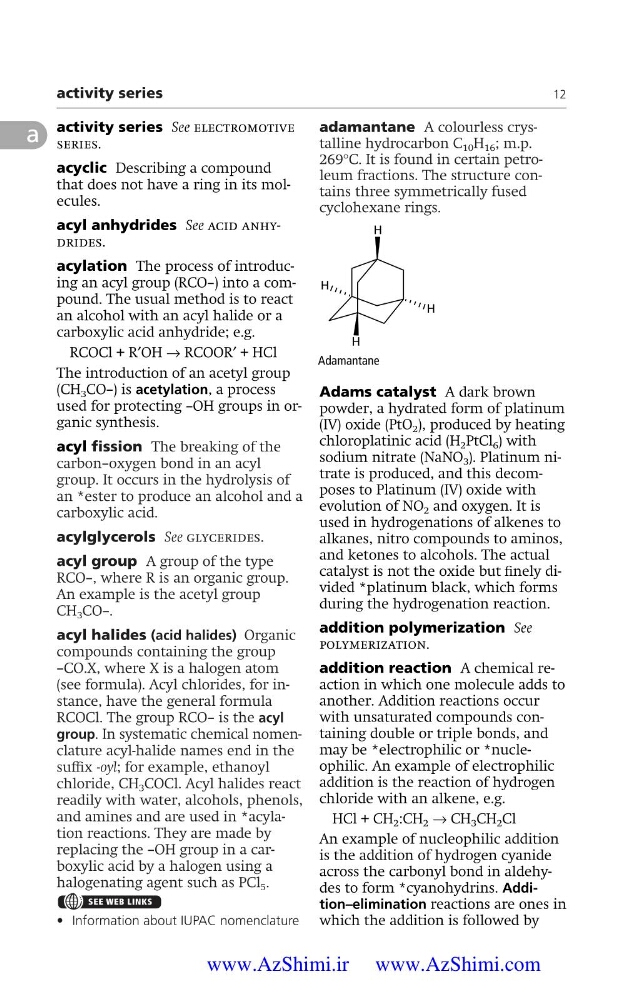
adamantane A colourless crystalline hydrocarbon C 10 H 16 ; m.p.
269°C. It is found in certain petroleum fractions. The structure contains three symmetrically fused
cyclohexane rings.
activity series
12
a
Adams catalyst A dark brown
powder, a hydrated form of platinum
(IV) oxide (PtO 2 ), produced by heating
chloroplatinic acid (H 2 PtCl 6 ) with
sodium nitrate (NaNO 3 ). Platinum nitrate is produced, and this decomposes to Platinum (IV) oxide with
evolution of NO 2 and oxygen. It is
used in hydrogenations of alkenes to
alkanes, nitro compounds to aminos,
and ketones to alcohols. The actual
catalyst is not the oxide but Ünely divided *platinum black, which forms
during the hydrogenation reaction.
addition polymerization See
polymerization.
addition reaction A chemical reaction in which one molecule adds to
another. Addition reactions occur
with unsaturated compounds containing double or triple bonds, and
may be *electrophilic or *nucleophilic. An example of electrophilic
addition is the reaction of hydrogen
chloride with an alkene, e.g.
HCl + CH 2 :CH 2 → CH 3 CH 2 Cl
An example of nucleophilic addition
is the addition of hydrogen cyanide
across the carbonyl bond in aldehydes to form *cyanohydrins. Addition–elimination reactions are ones in
which the addition is followed by
H
H
H
H
Adamantane
www.AzShimi.ir www.AzShimi.com
series.
acyclic Describing a compound
that does not have a ring in its molecules.
acyl anhydrides See acid anhydrides.
acylation The process of introducing an acyl group (RCO–) into a compound. The usual method is to react
an alcohol with an acyl halide or a
carboxylic acid anhydride; e.g.
RCOCl + R′OH → RCOOR′ + HCl
The introduction of an acetyl group
(CH 3 CO–) is acetylation, a process
used for protecting –OH groups in organic synthesis.
acyl Üssion The breaking of the
carbon–oxygen bond in an acyl
group. It occurs in the hydrolysis of
an *ester to produce an alcohol and a
carboxylic acid.
acylglycerols See glycerides.
acyl group A group of the type
RCO–, where R is an organic group.
An example is the acetyl group
CH 3 CO–.
acyl halides (acid halides) Organic
compounds containing the group
–CO.X, where X is a halogen atom
(see formula). Acyl chlorides, for instance, have the general formula
RCOCl. The group RCO– is the acyl
group. In systematic chemical nomenclature acyl-halide names end in the
sufÜx -oyl; for example, ethanoyl
chloride, CH 3 COCl. Acyl halides react
readily with water, alcohols, phenols,
and amines and are used in *acylation reactions. They are made by
replacing the –OH group in a carboxylic acid by a halogen using a
halogenating agent such as PCl 5 .
A
• Information about IUPAC nomenclature
adamantane A colourless crystalline hydrocarbon C 10 H 16 ; m.p.
269°C. It is found in certain petroleum fractions. The structure contains three symmetrically fused
cyclohexane rings.
activity series
12
a
Adams catalyst A dark brown
powder, a hydrated form of platinum
(IV) oxide (PtO 2 ), produced by heating
chloroplatinic acid (H 2 PtCl 6 ) with
sodium nitrate (NaNO 3 ). Platinum nitrate is produced, and this decomposes to Platinum (IV) oxide with
evolution of NO 2 and oxygen. It is
used in hydrogenations of alkenes to
alkanes, nitro compounds to aminos,
and ketones to alcohols. The actual
catalyst is not the oxide but Ünely divided *platinum black, which forms
during the hydrogenation reaction.
addition polymerization See
polymerization.
addition reaction A chemical reaction in which one molecule adds to
another. Addition reactions occur
with unsaturated compounds containing double or triple bonds, and
may be *electrophilic or *nucleophilic. An example of electrophilic
addition is the reaction of hydrogen
chloride with an alkene, e.g.
HCl + CH 2 :CH 2 → CH 3 CH 2 Cl
An example of nucleophilic addition
is the addition of hydrogen cyanide
across the carbonyl bond in aldehydes to form *cyanohydrins. Addition–elimination reactions are ones in
which the addition is followed by
H
H
H
H
Adamantane
www.AzShimi.ir www.AzShimi.com