

minimum energy required for a
chemical reaction to take place. In a
reaction, the reactant molecules
come together and chemical bonds
are stretched, broken, and formed in
producing the products. During this
process the energy of the system increases to a maximum, then decreases
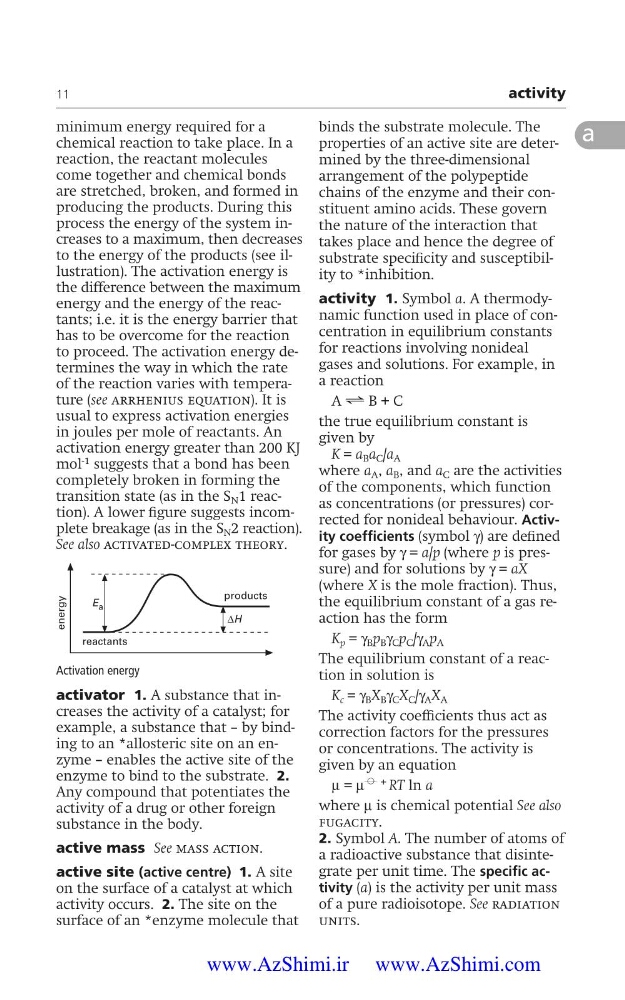
to the energy of the products (see illustration). The activation energy is
the difference between the maximum
energy and the energy of the reactants; i.e. it is the energy barrier that
has to be overcome for the reaction
to proceed. The activation energy determines the way in which the rate
of the reaction varies with temperature (see arrhenius equation). It is
usual to express activation energies
in joules per mole of reactants. An
activation energy greater than 200 KJ
mol
-1 suggests that a bond has been
completely broken in forming the
transition state (as in the S N 1 reaction). A lower Ügure suggests incomplete breakage (as in the S N 2 reaction).
See also activated-complex theory.
11
activity
a
energy
products
E a
∆H
reactants
Activation energy
activator 1. A substance that increases the activity of a catalyst; for
example, a substance that – by binding to an *allosteric site on an enzyme – enables the active site of the
enzyme to bind to the substrate. 2.
Any compound that potentiates the
activity of a drug or other foreign
substance in the body.
active mass See mass action.
active site (active centre) 1. A site
on the surface of a catalyst at which
activity occurs. 2. The site on the
surface of an *enzyme molecule that
binds the substrate molecule. The
properties of an active site are determined by the three-dimensional
arrangement of the polypeptide
chains of the enzyme and their constituent amino acids. These govern
the nature of the interaction that
takes place and hence the degree of
substrate speciÜcity and susceptibility to *inhibition.
activity 1. Symbol a. A thermodynamic function used in place of concentration in equilibrium constants
for reactions involving nonideal
gases and solutions. For example, in
a reaction
A ˆ B + C
the true equilibrium constant is
given by
K = a B a C /a A
where a A , a B , and a C are the activities
of the components, which function
as concentrations (or pressures) corrected for nonideal behaviour. Activity coefÜcients (symbol γ) are deÜned
for gases by γ = a/p (where p is pressure) and for solutions by γ = aX
(where X is the mole fraction). Thus,
the equilibrium constant of a gas reaction has the form
K p = γ B p B γ C p C /γ A p A
The equilibrium constant of a reaction in solution is
K c = γ B X B γ C X C /γ A X A
The activity coefÜcients thus act as
correction factors for the pressures
or concentrations. The activity is
given by an equation
µ = µŠ
+ RT ln a
where µ is chemical potential See also
fugacity.
2. Symbol A. The number of atoms of
a radioactive substance that disintegrate per unit time. The speciÜc activity (a) is the activity per unit mass
of a pure radioisotope. See radiation
units.
www.AzShimi.ir www.AzShimi.com
chemical reaction to take place. In a
reaction, the reactant molecules
come together and chemical bonds
are stretched, broken, and formed in
producing the products. During this
process the energy of the system increases to a maximum, then decreases
to the energy of the products (see illustration). The activation energy is
the difference between the maximum
energy and the energy of the reactants; i.e. it is the energy barrier that
has to be overcome for the reaction
to proceed. The activation energy determines the way in which the rate
of the reaction varies with temperature (see arrhenius equation). It is
usual to express activation energies
in joules per mole of reactants. An
activation energy greater than 200 KJ
mol
-1 suggests that a bond has been
completely broken in forming the
transition state (as in the S N 1 reaction). A lower Ügure suggests incomplete breakage (as in the S N 2 reaction).
See also activated-complex theory.
11
activity
a
energy
products
E a
∆H
reactants
Activation energy
activator 1. A substance that increases the activity of a catalyst; for
example, a substance that – by binding to an *allosteric site on an enzyme – enables the active site of the
enzyme to bind to the substrate. 2.
Any compound that potentiates the
activity of a drug or other foreign
substance in the body.
active mass See mass action.
active site (active centre) 1. A site
on the surface of a catalyst at which
activity occurs. 2. The site on the
surface of an *enzyme molecule that
binds the substrate molecule. The
properties of an active site are determined by the three-dimensional
arrangement of the polypeptide
chains of the enzyme and their constituent amino acids. These govern
the nature of the interaction that
takes place and hence the degree of
substrate speciÜcity and susceptibility to *inhibition.
activity 1. Symbol a. A thermodynamic function used in place of concentration in equilibrium constants
for reactions involving nonideal
gases and solutions. For example, in
a reaction
A ˆ B + C
the true equilibrium constant is
given by
K = a B a C /a A
where a A , a B , and a C are the activities
of the components, which function
as concentrations (or pressures) corrected for nonideal behaviour. Activity coefÜcients (symbol γ) are deÜned
for gases by γ = a/p (where p is pressure) and for solutions by γ = aX
(where X is the mole fraction). Thus,
the equilibrium constant of a gas reaction has the form
K p = γ B p B γ C p C /γ A p A
The equilibrium constant of a reaction in solution is
K c = γ B X B γ C X C /γ A X A
The activity coefÜcients thus act as
correction factors for the pressures
or concentrations. The activity is
given by an equation
µ = µŠ
+ RT ln a
where µ is chemical potential See also
fugacity.
2. Symbol A. The number of atoms of
a radioactive substance that disintegrate per unit time. The speciÜc activity (a) is the activity per unit mass
of a pure radioisotope. See radiation
units.
www.AzShimi.ir www.AzShimi.com