

form constitute a pair of diastereoisomers. See optical activity.
diatomaceous earth See kieselguhr.
diatomic molecule A molecule
formed from two atoms (e.g. H 2 or
HCl).
diatomite See kieselguhr.
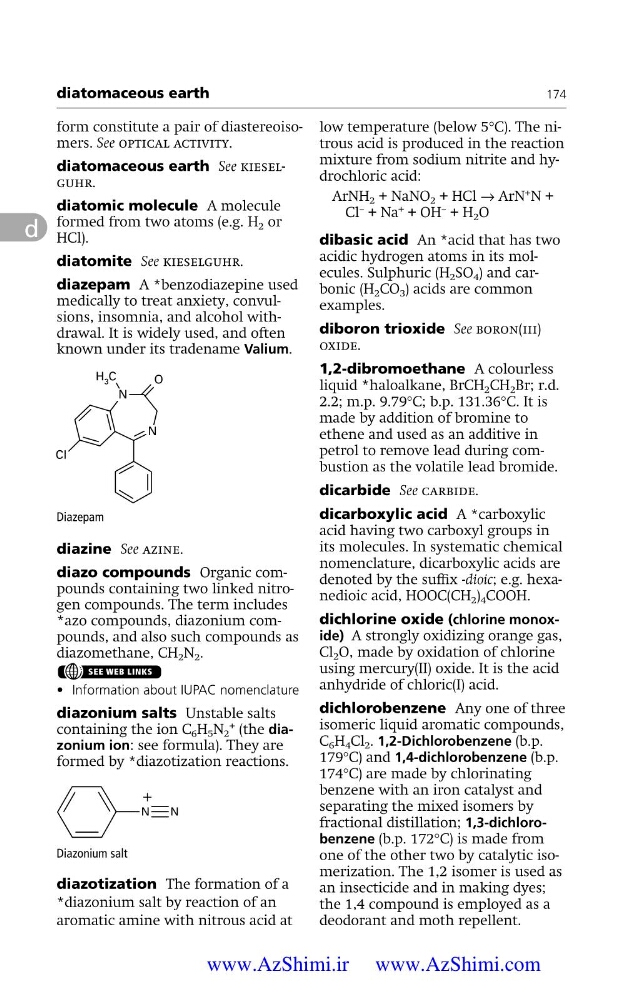
diazepam A *benzodiazepine used
medically to treat anxiety, convulsions, insomnia, and alcohol withdrawal. It is widely used, and often
known under its tradename Valium.
diazine See azine.
diazo compounds Organic compounds containing two linked nitrogen compounds. The term includes
*azo compounds, diazonium compounds, and also such compounds as
diazomethane, CH 2 N 2 .
A
• Information about IUPAC nomenclature
diazonium salts Unstable salts
containing the ion C 6 H 5 N 2
+ (the diazonium ion: see formula). They are
formed by *diazotization reactions.
diatomaceous earth
174
d
N
N
C
H 3
O
Cl
Diazepam
0
0
Diazonium salt
diazotization The formation of a
*diazonium salt by reaction of an
aromatic amine with nitrous acid at
low temperature (below 5°C). The nitrous acid is produced in the reaction
mixture from sodium nitrite and hydrochloric acid:
ArNH 2 + NaNO 2 + HCl → ArN
+ N +
Cl
– + Na
+ + OH
– + H 2 O
dibasic acid An *acid that has two
acidic hydrogen atoms in its molecules. Sulphuric (H 2 SO 4 ) and carbonic (H 2 CO 3 ) acids are common
examples.
diboron trioxide See boron(iii)
oxide.
1,2-dibromoethane A colourless
liquid *haloalkane, BrCH 2 CH 2 Br; r.d.
2.2; m.p. 9.79°C; b.p. 131.36°C. It is
made by addition of bromine to
ethene and used as an additive in
petrol to remove lead during combustion as the volatile lead bromide.
dicarbide See carbide.
dicarboxylic acid A *carboxylic
acid having two carboxyl groups in
its molecules. In systematic chemical
nomenclature, dicarboxylic acids are
denoted by the sufÜx -dioic; e.g. hexanedioic acid, HOOC(CH 2 ) 4 COOH.
dichlorine oxide (chlorine monoxide) A strongly oxidizing orange gas,
Cl 2 O, made by oxidation of chlorine
using mercury(II) oxide. It is the acid
anhydride of chloric(I) acid.
dichlorobenzene Any one of three
isomeric liquid aromatic compounds,
C 6 H 4 Cl 2 . 1,2-Dichlorobenzene (b.p.
179°C) and 1,4-dichlorobenzene (b.p.
174°C) are made by chlorinating
benzene with an iron catalyst and
separating the mixed isomers by
fractional distillation; 1,3-dichlorobenzene (b.p. 172°C) is made from
one of the other two by catalytic isomerization. The 1,2 isomer is used as
an insecticide and in making dyes;
the 1,4 compound is employed as a
deodorant and moth repellent.
www.AzShimi.ir www.AzShimi.com
diatomaceous earth See kieselguhr.
diatomic molecule A molecule
formed from two atoms (e.g. H 2 or
HCl).
diatomite See kieselguhr.
diazepam A *benzodiazepine used
medically to treat anxiety, convulsions, insomnia, and alcohol withdrawal. It is widely used, and often
known under its tradename Valium.
diazine See azine.
diazo compounds Organic compounds containing two linked nitrogen compounds. The term includes
*azo compounds, diazonium compounds, and also such compounds as
diazomethane, CH 2 N 2 .
A
• Information about IUPAC nomenclature
diazonium salts Unstable salts
containing the ion C 6 H 5 N 2
+ (the diazonium ion: see formula). They are
formed by *diazotization reactions.
diatomaceous earth
174
d
N
N
C
H 3
O
Cl
Diazepam
0
0
Diazonium salt
diazotization The formation of a
*diazonium salt by reaction of an
aromatic amine with nitrous acid at
low temperature (below 5°C). The nitrous acid is produced in the reaction
mixture from sodium nitrite and hydrochloric acid:
ArNH 2 + NaNO 2 + HCl → ArN
+ N +
Cl
– + Na
+ + OH
– + H 2 O
dibasic acid An *acid that has two
acidic hydrogen atoms in its molecules. Sulphuric (H 2 SO 4 ) and carbonic (H 2 CO 3 ) acids are common
examples.
diboron trioxide See boron(iii)
oxide.
1,2-dibromoethane A colourless
liquid *haloalkane, BrCH 2 CH 2 Br; r.d.
2.2; m.p. 9.79°C; b.p. 131.36°C. It is
made by addition of bromine to
ethene and used as an additive in
petrol to remove lead during combustion as the volatile lead bromide.
dicarbide See carbide.
dicarboxylic acid A *carboxylic
acid having two carboxyl groups in
its molecules. In systematic chemical
nomenclature, dicarboxylic acids are
denoted by the sufÜx -dioic; e.g. hexanedioic acid, HOOC(CH 2 ) 4 COOH.
dichlorine oxide (chlorine monoxide) A strongly oxidizing orange gas,
Cl 2 O, made by oxidation of chlorine
using mercury(II) oxide. It is the acid
anhydride of chloric(I) acid.
dichlorobenzene Any one of three
isomeric liquid aromatic compounds,
C 6 H 4 Cl 2 . 1,2-Dichlorobenzene (b.p.
179°C) and 1,4-dichlorobenzene (b.p.
174°C) are made by chlorinating
benzene with an iron catalyst and
separating the mixed isomers by
fractional distillation; 1,3-dichlorobenzene (b.p. 172°C) is made from
one of the other two by catalytic isomerization. The 1,2 isomer is used as
an insecticide and in making dyes;
the 1,4 compound is employed as a
deodorant and moth repellent.
www.AzShimi.ir www.AzShimi.com