

dichloroethanoic acid See
chloroethanoic acids.
dichloromethane (methylene chloride) A colourless, slightly toxic liquid, CH 2 Cl 2 , b.p. 41°C. It has a
characteristic odour similar to that of
trichloromethane (chloroform), from
which it is made by heating with
zinc and hydrochloric acid. It is used
as a refrigerant and solvent (for paint
stripping and degreasing).
2,4-dichlorophenoxyacetic acid
See 2,4-d.
dichroism The property of some
crystals, such as tourmaline, of selectively absorbing light vibrations in
one plane while allowing light vibrations at right angles to this plane to
pass through. Polaroid is a synthetic
dichroic material. See polarization.
dichromate(VI) A salt containing
the ion Cr 2 O 7
– . Solutions containing
dichromate(VI) ions are strongly oxidizing.
1,2-didehydrobenzene See benzyne.
dielectric constant See permittivity.
Diels, Otto Paul Hermann
(1876–1954) German organic chemist
who worked mostly at the University
of Kiel. In 1906 he discovered tricarbon dioxide (C 3 O 2 ). Diels also did
important work on steroids but is remembered for his discovery in 1928
of the *Diels–Alder reaction, which
he made with his assistant Kurt Alder
(1902–58). Diels and Alder shared the
1950 Nobel Prize for chemistry.
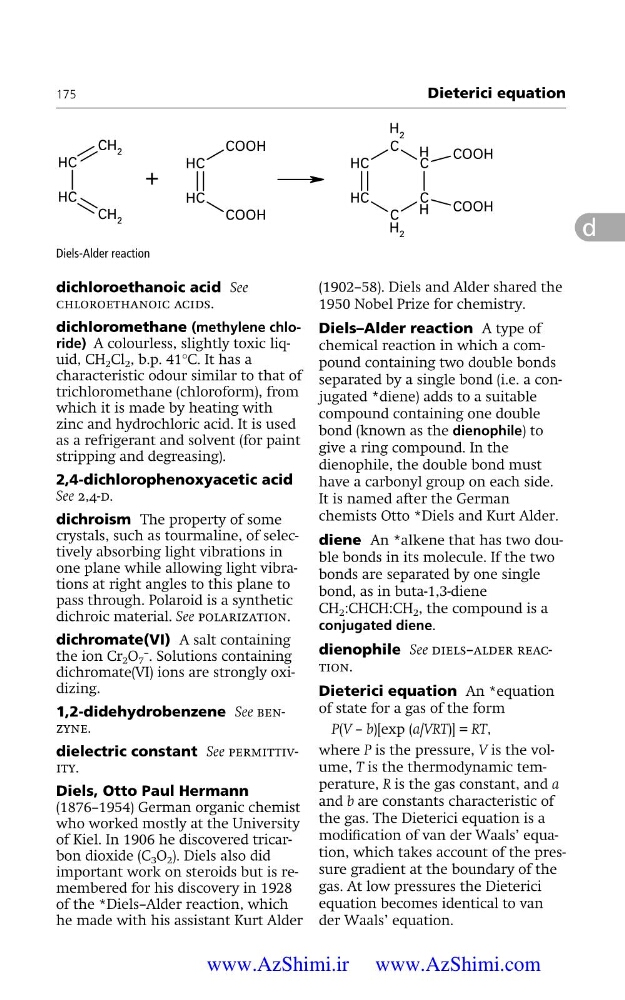
Diels–Alder reaction A type of
chemical reaction in which a compound containing two double bonds
separated by a single bond (i.e. a conjugated *diene) adds to a suitable
compound containing one double
bond (known as the dienophile) to
give a ring compound. In the
dienophile, the double bond must
have a carbonyl group on each side.
It is named after the German
chemists Otto *Diels and Kurt Alder.
diene An *alkene that has two double bonds in its molecule. If the two
bonds are separated by one single
bond, as in buta-1,3-diene
CH 2 :CHCH:CH 2 , the compound is a
conjugated diene.
dienophile See diels–alder reaction.
Dieterici equation An *equation
of state for a gas of the form
P(V – b)[exp (a/VRT)] = RT,
where P is the pressure, V is the volume, T is the thermodynamic temperature, R is the gas constant, and a
and b are constants characteristic of
the gas. The Dieterici equation is a
modiÜcation of van der Waals’ equation, which takes account of the pressure gradient at the boundary of the
gas. At low pressures the Dieterici
equation becomes identical to van
der Waals’ equation.
175
Dieterici equation
d
CH 2
C
H
C
H
CH 2
C
H
C
H
COOH
COOH
C
H
C
H
C
H 2
C
H
C
H
C
H 2
COOH
COOH
+
Diels-Alder reaction
www.AzShimi.ir www.AzShimi.com
chloroethanoic acids.
dichloromethane (methylene chloride) A colourless, slightly toxic liquid, CH 2 Cl 2 , b.p. 41°C. It has a
characteristic odour similar to that of
trichloromethane (chloroform), from
which it is made by heating with
zinc and hydrochloric acid. It is used
as a refrigerant and solvent (for paint
stripping and degreasing).
2,4-dichlorophenoxyacetic acid
See 2,4-d.
dichroism The property of some
crystals, such as tourmaline, of selectively absorbing light vibrations in
one plane while allowing light vibrations at right angles to this plane to
pass through. Polaroid is a synthetic
dichroic material. See polarization.
dichromate(VI) A salt containing
the ion Cr 2 O 7
– . Solutions containing
dichromate(VI) ions are strongly oxidizing.
1,2-didehydrobenzene See benzyne.
dielectric constant See permittivity.
Diels, Otto Paul Hermann
(1876–1954) German organic chemist
who worked mostly at the University
of Kiel. In 1906 he discovered tricarbon dioxide (C 3 O 2 ). Diels also did
important work on steroids but is remembered for his discovery in 1928
of the *Diels–Alder reaction, which
he made with his assistant Kurt Alder
(1902–58). Diels and Alder shared the
1950 Nobel Prize for chemistry.
Diels–Alder reaction A type of
chemical reaction in which a compound containing two double bonds
separated by a single bond (i.e. a conjugated *diene) adds to a suitable
compound containing one double
bond (known as the dienophile) to
give a ring compound. In the
dienophile, the double bond must
have a carbonyl group on each side.
It is named after the German
chemists Otto *Diels and Kurt Alder.
diene An *alkene that has two double bonds in its molecule. If the two
bonds are separated by one single
bond, as in buta-1,3-diene
CH 2 :CHCH:CH 2 , the compound is a
conjugated diene.
dienophile See diels–alder reaction.
Dieterici equation An *equation
of state for a gas of the form
P(V – b)[exp (a/VRT)] = RT,
where P is the pressure, V is the volume, T is the thermodynamic temperature, R is the gas constant, and a
and b are constants characteristic of
the gas. The Dieterici equation is a
modiÜcation of van der Waals’ equation, which takes account of the pressure gradient at the boundary of the
gas. At low pressures the Dieterici
equation becomes identical to van
der Waals’ equation.
175
Dieterici equation
d
CH 2
C
H
C
H
CH 2
C
H
C
H
COOH
COOH
C
H
C
H
C
H 2
C
H
C
H
C
H 2
COOH
COOH
+
Diels-Alder reaction
www.AzShimi.ir www.AzShimi.com