

which rapidly darkens on standing in
air. It is made by the reduction of 1,4nitrophenylamine and is used as a
photographic develop and hair dye.
1,2-diaminoethane (ethylenediamine) A colourless fuming liquid
that smells of ammonia,
H 2 NCH 2 CH 2 NH 2 ; b.p. 116°C. It is
made from ammonia and 1,2dichloroethane, which are heated
under pressure with a copper(I) chloride catalyst. In air it absorbs water
and carbon dioxide to form diaminoethane carbamate. With fatty
acids diaminoethane produces soaps,
employed as emulsifying agents and
detergents. It is also used as a solvent
(for resins) and in making coatings,
paper and textiles. Crystals of its tartrate derivative are employed in
piezoelectric devices. It is a bidentate
ligand, given the symbol en in formulae.
1,6-diaminohexane (hexamethylenediamine) A solid colourless
amine, H 2 N(CH 2 ) 6 NH 2 ; m.p. 41°C; b.p.
204°C. It is made by oxidizing cyclohexane to hexanedioic acid, reacting
this with ammonia to give the ammonium salt, and dehydrating the
salt to give hexanedionitrile
(NC(CH 2 ) 6 CN). This is reduced with
hydrogen to the diamine. The compound is used, with hexanedioic acid,
for producing *nylon 6,6.
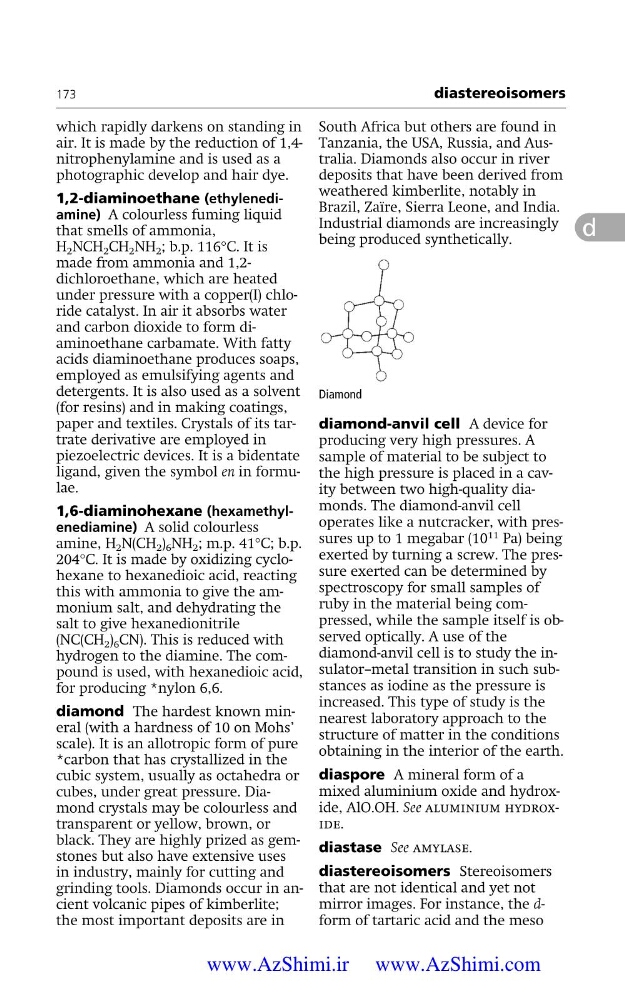
diamond The hardest known mineral (with a hardness of 10 on Mohs’
scale). It is an allotropic form of pure
*carbon that has crystallized in the
cubic system, usually as octahedra or
cubes, under great pressure. Diamond crystals may be colourless and
transparent or yellow, brown, or
black. They are highly prized as gemstones but also have extensive uses
in industry, mainly for cutting and
grinding tools. Diamonds occur in ancient volcanic pipes of kimberlite;
the most important deposits are in
South Africa but others are found in
Tanzania, the USA, Russia, and Australia. Diamonds also occur in river
deposits that have been derived from
weathered kimberlite, notably in
Brazil, Zaïre, Sierra Leone, and India.
Industrial diamonds are increasingly
being produced synthetically.
173
diastereoisomers
d
Diamond
diamond-anvil cell A device for
producing very high pressures. A
sample of material to be subject to
the high pressure is placed in a cavity between two high-quality diamonds. The diamond-anvil cell
operates like a nutcracker, with pressures up to 1 megabar (10
11 Pa) being
exerted by turning a screw. The pressure exerted can be determined by
spectroscopy for small samples of
ruby in the material being compressed, while the sample itself is observed optically. A use of the
diamond-anvil cell is to study the insulator–metal transition in such substances as iodine as the pressure is
increased. This type of study is the
nearest laboratory approach to the
structure of matter in the conditions
obtaining in the interior of the earth.
diaspore A mineral form of a
mixed aluminium oxide and hydroxide, AlO.OH. See aluminium hydroxide.
diastase See amylase.
diastereoisomers Stereoisomers
that are not identical and yet not
mirror images. For instance, the dform of tartaric acid and the meso
www.AzShimi.ir www.AzShimi.com
air. It is made by the reduction of 1,4nitrophenylamine and is used as a
photographic develop and hair dye.
1,2-diaminoethane (ethylenediamine) A colourless fuming liquid
that smells of ammonia,
H 2 NCH 2 CH 2 NH 2 ; b.p. 116°C. It is
made from ammonia and 1,2dichloroethane, which are heated
under pressure with a copper(I) chloride catalyst. In air it absorbs water
and carbon dioxide to form diaminoethane carbamate. With fatty
acids diaminoethane produces soaps,
employed as emulsifying agents and
detergents. It is also used as a solvent
(for resins) and in making coatings,
paper and textiles. Crystals of its tartrate derivative are employed in
piezoelectric devices. It is a bidentate
ligand, given the symbol en in formulae.
1,6-diaminohexane (hexamethylenediamine) A solid colourless
amine, H 2 N(CH 2 ) 6 NH 2 ; m.p. 41°C; b.p.
204°C. It is made by oxidizing cyclohexane to hexanedioic acid, reacting
this with ammonia to give the ammonium salt, and dehydrating the
salt to give hexanedionitrile
(NC(CH 2 ) 6 CN). This is reduced with
hydrogen to the diamine. The compound is used, with hexanedioic acid,
for producing *nylon 6,6.
diamond The hardest known mineral (with a hardness of 10 on Mohs’
scale). It is an allotropic form of pure
*carbon that has crystallized in the
cubic system, usually as octahedra or
cubes, under great pressure. Diamond crystals may be colourless and
transparent or yellow, brown, or
black. They are highly prized as gemstones but also have extensive uses
in industry, mainly for cutting and
grinding tools. Diamonds occur in ancient volcanic pipes of kimberlite;
the most important deposits are in
South Africa but others are found in
Tanzania, the USA, Russia, and Australia. Diamonds also occur in river
deposits that have been derived from
weathered kimberlite, notably in
Brazil, Zaïre, Sierra Leone, and India.
Industrial diamonds are increasingly
being produced synthetically.
173
diastereoisomers
d
Diamond
diamond-anvil cell A device for
producing very high pressures. A
sample of material to be subject to
the high pressure is placed in a cavity between two high-quality diamonds. The diamond-anvil cell
operates like a nutcracker, with pressures up to 1 megabar (10
11 Pa) being
exerted by turning a screw. The pressure exerted can be determined by
spectroscopy for small samples of
ruby in the material being compressed, while the sample itself is observed optically. A use of the
diamond-anvil cell is to study the insulator–metal transition in such substances as iodine as the pressure is
increased. This type of study is the
nearest laboratory approach to the
structure of matter in the conditions
obtaining in the interior of the earth.
diaspore A mineral form of a
mixed aluminium oxide and hydroxide, AlO.OH. See aluminium hydroxide.
diastase See amylase.
diastereoisomers Stereoisomers
that are not identical and yet not
mirror images. For instance, the dform of tartaric acid and the meso
www.AzShimi.ir www.AzShimi.com