

i.e. the rings are of carbon atoms. If
different atoms occur in the ring, as
in pyridine (C 5 H 5 N), the compound is
said to be heterocyclic.
cyclic AMP A derivative of *ATP
that is widespread in animal cells as
a second messenger in many biochemical reactions induced by hormones. Upon reaching their target
cells, the hormones activate adenylate cyclase, the enzyme that catalyses cyclic AMP production. Cyclic
AMP ultimately activates the enzymes of the reaction induced by the
hormone concerned. Cyclic AMP is
also involved in controlling gene expression and cell division, in immune responses, and in nervous
transmission.
cyclization The formation of a
cyclic compound from an open-chain
compound. See ring.
cyclo- PreÜx designating a cyclic
compound, e.g. a cycloalkane or a
cyclosilicate.
cycloaddition A reaction in which
two or more unsaturated compounds
form a cyclic adduct or in which a
cyclic compound is formed by addition between unsaturated parts of
the same molecule. In cycloaddition,
there is no net reduction in bond
multiplicity. The *Diels–Alder reaction is an example. Cycloadditions
may be stepwise reactions or may be
*pericyclic reactions.
cycloalkanes Cyclic saturated hydrocarbons containing a ring of carbon atoms joined by single bonds.
They have the general formula
C n H 2n , for example cyclohexane,
C 6 H 12 , etc. In general they behave
like the *alkanes but are rather less
reactive.
A
• Information about IUPAC nomenclature
cyclobutadiene A short-lived
cyclic diene hydrocarbon, C 4 H 4 , with
its four carbon atoms in a square
ring. It is made by degradation of its
metal complexes, and has a short
lifetime of a few seconds. It undergoes addition reactions with alkynes.
cyclohexadiene-1,4-dione
(benzoquinone; quinone) A yellow
solid, C 6 H 4 O 2 ; r.d. 1.3; m.p. 116°C. It
has a six-membered ring of carbon
atoms with two opposite carbon
atoms linked to oxygen atoms (C=O)
and the other two pairs of carbon
atoms linked by double bonds
(HC=CH). The compound is used in
making dyes. See also quinhydrone
electrode.
cyclohexane A colourless liquid
*cycloalkane, C 6 H 12 ; r.d. 0.78; m.p.
6.5°C; b.p. 81°C. It occurs in petroleum and is made by passing benzene and hydrogen under pressure
over a heated Raney nickel catalyst at
150°C, or by the reduction of cyclohexanone. It is used as a solvent and
paint remover and can be oxidized
using hot concentrated nitric acid to
hexanedioic acid (adipic acid). The cyclohexane ring is not planar and can
adopt boat and chair *conformations; in formulae it is represented
by a single hexagon.
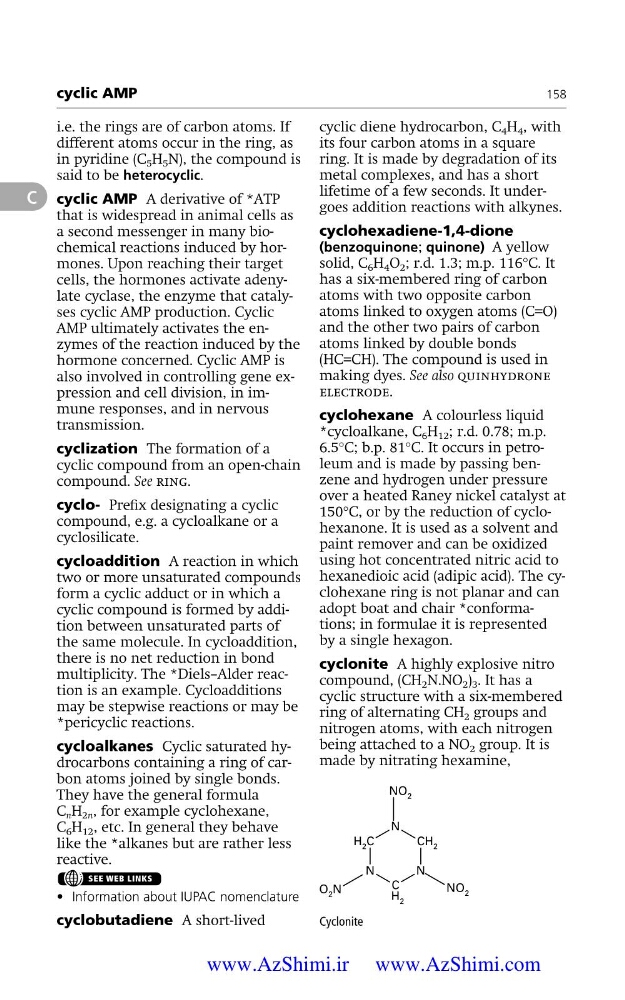
cyclonite A highly explosive nitro
compound, (CH 2 N.NO 2 ) 3 . It has a
cyclic structure with a six-membered
ring of alternating CH 2 groups and
nitrogen atoms, with each nitrogen
being attached to a NO 2 group. It is
made by nitrating hexamine,
cyclic AMP
158
c
C
H 2
N
C
H 2
N
CH 2
N
NO 2
NO 2
O 2 N
Cyclonite
www.AzShimi.ir www.AzShimi.com
different atoms occur in the ring, as
in pyridine (C 5 H 5 N), the compound is
said to be heterocyclic.
cyclic AMP A derivative of *ATP
that is widespread in animal cells as
a second messenger in many biochemical reactions induced by hormones. Upon reaching their target
cells, the hormones activate adenylate cyclase, the enzyme that catalyses cyclic AMP production. Cyclic
AMP ultimately activates the enzymes of the reaction induced by the
hormone concerned. Cyclic AMP is
also involved in controlling gene expression and cell division, in immune responses, and in nervous
transmission.
cyclization The formation of a
cyclic compound from an open-chain
compound. See ring.
cyclo- PreÜx designating a cyclic
compound, e.g. a cycloalkane or a
cyclosilicate.
cycloaddition A reaction in which
two or more unsaturated compounds
form a cyclic adduct or in which a
cyclic compound is formed by addition between unsaturated parts of
the same molecule. In cycloaddition,
there is no net reduction in bond
multiplicity. The *Diels–Alder reaction is an example. Cycloadditions
may be stepwise reactions or may be
*pericyclic reactions.
cycloalkanes Cyclic saturated hydrocarbons containing a ring of carbon atoms joined by single bonds.
They have the general formula
C n H 2n , for example cyclohexane,
C 6 H 12 , etc. In general they behave
like the *alkanes but are rather less
reactive.
A
• Information about IUPAC nomenclature
cyclobutadiene A short-lived
cyclic diene hydrocarbon, C 4 H 4 , with
its four carbon atoms in a square
ring. It is made by degradation of its
metal complexes, and has a short
lifetime of a few seconds. It undergoes addition reactions with alkynes.
cyclohexadiene-1,4-dione
(benzoquinone; quinone) A yellow
solid, C 6 H 4 O 2 ; r.d. 1.3; m.p. 116°C. It
has a six-membered ring of carbon
atoms with two opposite carbon
atoms linked to oxygen atoms (C=O)
and the other two pairs of carbon
atoms linked by double bonds
(HC=CH). The compound is used in
making dyes. See also quinhydrone
electrode.
cyclohexane A colourless liquid
*cycloalkane, C 6 H 12 ; r.d. 0.78; m.p.
6.5°C; b.p. 81°C. It occurs in petroleum and is made by passing benzene and hydrogen under pressure
over a heated Raney nickel catalyst at
150°C, or by the reduction of cyclohexanone. It is used as a solvent and
paint remover and can be oxidized
using hot concentrated nitric acid to
hexanedioic acid (adipic acid). The cyclohexane ring is not planar and can
adopt boat and chair *conformations; in formulae it is represented
by a single hexagon.
cyclonite A highly explosive nitro
compound, (CH 2 N.NO 2 ) 3 . It has a
cyclic structure with a six-membered
ring of alternating CH 2 groups and
nitrogen atoms, with each nitrogen
being attached to a NO 2 group. It is
made by nitrating hexamine,
cyclic AMP
158
c
C
H 2
N
C
H 2
N
CH 2
N
NO 2
NO 2
O 2 N
Cyclonite
www.AzShimi.ir www.AzShimi.com