

cyanine dyes A class of dyes that
contain a –CH= group linking two nitrogen-containing heterocyclic rings.
They are used as sensitizers in photography.
cyanoacrylate A compound
formed by the condensation of an
alkyl cyanoethanoate and methanal.
Cyanoacrylates have the general formula CH 2 :C(CN)COOR. The methyl
and ethyl esters are the basis of various ‘superglues’, which rapidly polymerize in air (under the action of
moisture) to form strong adhesives.
cyanocobalamin See vitamin b
complex.
cyanogen A colourless gas, (CN) 2 ,
with a pungent odour; soluble in
water, ethanol, and ether; d. 2.335
g dm
–3 ; m.p. –27.9°C; b.p. –20.7°C.
The compound is very toxic. It may
be prepared in the laboratory by
heating mercury(II) cyanide; industrially it is made by gas-phase oxidation
of hydrogen cyanide using air over a
silver catalyst, chlorine over activated silicon(IV) oxide, or nitrogen
dioxide over a copper(II) salt.
Cyanogen is an important intermediate in the preparation of various fertilizers and is also used as a stabilizer
in making nitrocellulose. It is an example of a *pseudohalogen.
cyano group The group –CN in a
chemical compound. See nitriles.
cyanohydrins Organic compounds
formed by the addition of hydrogen
cyanide to aldehydes or ketones (in
the presence of a base). The Ürst step
is attack by a CN
– ion on the carbonyl carbon atom. The Ünal product
is a compound in which a –CN and
–OH group are attached to the same
carbon atom. For example, ethanal
reacts as follows
CH 3 CHO + HCN → CH 3 CH(OH)(CN)
The product is 2-hydroxypropanonitrile. Cyanohydrins of this type can
be oxidized to α-hydroxy carboxylic
acids.
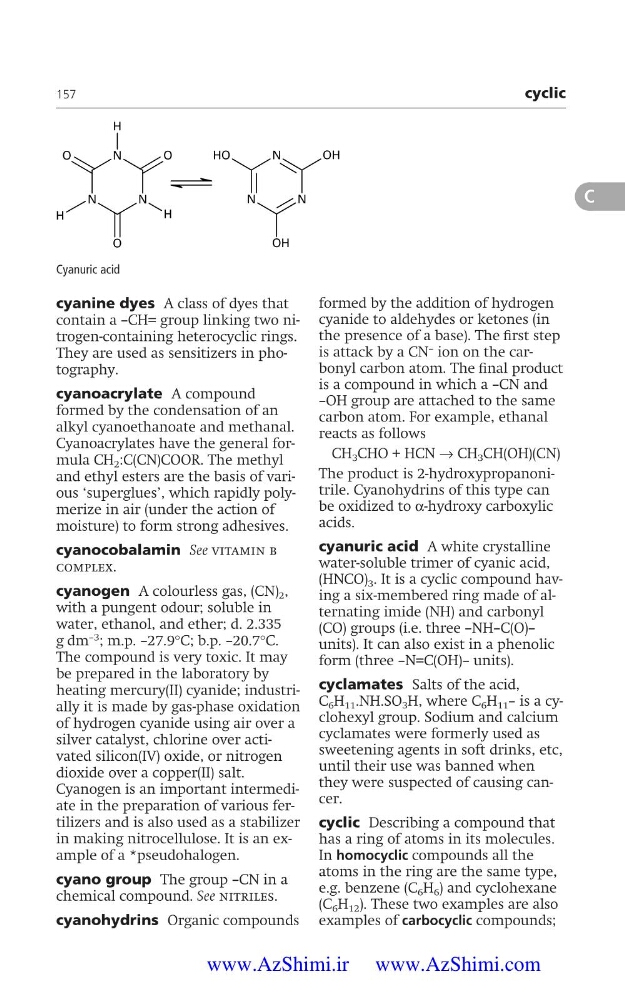
cyanuric acid A white crystalline
water-soluble trimer of cyanic acid,
(HNCO) 3 . It is a cyclic compound having a six-membered ring made of alternating imide (NH) and carbonyl
(CO) groups (i.e. three –NH–C(O)–
units). It can also exist in a phenolic
form (three –N=C(OH)– units).
cyclamates Salts of the acid,
C 6 H 11 .NH.SO 3 H, where C 6 H 11 – is a cyclohexyl group. Sodium and calcium
cyclamates were formerly used as
sweetening agents in soft drinks, etc,
until their use was banned when
they were suspected of causing cancer.
cyclic Describing a compound that
has a ring of atoms in its molecules.
In homocyclic compounds all the
atoms in the ring are the same type,
e.g. benzene (C 6 H 6 ) and cyclohexane
(C 6 H 12 ). These two examples are also
examples of carbocyclic compounds;
157
cyclic
c
N
N
N
H
H
O
O
O
H
N
N
N
OH
O
H
OH
Cyanuric acid
www.AzShimi.ir www.AzShimi.com
contain a –CH= group linking two nitrogen-containing heterocyclic rings.
They are used as sensitizers in photography.
cyanoacrylate A compound
formed by the condensation of an
alkyl cyanoethanoate and methanal.
Cyanoacrylates have the general formula CH 2 :C(CN)COOR. The methyl
and ethyl esters are the basis of various ‘superglues’, which rapidly polymerize in air (under the action of
moisture) to form strong adhesives.
cyanocobalamin See vitamin b
complex.
cyanogen A colourless gas, (CN) 2 ,
with a pungent odour; soluble in
water, ethanol, and ether; d. 2.335
g dm
–3 ; m.p. –27.9°C; b.p. –20.7°C.
The compound is very toxic. It may
be prepared in the laboratory by
heating mercury(II) cyanide; industrially it is made by gas-phase oxidation
of hydrogen cyanide using air over a
silver catalyst, chlorine over activated silicon(IV) oxide, or nitrogen
dioxide over a copper(II) salt.
Cyanogen is an important intermediate in the preparation of various fertilizers and is also used as a stabilizer
in making nitrocellulose. It is an example of a *pseudohalogen.
cyano group The group –CN in a
chemical compound. See nitriles.
cyanohydrins Organic compounds
formed by the addition of hydrogen
cyanide to aldehydes or ketones (in
the presence of a base). The Ürst step
is attack by a CN
– ion on the carbonyl carbon atom. The Ünal product
is a compound in which a –CN and
–OH group are attached to the same
carbon atom. For example, ethanal
reacts as follows
CH 3 CHO + HCN → CH 3 CH(OH)(CN)
The product is 2-hydroxypropanonitrile. Cyanohydrins of this type can
be oxidized to α-hydroxy carboxylic
acids.
cyanuric acid A white crystalline
water-soluble trimer of cyanic acid,
(HNCO) 3 . It is a cyclic compound having a six-membered ring made of alternating imide (NH) and carbonyl
(CO) groups (i.e. three –NH–C(O)–
units). It can also exist in a phenolic
form (three –N=C(OH)– units).
cyclamates Salts of the acid,
C 6 H 11 .NH.SO 3 H, where C 6 H 11 – is a cyclohexyl group. Sodium and calcium
cyclamates were formerly used as
sweetening agents in soft drinks, etc,
until their use was banned when
they were suspected of causing cancer.
cyclic Describing a compound that
has a ring of atoms in its molecules.
In homocyclic compounds all the
atoms in the ring are the same type,
e.g. benzene (C 6 H 6 ) and cyclohexane
(C 6 H 12 ). These two examples are also
examples of carbocyclic compounds;
157
cyclic
c
N
N
N
H
H
O
O
O
H
N
N
N
OH
O
H
OH
Cyanuric acid
www.AzShimi.ir www.AzShimi.com