

C 6 H 12 N 4 , which is obtained from ammonia and methanal. Cyclonite is a
very powerful explosive used mainly
for military purposes. It is also called
RDX. The abbreviation is for ‘Research Department composition X’,
used at the Chemical Research and
Development Department, Woolwich.
cyclo-octatetraene (COT) A yellow
liquid cyclic compound, C 8 H 8 , with
eight carbon atoms and four double
bonds in its ring; b.p. 142°C. It is
made by polymerizing ethyne (acetylene) in the presence of nickel salts.
It forms addition compounds and certain metal complexes, such as uranocene, (C 8 H 8 ) 2 U.
cyclopentadiene A colourless liquid cyclic *alkene, C 5 H 6 ; r.d. 0.8021;
m.p. –97.2°C; b.p. 40.0°C. It is prepared as a by-product during the fractional distillation of crude benzene
from coal tar. It undergoes condensation reactions with ketones to give
highly coloured compounds (fulvenes) and readily undergoes polymerization at room temperature to
give the dimer, dicyclopentadiene.
Cyclopentadiene itself is not an aromatic compound because it does not
have the required number of pi electrons. However, removal of a hydrogen atom produces the stable
cyclopentadienyl ion, C 5 H 5
–
, which
does have aromatic properties. In
particular, the ring can coordinate to
positive ions in such compounds as
*ferrocene.
159
cystine
c
C
H 2
CH
C
H
C
H
C
H
Cyclopentadiene
Cyclophane
cyclopentadienyl ion See cyclopentadiene.
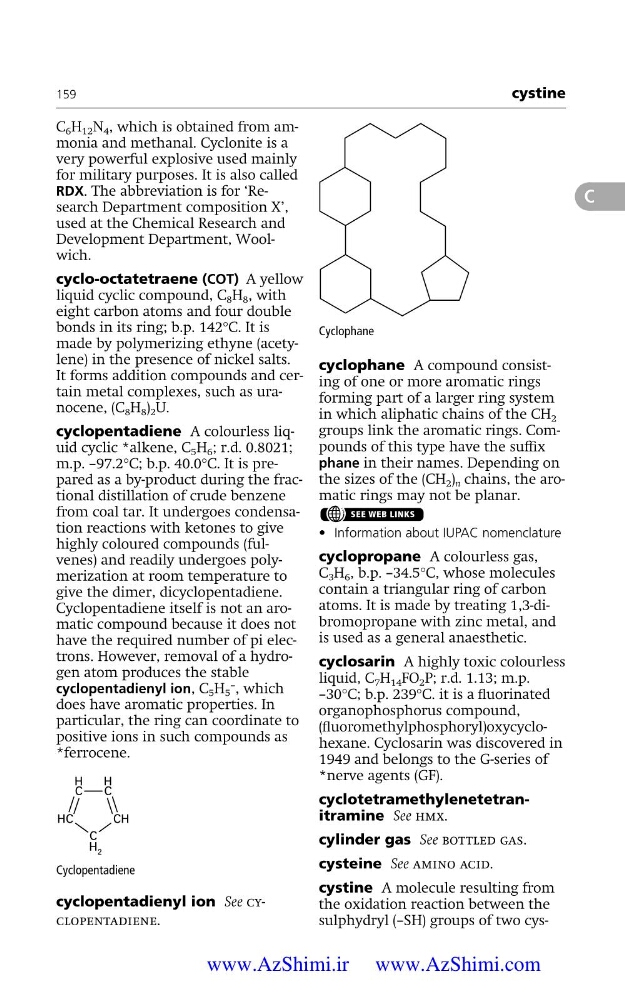
cyclophane A compound consisting of one or more aromatic rings
forming part of a larger ring system
in which aliphatic chains of the CH 2
groups link the aromatic rings. Compounds of this type have the sufÜx
phane in their names. Depending on
the sizes of the (CH 2 ) n chains, the aromatic rings may not be planar.
A
• Information about IUPAC nomenclature
cyclopropane A colourless gas,
C 3 H 6 , b.p. –34.5°C, whose molecules
contain a triangular ring of carbon
atoms. It is made by treating 1,3-dibromopropane with zinc metal, and
is used as a general anaesthetic.
cyclosarin A highly toxic colourless
liquid, C 7 H 14 FO 2 P; r.d. 1.13; m.p.
–30°C; b.p. 239°C. it is a Ûuorinated
organophosphorus compound,
(Ûuoromethylphosphoryl)oxycyclohexane. Cyclosarin was discovered in
1949 and belongs to the G-series of
*nerve agents (GF).
cyclotetramethylenetetranitramine See hmx.
cylinder gas See bottled gas.
cysteine See amino acid.
cystine A molecule resulting from
the oxidation reaction between the
sulphydryl (–SH) groups of two cyswww.AzShimi.ir www.AzShimi.com
very powerful explosive used mainly
for military purposes. It is also called
RDX. The abbreviation is for ‘Research Department composition X’,
used at the Chemical Research and
Development Department, Woolwich.
cyclo-octatetraene (COT) A yellow
liquid cyclic compound, C 8 H 8 , with
eight carbon atoms and four double
bonds in its ring; b.p. 142°C. It is
made by polymerizing ethyne (acetylene) in the presence of nickel salts.
It forms addition compounds and certain metal complexes, such as uranocene, (C 8 H 8 ) 2 U.
cyclopentadiene A colourless liquid cyclic *alkene, C 5 H 6 ; r.d. 0.8021;
m.p. –97.2°C; b.p. 40.0°C. It is prepared as a by-product during the fractional distillation of crude benzene
from coal tar. It undergoes condensation reactions with ketones to give
highly coloured compounds (fulvenes) and readily undergoes polymerization at room temperature to
give the dimer, dicyclopentadiene.
Cyclopentadiene itself is not an aromatic compound because it does not
have the required number of pi electrons. However, removal of a hydrogen atom produces the stable
cyclopentadienyl ion, C 5 H 5
–
, which
does have aromatic properties. In
particular, the ring can coordinate to
positive ions in such compounds as
*ferrocene.
159
cystine
c
C
H 2
CH
C
H
C
H
C
H
Cyclopentadiene
Cyclophane
cyclopentadienyl ion See cyclopentadiene.
cyclophane A compound consisting of one or more aromatic rings
forming part of a larger ring system
in which aliphatic chains of the CH 2
groups link the aromatic rings. Compounds of this type have the sufÜx
phane in their names. Depending on
the sizes of the (CH 2 ) n chains, the aromatic rings may not be planar.
A
• Information about IUPAC nomenclature
cyclopropane A colourless gas,
C 3 H 6 , b.p. –34.5°C, whose molecules
contain a triangular ring of carbon
atoms. It is made by treating 1,3-dibromopropane with zinc metal, and
is used as a general anaesthetic.
cyclosarin A highly toxic colourless
liquid, C 7 H 14 FO 2 P; r.d. 1.13; m.p.
–30°C; b.p. 239°C. it is a Ûuorinated
organophosphorus compound,
(Ûuoromethylphosphoryl)oxycyclohexane. Cyclosarin was discovered in
1949 and belongs to the G-series of
*nerve agents (GF).
cyclotetramethylenetetranitramine See hmx.
cylinder gas See bottled gas.
cysteine See amino acid.
cystine A molecule resulting from
the oxidation reaction between the
sulphydryl (–SH) groups of two cyswww.AzShimi.ir www.AzShimi.com