

known as hashish. The normal
method of using cannabis is to
smoke it, although it can also be
taken in certain foods. Cannabis is a
class C controlled substance in the
UK. It contains a large number of related compounds known as herbal
*cannabinoids. The main active component is *tetrahydrocannabinol
(THC).
Cannizzaro, Stanislao
(1826–1910) Italian chemist. He discovered the *Cannizzaro reaction in
1853. His main contribution to chemistry was his recognition of the validity of *Avogadro’s law and his
deduction that common gases such
as H 2 and O 2 are diatomic molecules.
This led to the establishment of a reliable system of atomic and molecular weights.
Cannizzaro reaction A reaction of
aldehydes to give carboxylic acids
and alcohols. It occurs in the presence of strong bases with aldehydes
that do not have alpha hydrogen
atoms. For example, benzenecarbaldehyde gives benzenecarboxylic
acid and benzyl alcohol:
2C 6 H 5 CHO → C 6 H 5 COOH +
C 6 H 5 CH 2 OH
Aldehydes that have alpha hydrogen
atoms undergo the *aldol reaction instead. The Cannizzaro reaction is an
example of a *disproportionation. It
was discovered by Stanislao *Cannizzaro.
canonical form One of the possible structures of a molecule that together form a *resonance hybrid.
capillary A tube of small diameter.
capillary electrophoresis (CE) A
technique for investigating mixtures
of charged species. In capilliary zone
electrophoresis (CZE), the sample is
introduced into a Üne capillary tube,
with each end of the capillary placed
in a reservoir containing an electrolyte (e.g. a buffer solution). The
source reservoir contains a positive
electrode and the destination reservoir contains a negative electrode. A
high potential difference is maintained between the electrodes. Components of the sample Ûow through
the buffer solution in the capillary
under the inÛuence of the electric
Üeld. Their mobility depends on their
charge, size, and shape, and the components separate as they move
through the tube. They are detected
close to the end of the capillary, usually by ultraviolet absorption. Capilliary gel electrophoresis (CGE) is used
for separating large charged species,
such as DNA fragments. The capilliary is Ülled with a gel and separation depends on the size of the
species. In CE, a graph of detector
output against time is known as an
electropherogram. Individual components can be identiÜed by their retention times in the capillary. The
technique can be highly sensitive
and is widely used in forensic laboratories.
capillary gel electrophoresis
(CGE) See capillary electrophoresis.
capillary zone electrophoresis
(CZE) See capillary electrophoresis.
capric acid See decanoic acid.
caproic acid See hexanoic acid.
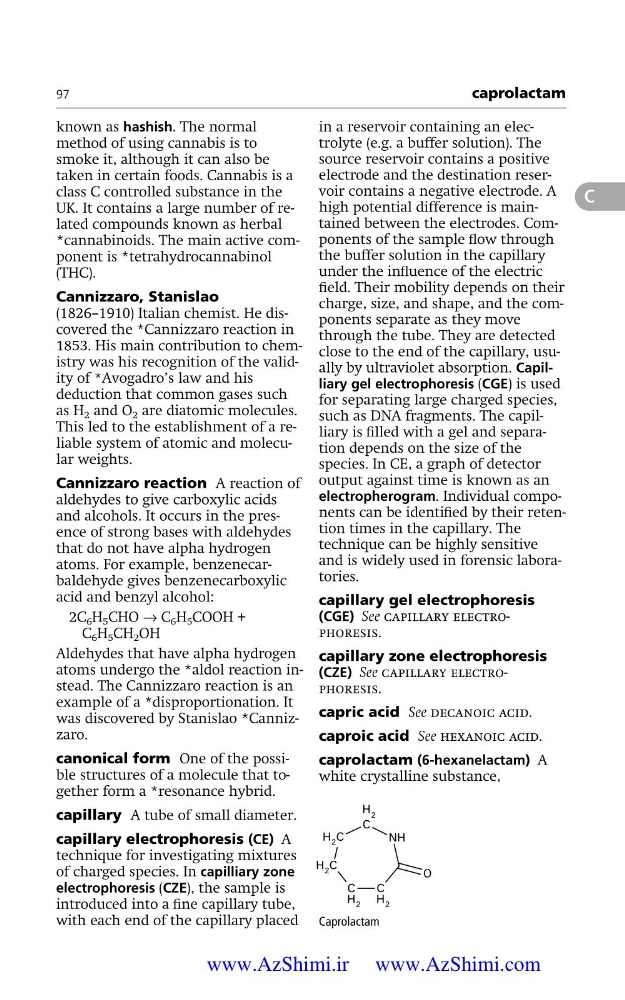
caprolactam (6-hexanelactam) A
white crystalline substance,
97
caprolactam
c
%
*
%
*
0*
%
*
%
*
%
*
1
Caprolactam
www.AzShimi.ir www.AzShimi.com
method of using cannabis is to
smoke it, although it can also be
taken in certain foods. Cannabis is a
class C controlled substance in the
UK. It contains a large number of related compounds known as herbal
*cannabinoids. The main active component is *tetrahydrocannabinol
(THC).
Cannizzaro, Stanislao
(1826–1910) Italian chemist. He discovered the *Cannizzaro reaction in
1853. His main contribution to chemistry was his recognition of the validity of *Avogadro’s law and his
deduction that common gases such
as H 2 and O 2 are diatomic molecules.
This led to the establishment of a reliable system of atomic and molecular weights.
Cannizzaro reaction A reaction of
aldehydes to give carboxylic acids
and alcohols. It occurs in the presence of strong bases with aldehydes
that do not have alpha hydrogen
atoms. For example, benzenecarbaldehyde gives benzenecarboxylic
acid and benzyl alcohol:
2C 6 H 5 CHO → C 6 H 5 COOH +
C 6 H 5 CH 2 OH
Aldehydes that have alpha hydrogen
atoms undergo the *aldol reaction instead. The Cannizzaro reaction is an
example of a *disproportionation. It
was discovered by Stanislao *Cannizzaro.
canonical form One of the possible structures of a molecule that together form a *resonance hybrid.
capillary A tube of small diameter.
capillary electrophoresis (CE) A
technique for investigating mixtures
of charged species. In capilliary zone
electrophoresis (CZE), the sample is
introduced into a Üne capillary tube,
with each end of the capillary placed
in a reservoir containing an electrolyte (e.g. a buffer solution). The
source reservoir contains a positive
electrode and the destination reservoir contains a negative electrode. A
high potential difference is maintained between the electrodes. Components of the sample Ûow through
the buffer solution in the capillary
under the inÛuence of the electric
Üeld. Their mobility depends on their
charge, size, and shape, and the components separate as they move
through the tube. They are detected
close to the end of the capillary, usually by ultraviolet absorption. Capilliary gel electrophoresis (CGE) is used
for separating large charged species,
such as DNA fragments. The capilliary is Ülled with a gel and separation depends on the size of the
species. In CE, a graph of detector
output against time is known as an
electropherogram. Individual components can be identiÜed by their retention times in the capillary. The
technique can be highly sensitive
and is widely used in forensic laboratories.
capillary gel electrophoresis
(CGE) See capillary electrophoresis.
capillary zone electrophoresis
(CZE) See capillary electrophoresis.
capric acid See decanoic acid.
caproic acid See hexanoic acid.
caprolactam (6-hexanelactam) A
white crystalline substance,
97
caprolactam
c
%
*
%
*
0*
%
*
%
*
%
*
1
Caprolactam
www.AzShimi.ir www.AzShimi.com