

C 6 H 11 NO; r.d. 1.02; m.p. 69–71°C; b.p.
139°C. It is a *lactam containing the
–NH.CO– group with Üve CH 2 groups
making up the rest of the sevenmembered ring. Caprolactam is used
in making *nylon.
caprylic acid See octanoic acid.
capture Any of various processes in
which a system of particles absorbs
an extra particle. There are several
examples in atomic and nuclear
physics. For instance, a positive ion
may capture an electron to give a
neutral atom or molecule. Similarly,
a neutral atom or molecule capturing
an electron becomes a negative ion.
An atomic nucleus may capture a
neutron to produce a different (often
unstable) nucleus. Another type of
nuclear capture is the process in
which the nucleus of an atom absorbs an electron from the innermost
orbit (the K shell) to transform into a
different nucleus. In this process
(called K capture) the atom is left in
an excited state and generally decays
by emission of an X-ray photon.
Radiative capture is any such
process in which the capture results
in an excited state that decays by
emission of photons. A common example is neutron capture to yield an
excited nucleus, which decays by
emission of a gamma ray.
carat 1. A measure of Üneness (purity) of gold. Pure gold is described as
24-carat gold. 14-carat gold contains
14 parts in 24 of gold, the remainder
usually being copper. 2. A unit of
mass equal to 0.200 gram, used to
measure the masses of diamonds and
other gemstones.
carbamide See urea.
carbanion An organic ion with a
negative charge on a carbon atom;
i.e. an ion of the type R 3 C
–
. Carbanions are intermediates in certain
types of organic reaction (e.g. the
*aldol reaction).
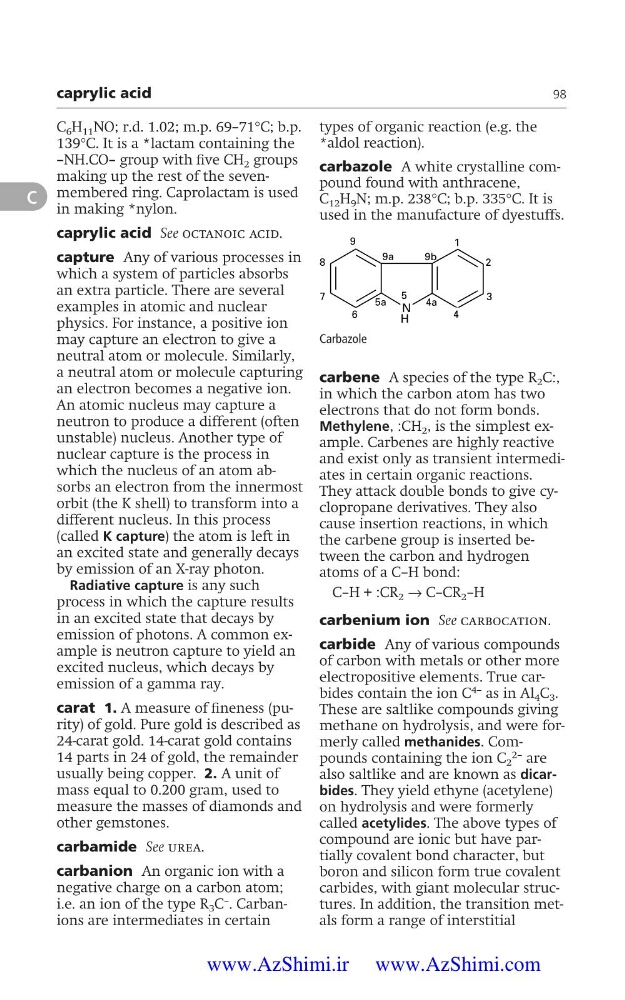
carbazole A white crystalline compound found with anthracene,
C 12 H 9 N; m.p. 238°C; b.p. 335°C. It is
used in the manufacture of dyestuffs.
caprylic acid
98
c
N
H
1
2
3
4
5
6
7
8
9
4a
5a
9a
9b
Carbazole
carbene A species of the type R 2 C:,
in which the carbon atom has two
electrons that do not form bonds.
Methylene, :CH 2 , is the simplest example. Carbenes are highly reactive
and exist only as transient intermediates in certain organic reactions.
They attack double bonds to give cyclopropane derivatives. They also
cause insertion reactions, in which
the carbene group is inserted between the carbon and hydrogen
atoms of a C–H bond:
C–H + :CR 2 → C–CR 2 –H
carbenium ion See carbocation.
carbide Any of various compounds
of carbon with metals or other more
electropositive elements. True carbides contain the ion C
4– as in Al 4 C 3 .
These are saltlike compounds giving
methane on hydrolysis, and were formerly called methanides. Compounds containing the ion C 2
2– are
also saltlike and are known as dicarbides. They yield ethyne (acetylene)
on hydrolysis and were formerly
called acetylides. The above types of
compound are ionic but have partially covalent bond character, but
boron and silicon form true covalent
carbides, with giant molecular structures. In addition, the transition metals form a range of interstitial
www.AzShimi.ir www.AzShimi.com
139°C. It is a *lactam containing the
–NH.CO– group with Üve CH 2 groups
making up the rest of the sevenmembered ring. Caprolactam is used
in making *nylon.
caprylic acid See octanoic acid.
capture Any of various processes in
which a system of particles absorbs
an extra particle. There are several
examples in atomic and nuclear
physics. For instance, a positive ion
may capture an electron to give a
neutral atom or molecule. Similarly,
a neutral atom or molecule capturing
an electron becomes a negative ion.
An atomic nucleus may capture a
neutron to produce a different (often
unstable) nucleus. Another type of
nuclear capture is the process in
which the nucleus of an atom absorbs an electron from the innermost
orbit (the K shell) to transform into a
different nucleus. In this process
(called K capture) the atom is left in
an excited state and generally decays
by emission of an X-ray photon.
Radiative capture is any such
process in which the capture results
in an excited state that decays by
emission of photons. A common example is neutron capture to yield an
excited nucleus, which decays by
emission of a gamma ray.
carat 1. A measure of Üneness (purity) of gold. Pure gold is described as
24-carat gold. 14-carat gold contains
14 parts in 24 of gold, the remainder
usually being copper. 2. A unit of
mass equal to 0.200 gram, used to
measure the masses of diamonds and
other gemstones.
carbamide See urea.
carbanion An organic ion with a
negative charge on a carbon atom;
i.e. an ion of the type R 3 C
–
. Carbanions are intermediates in certain
types of organic reaction (e.g. the
*aldol reaction).
carbazole A white crystalline compound found with anthracene,
C 12 H 9 N; m.p. 238°C; b.p. 335°C. It is
used in the manufacture of dyestuffs.
caprylic acid
98
c
N
H
1
2
3
4
5
6
7
8
9
4a
5a
9a
9b
Carbazole
carbene A species of the type R 2 C:,
in which the carbon atom has two
electrons that do not form bonds.
Methylene, :CH 2 , is the simplest example. Carbenes are highly reactive
and exist only as transient intermediates in certain organic reactions.
They attack double bonds to give cyclopropane derivatives. They also
cause insertion reactions, in which
the carbene group is inserted between the carbon and hydrogen
atoms of a C–H bond:
C–H + :CR 2 → C–CR 2 –H
carbenium ion See carbocation.
carbide Any of various compounds
of carbon with metals or other more
electropositive elements. True carbides contain the ion C
4– as in Al 4 C 3 .
These are saltlike compounds giving
methane on hydrolysis, and were formerly called methanides. Compounds containing the ion C 2
2– are
also saltlike and are known as dicarbides. They yield ethyne (acetylene)
on hydrolysis and were formerly
called acetylides. The above types of
compound are ionic but have partially covalent bond character, but
boron and silicon form true covalent
carbides, with giant molecular structures. In addition, the transition metals form a range of interstitial
www.AzShimi.ir www.AzShimi.com