

(kJ g
–1 ), although Calories (kilocalories) are often still used in nontechnical contexts. CaloriÜc values are
measured using a *bomb calorimeter.
calorimeter Any of various devices
used to measure thermal properties,
such as caloriÜc values or heats of
chemical reactions. See also bomb
calorimeter.
Calvin, Melvin (1911–97) US biochemist. After World War II, at the
Lawrence Radiation Laboratory,
Berkeley, he investigated the light-independent reactions of *photosynthesis. Using radioactive carbon-14 to
label carbon dioxide he discovered
the *Calvin cycle, for which he was
awarded the 1961 Nobel Prize for
chemistry.
Calvin cycle The metabolic pathway of the light-independent stage of
*photosynthesis, which occurs in the
stroma of the chloroplasts. The pathway was elucidated by Melvin
*Calvin and his co-workers and involves the Üxation of carbon dioxide
and its subsequent reduction to carbohydrate. During the cycle, carbon
dioxide combines with *ribulose bisphosphate, through the mediation of
the enzyme ribulose bisphosphate
carboxylase, to form an unstable
six-carbon compound that breaks
down to form two molecules of the
three-carbon compound glycerate
3-phosphate. This is converted to
glyceraldehyde 3-phosphate, which is
used to regenerate ribulose bisphosphate and to produce glucose and
fructose.
calx A metal oxide formed by heating an ore in air.
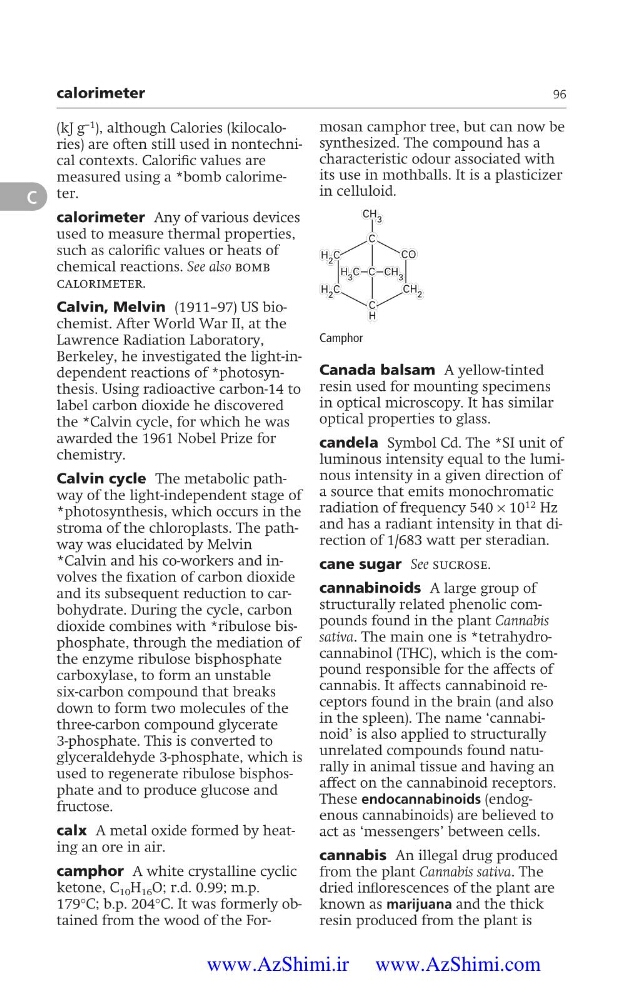
camphor A white crystalline cyclic
ketone, C 10 H 16 O; r.d. 0.99; m.p.
179°C; b.p. 204°C. It was formerly obtained from the wood of the Formosan camphor tree, but can now be
synthesized. The compound has a
characteristic odour associated with
its use in mothballs. It is a plasticizer
in celluloid.
calorimeter
96
c
CH 3
CH 3
CH 3
H 3 C C CH 3
H 3 C C CH 3
H 3 C C CH 3
CO CO CO
C C C
CH 2
CH 2
CH 2
C C C
H H H
H 2 C
H 2 C
H 2 C
H 2 C
H 2 C
H 2 C
Camphor
Canada balsam A yellow-tinted
resin used for mounting specimens
in optical microscopy. It has similar
optical properties to glass.
candela Symbol Cd. The *SI unit of
luminous intensity equal to the luminous intensity in a given direction of
a source that emits monochromatic
radiation of frequency 540 × 10
12 Hz
and has a radiant intensity in that direction of 1/683 watt per steradian.
cane sugar See sucrose.
cannabinoids A large group of
structurally related phenolic compounds found in the plant Cannabis
sativa. The main one is *tetrahydrocannabinol (THC), which is the compound responsible for the affects of
cannabis. It affects cannabinoid receptors found in the brain (and also
in the spleen). The name ‘cannabinoid’ is also applied to structurally
unrelated compounds found naturally in animal tissue and having an
affect on the cannabinoid receptors.
These endocannabinoids (endogenous cannabinoids) are believed to
act as ‘messengers’ between cells.
cannabis An illegal drug produced
from the plant Cannabis sativa. The
dried inÛorescences of the plant are
known as marijuana and the thick
resin produced from the plant is
www.AzShimi.ir www.AzShimi.com
–1 ), although Calories (kilocalories) are often still used in nontechnical contexts. CaloriÜc values are
measured using a *bomb calorimeter.
calorimeter Any of various devices
used to measure thermal properties,
such as caloriÜc values or heats of
chemical reactions. See also bomb
calorimeter.
Calvin, Melvin (1911–97) US biochemist. After World War II, at the
Lawrence Radiation Laboratory,
Berkeley, he investigated the light-independent reactions of *photosynthesis. Using radioactive carbon-14 to
label carbon dioxide he discovered
the *Calvin cycle, for which he was
awarded the 1961 Nobel Prize for
chemistry.
Calvin cycle The metabolic pathway of the light-independent stage of
*photosynthesis, which occurs in the
stroma of the chloroplasts. The pathway was elucidated by Melvin
*Calvin and his co-workers and involves the Üxation of carbon dioxide
and its subsequent reduction to carbohydrate. During the cycle, carbon
dioxide combines with *ribulose bisphosphate, through the mediation of
the enzyme ribulose bisphosphate
carboxylase, to form an unstable
six-carbon compound that breaks
down to form two molecules of the
three-carbon compound glycerate
3-phosphate. This is converted to
glyceraldehyde 3-phosphate, which is
used to regenerate ribulose bisphosphate and to produce glucose and
fructose.
calx A metal oxide formed by heating an ore in air.
camphor A white crystalline cyclic
ketone, C 10 H 16 O; r.d. 0.99; m.p.
179°C; b.p. 204°C. It was formerly obtained from the wood of the Formosan camphor tree, but can now be
synthesized. The compound has a
characteristic odour associated with
its use in mothballs. It is a plasticizer
in celluloid.
calorimeter
96
c
CH 3
CH 3
CH 3
H 3 C C CH 3
H 3 C C CH 3
H 3 C C CH 3
CO CO CO
C C C
CH 2
CH 2
CH 2
C C C
H H H
H 2 C
H 2 C
H 2 C
H 2 C
H 2 C
H 2 C
Camphor
Canada balsam A yellow-tinted
resin used for mounting specimens
in optical microscopy. It has similar
optical properties to glass.
candela Symbol Cd. The *SI unit of
luminous intensity equal to the luminous intensity in a given direction of
a source that emits monochromatic
radiation of frequency 540 × 10
12 Hz
and has a radiant intensity in that direction of 1/683 watt per steradian.
cane sugar See sucrose.
cannabinoids A large group of
structurally related phenolic compounds found in the plant Cannabis
sativa. The main one is *tetrahydrocannabinol (THC), which is the compound responsible for the affects of
cannabis. It affects cannabinoid receptors found in the brain (and also
in the spleen). The name ‘cannabinoid’ is also applied to structurally
unrelated compounds found naturally in animal tissue and having an
affect on the cannabinoid receptors.
These endocannabinoids (endogenous cannabinoids) are believed to
act as ‘messengers’ between cells.
cannabis An illegal drug produced
from the plant Cannabis sativa. The
dried inÛorescences of the plant are
known as marijuana and the thick
resin produced from the plant is
www.AzShimi.ir www.AzShimi.com