

Copyright © Glencoe/McGraw-Hill, a division of The McGraw-Hill Companies, Inc.
36 Chemistry: Matter and Change
Solving Problems: A Chemistry Handbook
SOLVING PROBLEMS:
A CHEMISTRY HANDBOOK
CHAPTER 4
You have also learned that a neutral atom has equal numbers of protons and electrons, so you can write the following expression.
Number of electrons ϭ number of protons ϭ 24
You also know that the number of neutrons can be determined from
the mass number and the atomic number.
Number of neutrons ϭ mass number Ϫ number of protons
Number of neutrons ϭ 53 Ϫ 24 ϭ 29
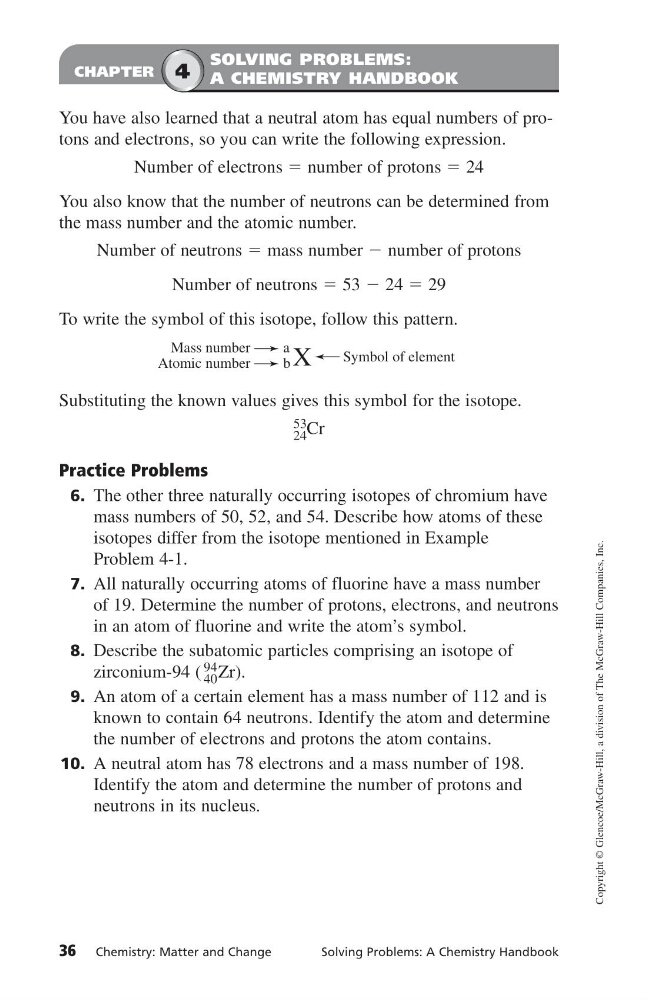
To write the symbol of this isotope, follow this pattern.
Substituting the known values gives this symbol for the isotope.
53
24 Cr
Practice Problems
6. The other three naturally occurring isotopes of chromium have
mass numbers of 50, 52, and 54. Describe how atoms of these
isotopes differ from the isotope mentioned in Example
Problem 4-1.
7. All naturally occurring atoms of fluorine have a mass number
of 19. Determine the number of protons, electrons, and neutrons
in an atom of fluorine and write the atom’s symbol.
8. Describe the subatomic particles comprising an isotope of
zirconium-94 ( 94
40 Zr).
9. An atom of a certain element has a mass number of 112 and is
known to contain 64 neutrons. Identify the atom and determine
the number of electrons and protons the atom contains.
10. A neutral atom has 78 electrons and a mass number of 198.
Identify the atom and determine the number of protons and
neutrons in its nucleus.
Mass number
Atomic number
Symbol of element
a
b X
36 Chemistry: Matter and Change
Solving Problems: A Chemistry Handbook
SOLVING PROBLEMS:
A CHEMISTRY HANDBOOK
CHAPTER 4
You have also learned that a neutral atom has equal numbers of protons and electrons, so you can write the following expression.
Number of electrons ϭ number of protons ϭ 24
You also know that the number of neutrons can be determined from
the mass number and the atomic number.
Number of neutrons ϭ mass number Ϫ number of protons
Number of neutrons ϭ 53 Ϫ 24 ϭ 29
To write the symbol of this isotope, follow this pattern.
Substituting the known values gives this symbol for the isotope.
53
24 Cr
Practice Problems
6. The other three naturally occurring isotopes of chromium have
mass numbers of 50, 52, and 54. Describe how atoms of these
isotopes differ from the isotope mentioned in Example
Problem 4-1.
7. All naturally occurring atoms of fluorine have a mass number
of 19. Determine the number of protons, electrons, and neutrons
in an atom of fluorine and write the atom’s symbol.
8. Describe the subatomic particles comprising an isotope of
zirconium-94 ( 94
40 Zr).
9. An atom of a certain element has a mass number of 112 and is
known to contain 64 neutrons. Identify the atom and determine
the number of electrons and protons the atom contains.
10. A neutral atom has 78 electrons and a mass number of 198.
Identify the atom and determine the number of protons and
neutrons in its nucleus.
Mass number
Atomic number
Symbol of element
a
b X