

Copyright © Glencoe/McGraw-Hill, a division of The McGraw-Hill Companies, Inc.
Solving Problems: A Chemistry Handbook
Chemistry: Matter and Change
35
SOLVING PROBLEMS:
A CHEMISTRY HANDBOOK
CHAPTER 4
An isotope of an element is identified by its mass number,
which is the sum of the number of protons and neutrons in the
atom’s nucleus.
Mass number ϭ number of protons ϩ number of neutrons
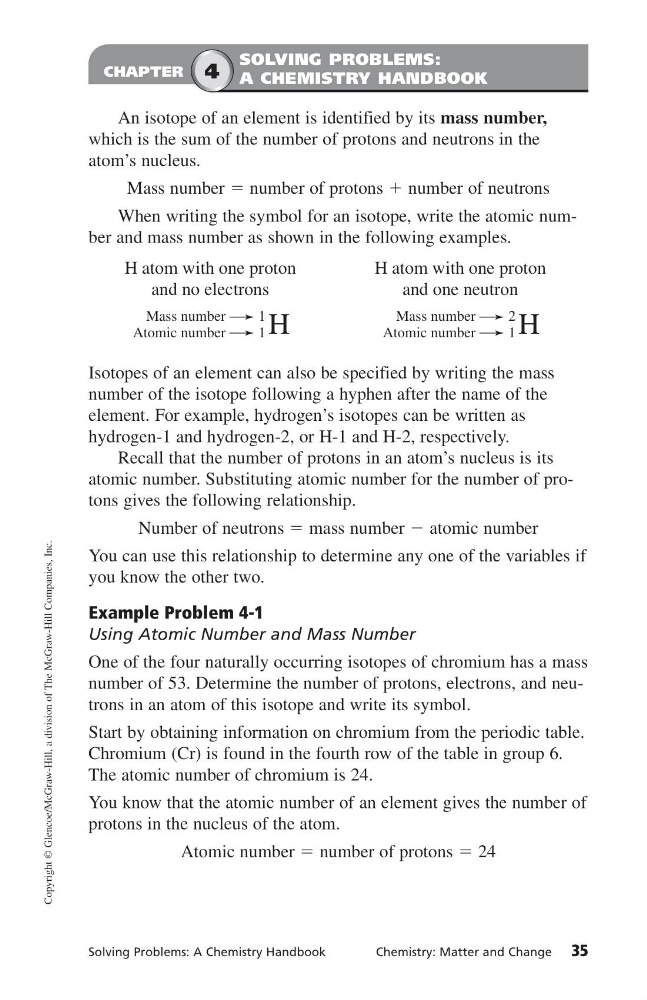
When writing the symbol for an isotope, write the atomic number and mass number as shown in the following examples.
Isotopes of an element can also be specified by writing the mass
number of the isotope following a hyphen after the name of the
element. For example, hydrogen’s isotopes can be written as
hydrogen-1 and hydrogen-2, or H-1 and H-2, respectively.
Recall that the number of protons in an atom’s nucleus is its
atomic number. Substituting atomic number for the number of protons gives the following relationship.
Number of neutrons ϭ mass number Ϫ atomic number
You can use this relationship to determine any one of the variables if
you know the other two.
Example Problem 4-1
Using Atomic Number and Mass Number
One of the four naturally occurring isotopes of chromium has a mass
number of 53. Determine the number of protons, electrons, and neutrons in an atom of this isotope and write its symbol.
Start by obtaining information on chromium from the periodic table.
Chromium (Cr) is found in the fourth row of the table in group 6.
The atomic number of chromium is 24.
You know that the atomic number of an element gives the number of
protons in the nucleus of the atom.
Atomic number ϭ number of protons ϭ 24
Mass number
H atom with one proton
and no electrons
Atomic number
1
1 H
Mass number
H atom with one proton
and one neutron
Atomic number
2
1 H
Solving Problems: A Chemistry Handbook
Chemistry: Matter and Change
35
SOLVING PROBLEMS:
A CHEMISTRY HANDBOOK
CHAPTER 4
An isotope of an element is identified by its mass number,
which is the sum of the number of protons and neutrons in the
atom’s nucleus.
Mass number ϭ number of protons ϩ number of neutrons
When writing the symbol for an isotope, write the atomic number and mass number as shown in the following examples.
Isotopes of an element can also be specified by writing the mass
number of the isotope following a hyphen after the name of the
element. For example, hydrogen’s isotopes can be written as
hydrogen-1 and hydrogen-2, or H-1 and H-2, respectively.
Recall that the number of protons in an atom’s nucleus is its
atomic number. Substituting atomic number for the number of protons gives the following relationship.
Number of neutrons ϭ mass number Ϫ atomic number
You can use this relationship to determine any one of the variables if
you know the other two.
Example Problem 4-1
Using Atomic Number and Mass Number
One of the four naturally occurring isotopes of chromium has a mass
number of 53. Determine the number of protons, electrons, and neutrons in an atom of this isotope and write its symbol.
Start by obtaining information on chromium from the periodic table.
Chromium (Cr) is found in the fourth row of the table in group 6.
The atomic number of chromium is 24.
You know that the atomic number of an element gives the number of
protons in the nucleus of the atom.
Atomic number ϭ number of protons ϭ 24
Mass number
H atom with one proton
and no electrons
Atomic number
1
1 H
Mass number
H atom with one proton
and one neutron
Atomic number
2
1 H