

Copyright © Glencoe/McGraw-Hill, a division of The McGraw-Hill Companies, Inc.
Solving Problems: A Chemistry Handbook
Chemistry: Matter and Change
37
SOLVING PROBLEMS:
A CHEMISTRY HANDBOOK
CHAPTER 4
Atomic mass Scientists have established a standard for the measurement of atomic mass by assigning the carbon-12 atom a mass of
12 atomic mass units (amu). Thus, 1 amu is equal to 1/12 the mass
of a carbon-12 atom.
The number at the bottom of each square in the periodic table is
the atomic mass of that element in amu. A scan of the periodic table
will immediately tell you that the atomic masses of many elements
are not whole numbers. The reason for this is that many elements
occur in nature as a mixture of isotopes—isotopes with different
masses. The atomic mass of an element given in the table is a
weighted average of the atomic masses of the naturally occurring
isotopes of the element. This weighted average takes into account
the mass and abundance of each of the isotopes. The following
Example Problem shows you how to calculate the atomic mass of
an element.
Example Problem 4-2
Calculating Atomic Mass
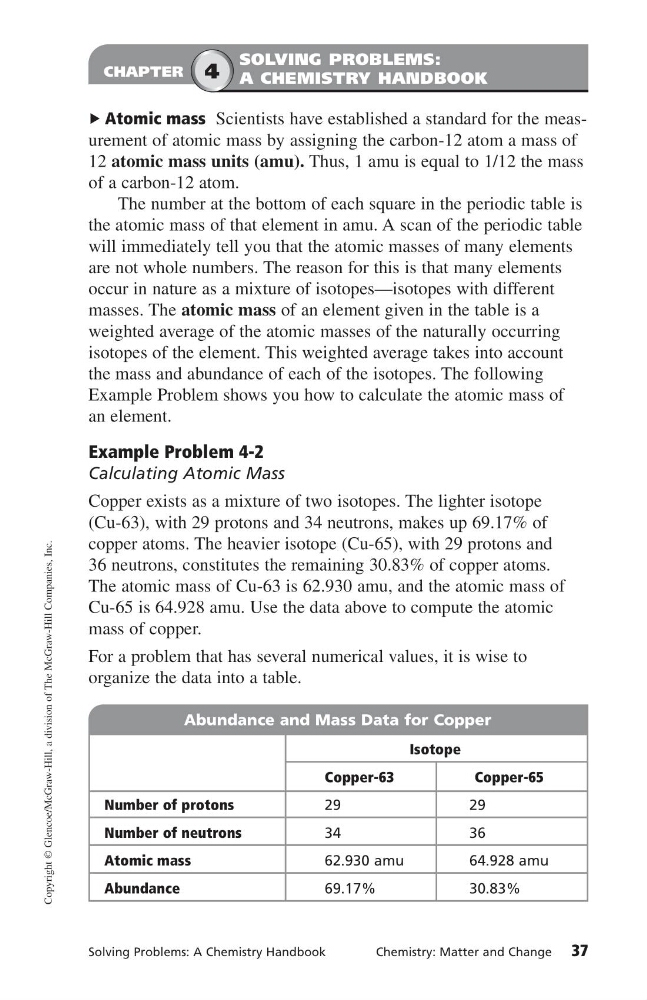
Copper exists as a mixture of two isotopes. The lighter isotope
(Cu-63), with 29 protons and 34 neutrons, makes up 69.17% of
copper atoms. The heavier isotope (Cu-65), with 29 protons and
36 neutrons, constitutes the remaining 30.83% of copper atoms.
The atomic mass of Cu-63 is 62.930 amu, and the atomic mass of
Cu-65 is 64.928 amu. Use the data above to compute the atomic
mass of copper.
For a problem that has several numerical values, it is wise to
organize the data into a table.
▲
Abundance and Mass Data for Copper
Isotope
Copper-63
Copper-65
Number of protons
29
29
Number of neutrons
34
36
Atomic mass
62.930 amu
64.928 amu
Abundance
69.17%
30.83%
Solving Problems: A Chemistry Handbook
Chemistry: Matter and Change
37
SOLVING PROBLEMS:
A CHEMISTRY HANDBOOK
CHAPTER 4
Atomic mass Scientists have established a standard for the measurement of atomic mass by assigning the carbon-12 atom a mass of
12 atomic mass units (amu). Thus, 1 amu is equal to 1/12 the mass
of a carbon-12 atom.
The number at the bottom of each square in the periodic table is
the atomic mass of that element in amu. A scan of the periodic table
will immediately tell you that the atomic masses of many elements
are not whole numbers. The reason for this is that many elements
occur in nature as a mixture of isotopes—isotopes with different
masses. The atomic mass of an element given in the table is a
weighted average of the atomic masses of the naturally occurring
isotopes of the element. This weighted average takes into account
the mass and abundance of each of the isotopes. The following
Example Problem shows you how to calculate the atomic mass of
an element.
Example Problem 4-2
Calculating Atomic Mass
Copper exists as a mixture of two isotopes. The lighter isotope
(Cu-63), with 29 protons and 34 neutrons, makes up 69.17% of
copper atoms. The heavier isotope (Cu-65), with 29 protons and
36 neutrons, constitutes the remaining 30.83% of copper atoms.
The atomic mass of Cu-63 is 62.930 amu, and the atomic mass of
Cu-65 is 64.928 amu. Use the data above to compute the atomic
mass of copper.
For a problem that has several numerical values, it is wise to
organize the data into a table.
▲
Abundance and Mass Data for Copper
Isotope
Copper-63
Copper-65
Number of protons
29
29
Number of neutrons
34
36
Atomic mass
62.930 amu
64.928 amu
Abundance
69.17%
30.83%