

Copyright © Glencoe/McGraw-Hill, a division of The McGraw-Hill Companies, Inc.
234 Chemistry: Matter and Change
Solving Problems: A Chemistry Handbook
SOLVING PROBLEMS:
A CHEMISTRY HANDBOOK
CHAPTER 22
a. The reaction is an addition reaction. Atoms are bonding to each
of two double-bonded carbon atoms in an ethene molecule,
forming an ethanol molecule. The reaction is also a hydration
reaction because a hydrogen atom and a hydroxyl group from a
water molecule are being added.
b. The reaction is an elimination reaction. A combination of atoms
(an H atom and a Cl atom) is being removed from two adjacent
carbon atoms in a molecule of chloroethane, forming a double
bond between the carbon atoms in a molecule of ethene.
Because the elimination is not of two hydrogen atoms nor of
water, this is neither a dehydrogenation nor a dehydration
reaction.
c. The reaction is an elimination reaction. A combination of atoms
(an H atom and an –OH group) is being removed from two
adjacent carbon atoms in a 1-propanol molecule, forming a
double bond between the carbon atoms in a propene molecule.
Because the atoms removed form water, the reaction is a dehydration reaction.
Practice Problems
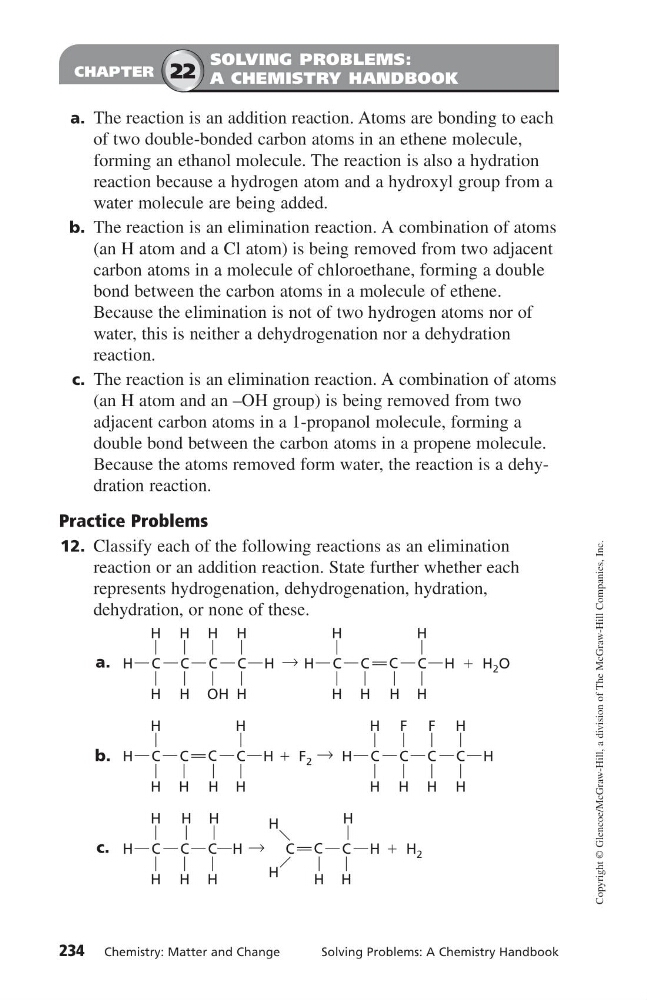
12. Classify each of the following reactions as an elimination
reaction or an addition reaction. State further whether each
represents hydrogenation, dehydrogenation, hydration,
dehydration, or none of these.
H C
H
H
C
H H
H C
H
H
C
H
H
C
OH
H
C
H
H
H
H C
H
H
C
H
F
C
H
F
C
H
H
H
C
H
H
H
C
H
H
a.
C
ϩ H 2 O
C
H H
H C
H
H
C
H
H
H
C
ϩ F 2
ϩ H 2
0
0
b.
H C
H
H H
C
H
H
C
H
H
C
H
H
c.
H
H
C
0
234 Chemistry: Matter and Change
Solving Problems: A Chemistry Handbook
SOLVING PROBLEMS:
A CHEMISTRY HANDBOOK
CHAPTER 22
a. The reaction is an addition reaction. Atoms are bonding to each
of two double-bonded carbon atoms in an ethene molecule,
forming an ethanol molecule. The reaction is also a hydration
reaction because a hydrogen atom and a hydroxyl group from a
water molecule are being added.
b. The reaction is an elimination reaction. A combination of atoms
(an H atom and a Cl atom) is being removed from two adjacent
carbon atoms in a molecule of chloroethane, forming a double
bond between the carbon atoms in a molecule of ethene.
Because the elimination is not of two hydrogen atoms nor of
water, this is neither a dehydrogenation nor a dehydration
reaction.
c. The reaction is an elimination reaction. A combination of atoms
(an H atom and an –OH group) is being removed from two
adjacent carbon atoms in a 1-propanol molecule, forming a
double bond between the carbon atoms in a propene molecule.
Because the atoms removed form water, the reaction is a dehydration reaction.
Practice Problems
12. Classify each of the following reactions as an elimination
reaction or an addition reaction. State further whether each
represents hydrogenation, dehydrogenation, hydration,
dehydration, or none of these.
H C
H
H
C
H H
H C
H
H
C
H
H
C
OH
H
C
H
H
H
H C
H
H
C
H
F
C
H
F
C
H
H
H
C
H
H
H
C
H
H
a.
C
ϩ H 2 O
C
H H
H C
H
H
C
H
H
H
C
ϩ F 2
ϩ H 2
0
0
b.
H C
H
H H
C
H
H
C
H
H
C
H
H
c.
H
H
C
0