

Copyright © Glencoe/McGraw-Hill, a division of The McGraw-Hill Companies, Inc.
Solving Problems: A Chemistry Handbook
Chemistry: Matter and Change
233
SOLVING PROBLEMS:
A CHEMISTRY HANDBOOK
CHAPTER 22
22.4 Other Reactions of Organic Compounds
Besides substitution and condensation reactions, there also are several other important types of organic reactions. In an elimination
reaction, a combination of atoms is removed from two adjacent
carbon atoms, forming an additional bond between the carbon
atoms. The formation of an alkene from an alkane is an example of
an elimination reaction, in this case involving the loss of two hydrogen atoms per double bond formed. Such elimination of hydrogen
atoms is called dehydrogenation. If the atoms removed form water,
the reaction is called a dehydration reaction.
Another type of organic reaction is like an elimination reaction in
reverse. An addition reaction results when other atoms bond to each
of two atoms bonded by double or triple covalent bonds. A hydration reaction is an addition reaction in which a hydrogen atom and a
hydroxyl group from a water molecule add to a double or triple bond.
An addition reaction that involves the addition of hydrogen to atoms
in a double or triple bond is called a hydrogenation reaction.
Oxidation-reduction reactions also can occur among organic
molecules. Oxidation is often recognizable through a gain of oxygen
or a loss of hydrogen.
Example Problem 22-7
Classifying Organic Reactions
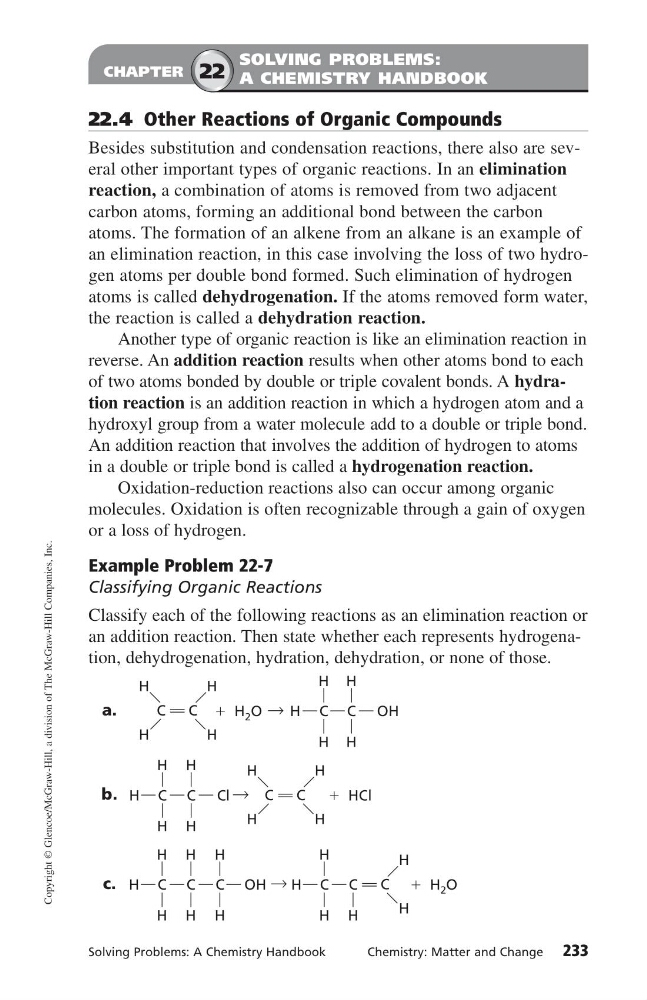
Classify each of the following reactions as an elimination reaction or
an addition reaction. Then state whether each represents hydrogenation, dehydrogenation, hydration, dehydration, or none of those.
H
H
H
H
C
C
a.
C
H
H
OH
H
C
H
H
ϩ H 2 O 0
H C
H
H
C
H
H
Cl
b.
H
H
H
H
C
C
ϩ HCl
0
H C
H
H
C
H
H
C
H
H
OH
ϩ H 2 O
H C
H
H
C
H
c.
H
H
C
0
Solving Problems: A Chemistry Handbook
Chemistry: Matter and Change
233
SOLVING PROBLEMS:
A CHEMISTRY HANDBOOK
CHAPTER 22
22.4 Other Reactions of Organic Compounds
Besides substitution and condensation reactions, there also are several other important types of organic reactions. In an elimination
reaction, a combination of atoms is removed from two adjacent
carbon atoms, forming an additional bond between the carbon
atoms. The formation of an alkene from an alkane is an example of
an elimination reaction, in this case involving the loss of two hydrogen atoms per double bond formed. Such elimination of hydrogen
atoms is called dehydrogenation. If the atoms removed form water,
the reaction is called a dehydration reaction.
Another type of organic reaction is like an elimination reaction in
reverse. An addition reaction results when other atoms bond to each
of two atoms bonded by double or triple covalent bonds. A hydration reaction is an addition reaction in which a hydrogen atom and a
hydroxyl group from a water molecule add to a double or triple bond.
An addition reaction that involves the addition of hydrogen to atoms
in a double or triple bond is called a hydrogenation reaction.
Oxidation-reduction reactions also can occur among organic
molecules. Oxidation is often recognizable through a gain of oxygen
or a loss of hydrogen.
Example Problem 22-7
Classifying Organic Reactions
Classify each of the following reactions as an elimination reaction or
an addition reaction. Then state whether each represents hydrogenation, dehydrogenation, hydration, dehydration, or none of those.
H
H
H
H
C
C
a.
C
H
H
OH
H
C
H
H
ϩ H 2 O 0
H C
H
H
C
H
H
Cl
b.
H
H
H
H
C
C
ϩ HCl
0
H C
H
H
C
H
H
C
H
H
OH
ϩ H 2 O
H C
H
H
C
H
c.
H
H
C
0